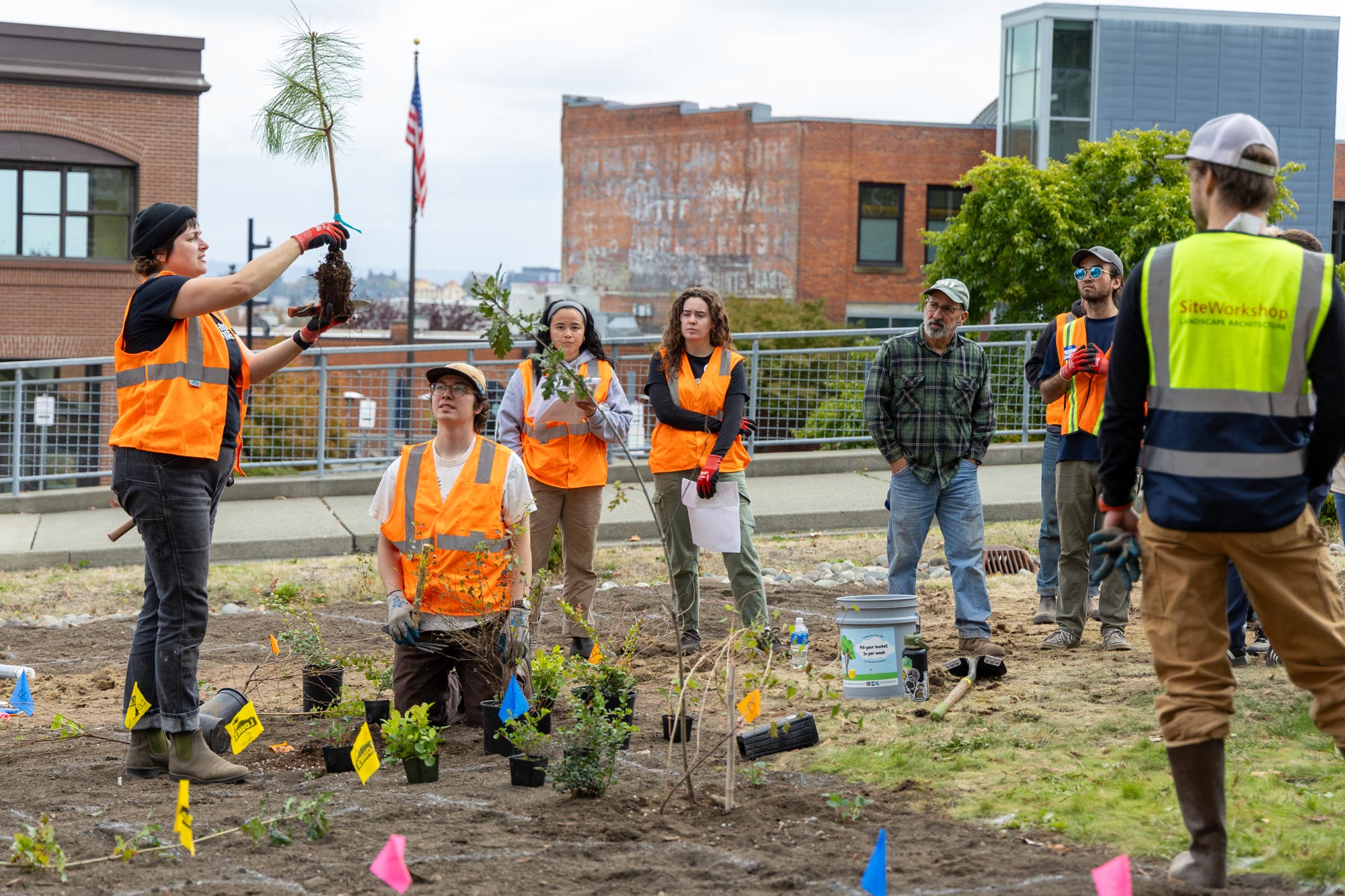
When most people hear the term micro-forest, they might picture a meadow planted with tiny bonsai trees. But a Miyawaki micro-forest is something far more complex: a dense, diverse self-sustaining ecosystem created on a small plot of land, like an empty lot or planting strip. These forests layer an apex tree species with mutually beneficial subspecies, shrubs and ground-covering plants to restore degraded landscapes.
“We call it a micro–forest because the creation of a thriving, vital ecosystem can be accomplished in a compressed amount of time,” says Rubén Casas, an associate professor at UW Tacoma and the project’s advisor. “We think of forests as these massive plots of land where trees and time give you these very lush, vibrant ecosystems. But you can do this on a common planting strip or plot that’s at least 10 by 10 feet.”
Casas serves as a faculty lead for the UWT Miyawaki micro-forest project, alongside professor Mark Pagano. His interest grew out of his work with the Urban Environmental Justice Initiative at Urban@UW, a collaborative research consortium that pursues solutions to urban challenges. As he was thinking about ways to mitigate the effects of urban heat islands, Tacoma’s lack of trees stood out.
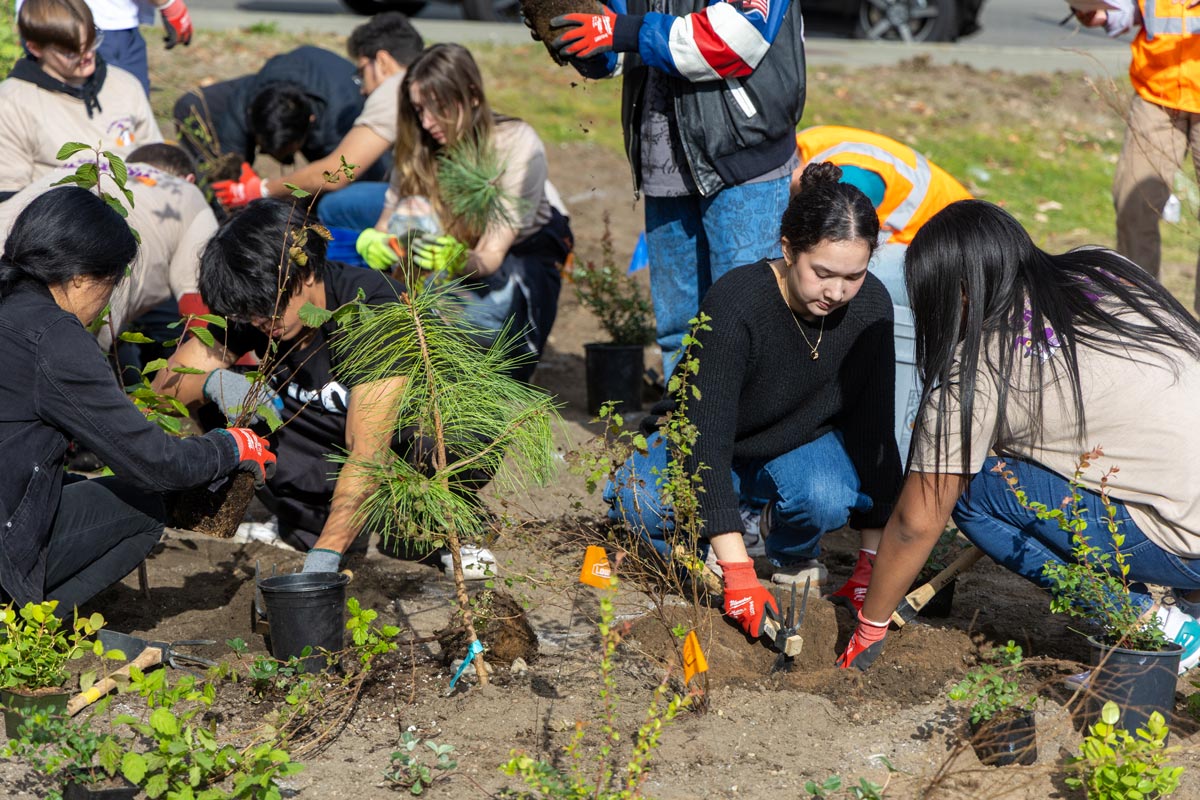
In addition to growing Tacoma’s tree canopy, this microforest gives students and faculty hands-on experience in environmental sustainability.
The city has the lowest tree-coverage of any municipality in Western Washington. It can take up to 50 years for a new tree to mature enough to provide meaningful shade and contribute to reducing temperatures. Meanwhile, trees are routinely removed when a city’s needs change and streets need more parking or sidewalks need widening.
Casas looked into different approaches, like the Miyawaki Method, which accelerates afforestation. Forests planted with this method grow ten times faster and are typically 30 times more dense than conventional plantings and become self-sustaining in two to three years. As his ideas took shape, he was approached by two environmental science majors, Michael Dorner, ’26,and Andrew Yamato Shams, ’25, who were pursuing a project as part of a sustainability–in–action course.
“I had an idea for an outdoors third space where people would be able to convene freely, and others had an idea for increasing biodiversity on campus and within Tacoma,” Sham says. “We fused our ideas to come up with the micro-forest.” With Casas and Pagano, the students developed a plan for a micro-forest on campus. The team secured a grant for $50,000 from Urban@UW’s Research to Action Collaboratory to do soil testing, hire a professional landscape designer and bring students on board as research assistants.
Dorner managed the ecological side of the project, curating the list of plants, sourcing them and “most importantly ensuring we provide an accurate representation of Tacoma’s rich natural history,” he says. Born and raised in Tacoma, Dormer sees the project as a meaningful way to give back in the form of “one of the most impactful green space installations in downtown history.”
Shams focused on the social aspects of the micro-forest, shaping its interpretive and story telling elements. Uncer his leadership, the project expanded beyond a demonstration site for afforestation to a public community space. The interpretive plan will tell the story the landscape before UWT or the city ever existed—a time before logging, when camas grew abundantly and dense forest was all around. Signage will feature the names of native plants in the Lushootseed, and visitors will learn about the Japanese American village and school that once stood on the site.
On October 17, student volunteers placed more than 600 plants into the ground with support of the Tacoma Tree Foundation. The group focused on small canopy and sub-canopy trees, shrubs and ground cover while establishing a micro–prairie with a native pollinator meadow seed mix suitable to the Western Cascades region, along with four varieties of bulbs.
“The whole site won’t be filled yet,” Casas says. “Like any living ecosystem we will learn from it.”
In the next phase, the team plans to source additional plants like wild camas and lupine, which can’t be purchased from a commercial nursery. The group will also continue fundraising, community outreach and installing seating and other “people places,” such as a pathway and lookout points.
If you’d like to learn more about the Miyawaki micro-forest project or volunteer, contact Rubén Casas at rcasas@uw.edu.