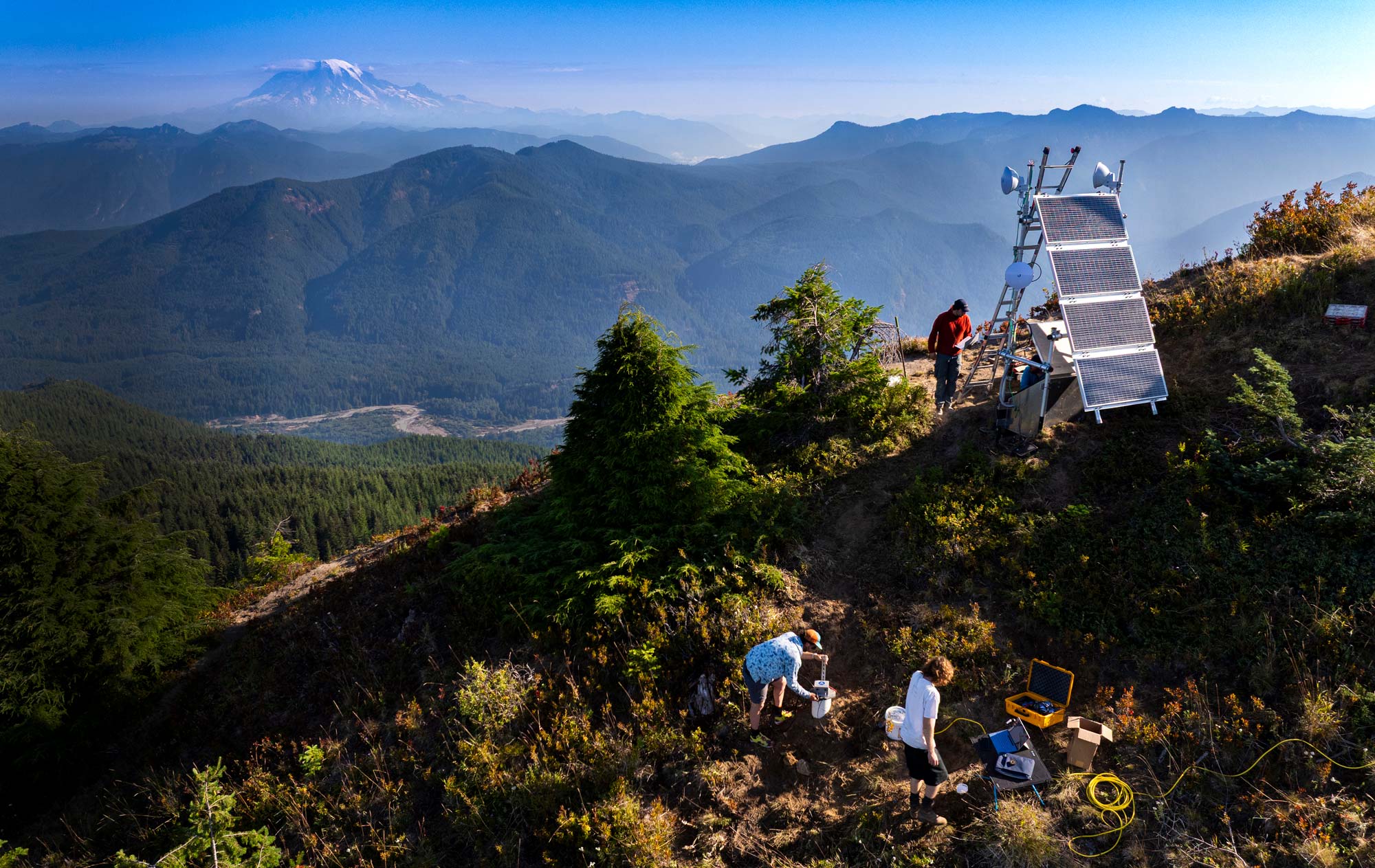
In late August at Burley Mountain, against an enviable view of Mt. Rainier, a UW team from the Pacific Northwest Seismic Network (PNSN) installed equipment to detect ground movement for a far-reaching purpose: to keep people safe across Washington and down the entire West Coast. This seismic station joined more than 700 others in the network spanning Washington and Oregon, to monitor shaking from earthquakes and volcanic eruptions.
“Earthquake hazards are a fact of life in the Pacific Northwest,” says PNSN Director Harold Tobin, a UW professor who’s also the Washington state seismologist. “But the PNSN is ever vigilant in the background, always monitoring for earthquake activity.” Headquartered at the University of Washington’s Department of Earth and Space Sciences, the PNSN is a partnership of the UW, University of Oregon and United States Geological Survey (USGS).
When an earthquake begins, seismic stations detect the first underground rumblings and quickly transmit data to the ShakeAlert early warning system. If the public is in danger, ShakeAlert instantly sends alerts to people’s smartphones, giving residents valuable seconds to prepare or get to safety before the worst of it hits.
Installing more seismic stations like this one allows the PNSN to improve the ShakeAlert system, operated jointly with the USGS. More stations mean that data can travel faster—and “now we can warn people who are farther away,” explains Tobin, who holds the Paros Endowed Chair in Seismology and Geohazards. Even when underground movement isn’t currently hazardous, the PNSN continues detecting and monitoring it, as with “swarms” of small earthquakes detected at Mt. Rainier last summer.
While the PNSN’s work is funded by state and federal governments, Tobin says private support allows them to conduct cutting-edge research, try new things—like adding earthquake early warnings directly to public-announcement systems at Washington schools—and hire UW students, who help with tasks including fieldwork and monitoring earthquake activity, gaining valuable career skills.