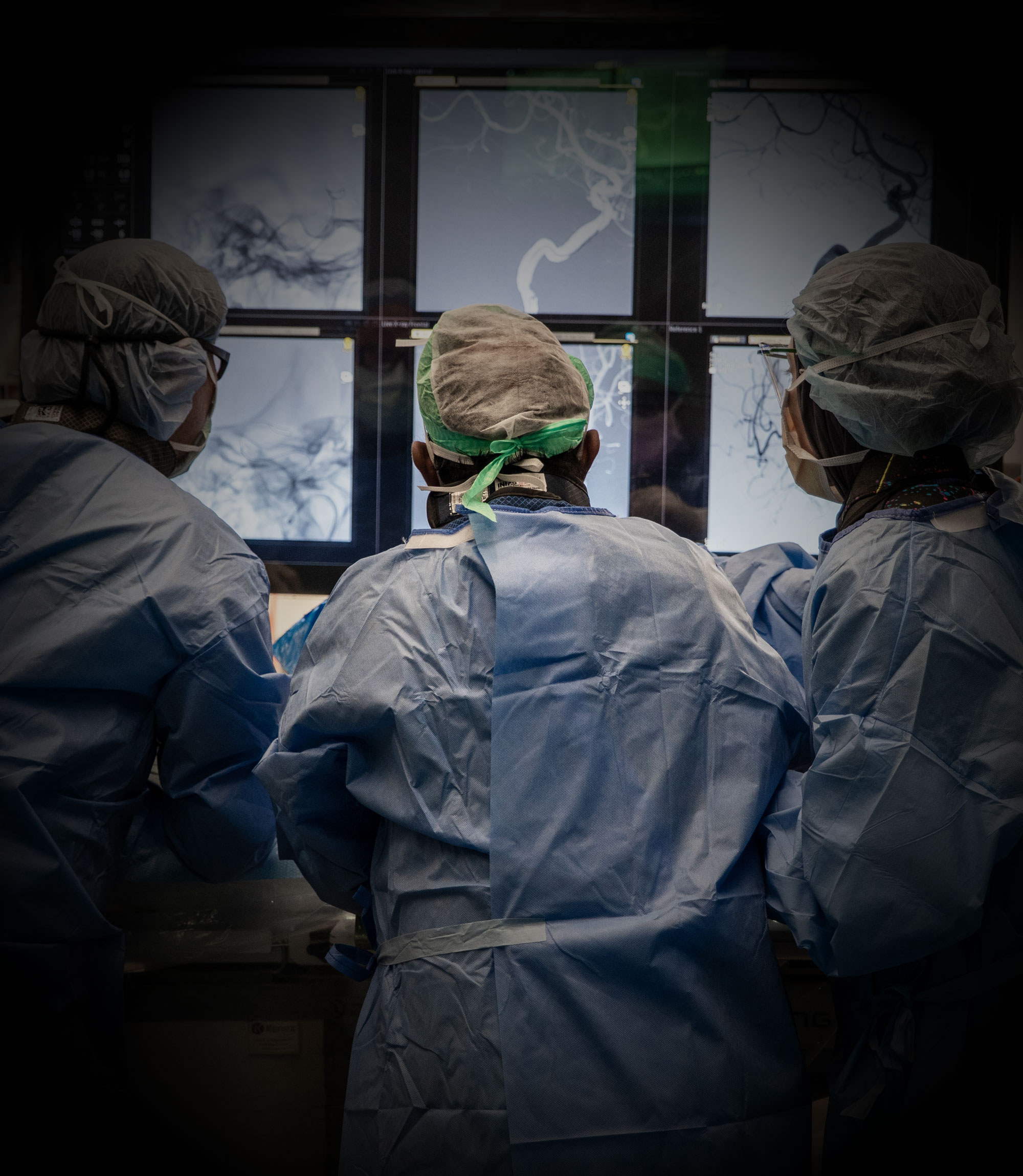
Beyond
trauma
Beyond
trauma
Beyond
trauma
Renowned for its emergency care, Harborview also delivers exceptional elective surgery expertise.
By Jon Marmor | Photos by Dan Lamont | March 2026
Perched high atop First Hill overlooking downtown Seattle and the Puget Sound, Harborview Medical Center is like a trusted friend, making sure everyone is safe and sound, always there for you in times of trouble.
Most everyone knows that Harborview is one of the premier Level 1 Trauma and Burn Centers on the planet. If you have spent enough time in the Pacific Northwest, you probably have a Harborview Emergency Department story that goes like this:
Dr. Rich Ellenbogen, chair of Neurological Surgery, recalls the time his wife, a registered nurse, was injured in an automobile accident. When EMTs arrived on the scene, the first words out of her mouth were, “Take me to Harborview!”
That sentiment is repeated daily throughout the region. It’s darn near impossible to find anyone in Western Washington who hasn’t had their life, or the lives of loved ones, saved by the phenomenal care provided by the UW Medicine professionals and staff at Harborview.
But here’s something most people don’t know: Harborview doesn’t just run the most famous emergency center around. And it isn’t defined only by the 95-year-old, Art Deco building at Ninth Avenue and Jefferson Street. The Harborview campus has expanded in more recent years to include facilities like the Ninth and Jefferson Building and the Norm Maleng Building, which are home to advanced biomedical research and state-of-the-art operating rooms, where a wide range of elective surgeries are performed daily.
“There is no hospital like us,” says Dr. Louis Kim, chief of Neurological Surgery at Harborview.
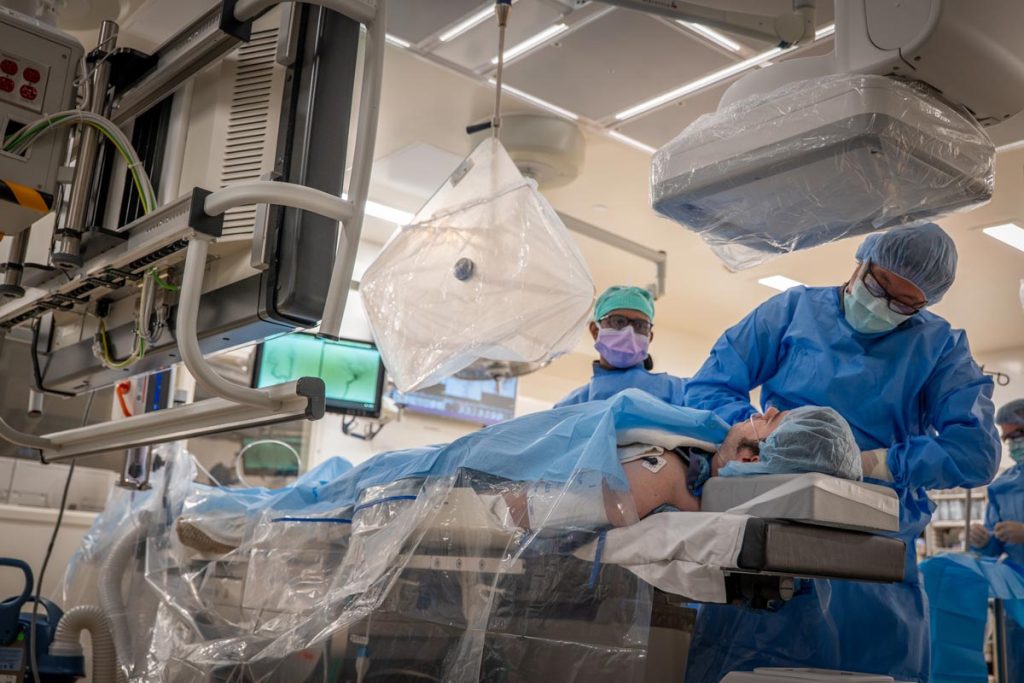
In one of Harborview’s new hybrid operating rooms, Dr. Louis Kim, chief of neurological surgery, and his team use an advanced angiography imaging system to see two- and three-dimensional images inside a patient’s vascular system.
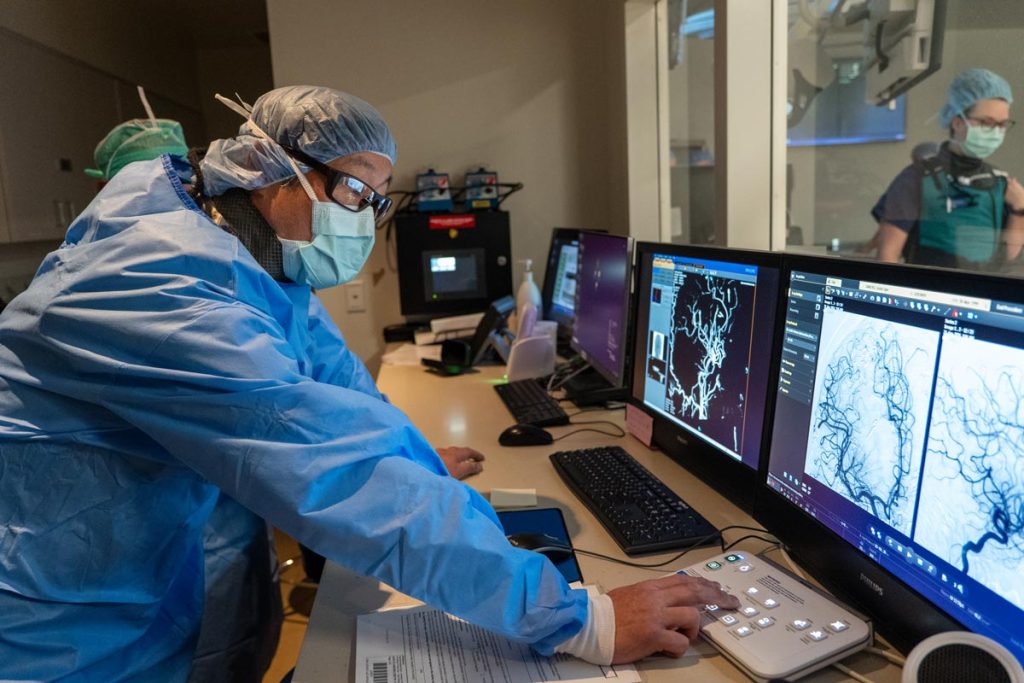
Before the hybrid OR existed, surgeons had to transport their patients between operation and imaging rooms in different parts of the hospital. Now that patient transport is no longer needed.
In his global travels, Kim has met people who recognize Harborview for its expertise. And yet, he laments, some “in our own backyard” are not aware of what a valuable resource Harborview is for everyone.
Owned by King County and operated by UW Medicine, the hospital’s unique structure ensures that any patient who comes through its doors can be treated by some of the nation’s best-trained and most-experienced surgeons and clinical staff.
“Many people are aware of our role as a trauma center and safety-net hospital for King County, and that identity and our mission are certainly an important part of what we do,” says Harborview CEO Sommer Kleweno Walley, ’09. “What many people don’t know is that, as a hospital staffed by UW Medicine, we have incredible providers and staff across so many different areas of care.”
“The team at Harborview is superb at trauma, but we're not just about trauma. If someone needing elective surgery wants the best possible care, this is the place they should come.”
Dr. Rich Ellenbogen, Chair of Neurological Surgery
Kleweno Walley and her team are working to broaden people’s perceptions, adding, “No matter what brings you to Harborview, you’re going to be seen by some of our nation’s top health-care experts.”
The fact is, Harborview is a top-tier academic medical center, like UW Medicine’s other hospital, UW Medical Center. As part of a leading academic health system, Harborview offers patients care backed by the full depth and expertise of a nationally recognized academic medical enterprise.
“Our academic mission means our patients have access to leading specialists, the newest surgical techniques, and care that’s guided by the latest research and teaching,” says Kleweno Walley.
It also means that Harborview doesn’t just make the news for its renowned trauma program. Last summer, neurosurgeons at Harborview and the UW School of Medicine made international news when they successfully implanted a new device for the first time in a human, which stimulates a stroke patient’s brain to restore lost function.
The patient in that milestone procedure was a 52-year-old man who over the past years had suffered several strokes that severely limited movement in his arms and legs. Rehabilitation helped him recover partial use of his limbs, but the improvement was limited.
With the procedure successfully completed, Harborview’s neurosciences team is now working with the patient to go through rehab while receiving stimulation through the device. The hope is that this will result in long-lasting improvements, after which they plan to remove the device.
Dr. Jeff Ojemann, professor in UW Medicine’s Department of Neurological Surgery and an attending surgeon at Harborview and Seattle Children’s Hospital, is the leader of the team that performed this groundbreaking advance at Harborview. The team is examining the efficacy of rewiring a stroke patient’s brain by activating damaged circuits with electrical impulses.
“The thing about Harborview is that it is so cutting edge,” says Ellenbogen, who previously served as chief of neurosurgery at Walter Reed Army Medical Center and earned a Bronze Star for treating soldiers in Operation Desert Storm who suffered traumatic brain injuries. “The team at Harborview is superb at trauma, but we’re not just about trauma. If someone needing elective surgery wants the best possible care, this is the place they should come.”
That world-class care includes Harborview’s best-in-class nursing team, which is Magnet-recognized by the American Nurses Credentialing Center, one of the most prestigious nationwide honors a nursing program can receive.
Harborview treats a wide range of medical conditions, and includes renowned surgical departments in neurological surgery, orthopedics and spine, according to Lanie Dschaak, director of operations for outpatient surgery at Harborview. Dschaak says other elective surgery offerings include ophthalmology (Harborview’s highest volume of outpatient surgery), as well as ear, nose and throat, and gynecologic care.
In January, a suite of new outpatient operating rooms opened in the Ninth and Jefferson Building as part of a larger campus expansion plan at Harborview. Known as the UW Medicine Outpatient Surgery Center at Harborview, the area features a renovated, spacious reception area and waiting rooms offering abundant natural light streaming from floor-to-ceiling windows throughout the space. The five new surgical suites are equipped with the latest technology to ensure the highest-quality patient care.
“Harborview is not the same hospital as it was 20 years ago,” says Kleweno Walley. “We continue to upgrade our facilities, so our patients are cared for in a more comforting, welcoming environment where they feel more at ease.”
-
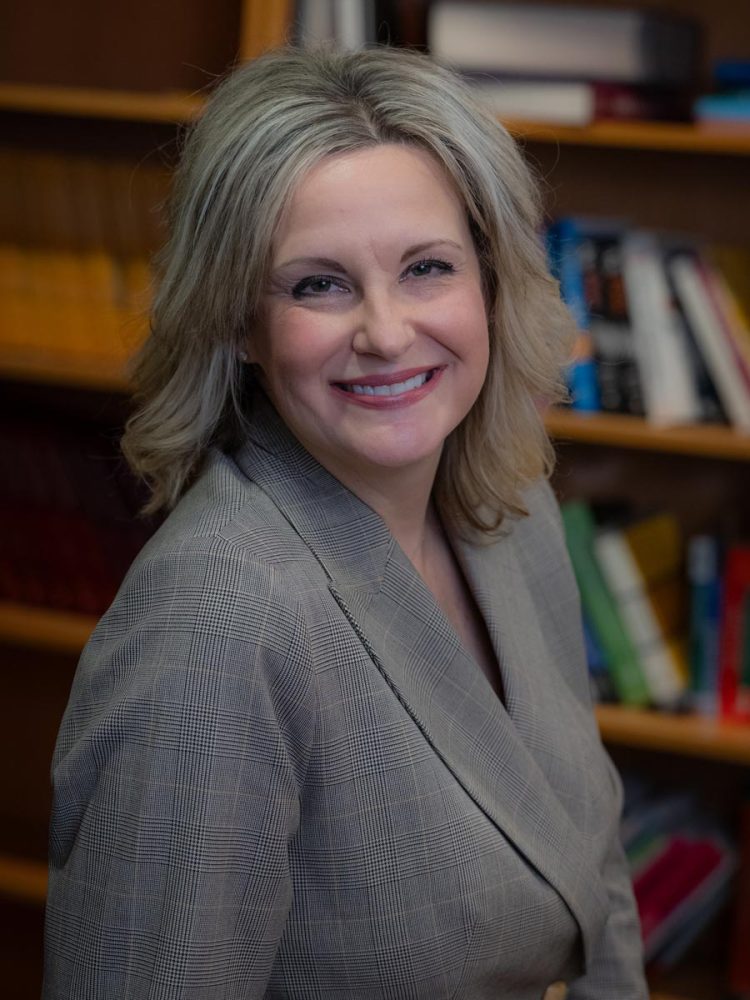
- Somer Klewano Walley, Harborview CEO
-
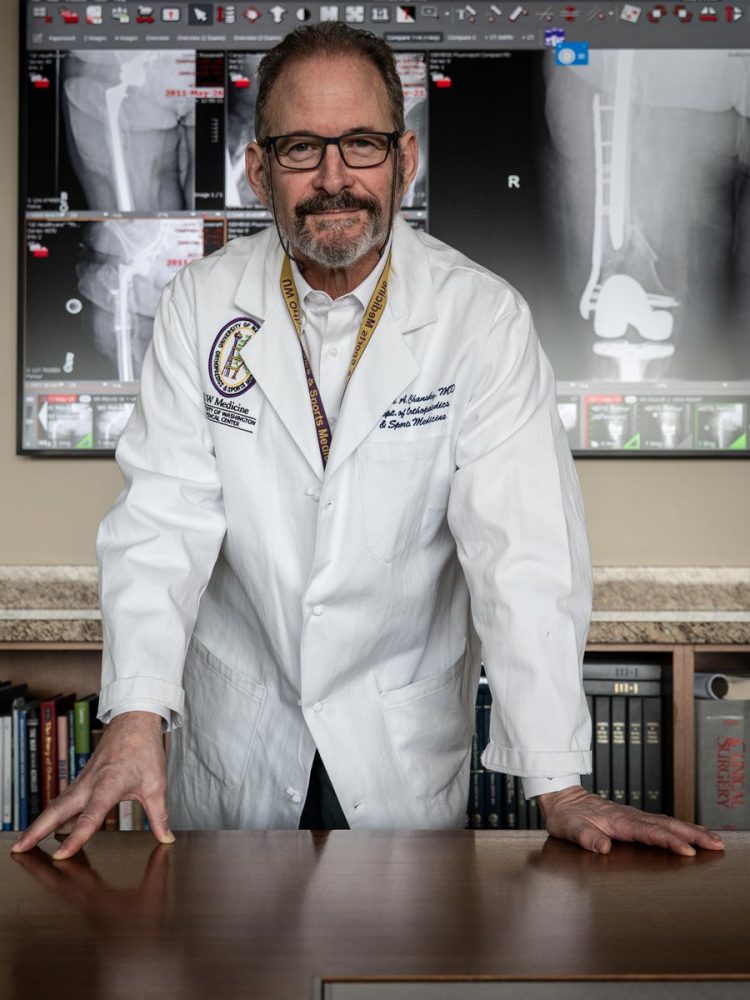
- Dr. Howard Chansky, Professor and Chair of the Department of Orthopaedic Surgery and Sports Medicine
Dr. Howard Chansky, who chairs the only academic orthopedics department in the five-state region of Washington, Wyoming, Alaska, Montana and Idaho (WWAMI), says these new outpatient operating rooms are especially helpful for his team’s ability to perform less-invasive surgeries, as well as other procedures in a state-of-the-art setting, improving the experience for patients and their families.
Then there are the newly built “smart rooms” for patients who require hospitalization after elective surgery. Two floors that opened last year in the Maleng Building offer private rooms with furnishings for family members who want to sleep over. In addition, these rooms are outfitted with two-way video monitoring that enables specially trained nurses to monitor patients as they recover.
The smart rooms combine care from onsite nurses, who regularly monitor and attend to patients in person, and “virtual nurses,” who sit in a control room near the unit to ensure that patients have access to care even if the onsite nurse has been called out to attend to another patient.
“We act like a second set of eyes and serve as a secondary nurse on the unit,” says nurse April Valaquio, RN, who splits her time as a virtual nurse and charge nurse, supervising the nursing staff and patients on the floor on different days. “Between the onsite and virtual teams, we can have more interaction with patients,” she says, adding that data from post-discharge surveys has shown that the virtual-nursing feature has increased patient satisfaction with their experience at Harborview.
Virtual nurses help with admission documentation, pain assessments, discharge education, chart reviews, meal ordering, critical-care notification and much more. “Virtual nurses often get to know patients just as well as in-person nurses,” says nurse Alison Zhang, RN, who has served in that role for more than a year. “Patients are happy to be here, in private rooms, with a very attentive nursing staff.”
To ensure that patients feel comfortable with cameras in their rooms, nursing teams strictly follow all privacy and HIPAA compliance regulations.
Virtual nurses, of course, are not the first time that patients may have interacted with health-care providers onscreen. “We started telemedicine using a camera during the COVID-19 pandemic, and it worked,” Valaquio says. “This is the next step in patient care.”
To date, Harborview is the only UW Medicine hospital with virtual nurses.
-
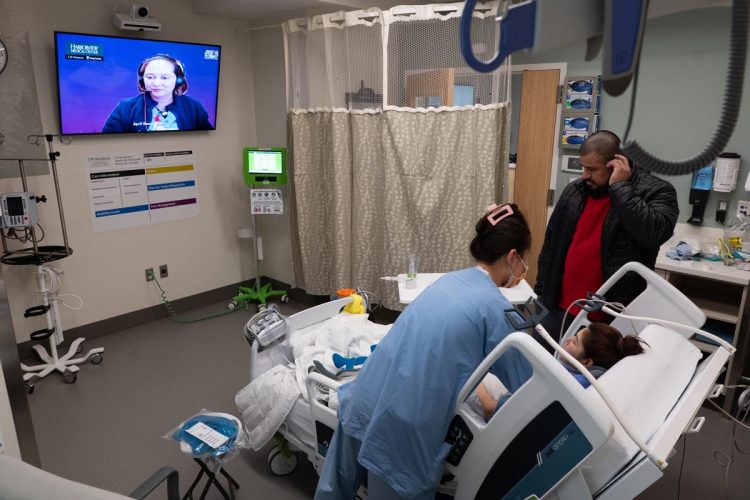
- In Harborview’s new “smart rooms,” nursing staff remotely monitor and communicate with patients.
-
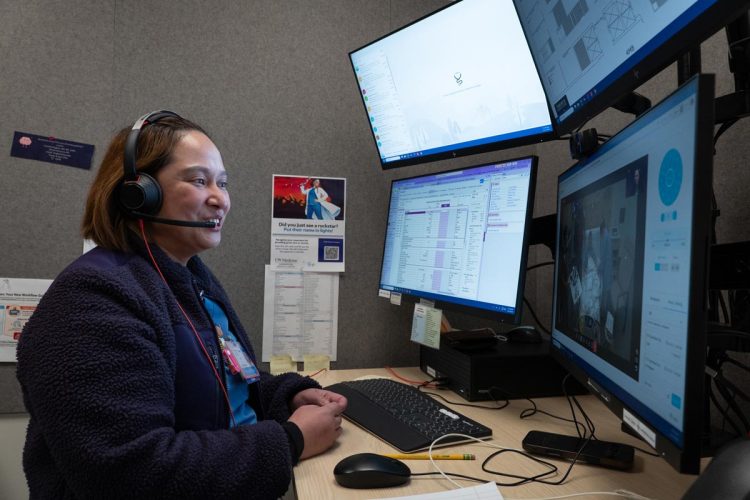
- Here, April Valaquio, RN, acts as a virtual nurse in a control room while Alison Zhang, RN, checks on a patient.
Patients who might be a bit surprised to learn that their planned surgeries are going to be done at Harborview—thinking it treated only emergency cases—should know they are receiving the best possible care. “Why would anyone not want to benefit from the best care available from surgeons with the best training and experience?” says Chansky, who adds that like many UW Medicine employees, he has chosen to receive his own elective care at Harborview.
Chansky, chair of the Department of Orthopaedic Surgery and Sports Medicine, has worked for UW Medicine for 33 years. Ellenbogen, chair of neurological surgery, has been here since 1997. Kim, chief of neurological surgery, has been at Harborview for 18 years.
“There’s a reason why people work here a long time,” says Kleweno Walley, who herself has been working at Harborview for 28 years, starting as a speech-language pathologist before being promoted into leadership positions and eventually the CEO role. “Harborview is known for its can-do attitude. If a problem needs to be solved, we just solve it. This gives our staff the opportunity to bring ideas forward and help ensure care is focused on our patients.”
When Kim speaks at conferences around the world, he says people everywhere are thrilled to meet someone who practices at Harborview because of its sterling reputation.
“We have no shortage of the best, cutting-edge care in our hospital,” he says. And with a new hospital tower expected to break ground by the end of 2028, he is even more excited at Harborview’s prospects. “Harborview is the best hospital in the world for those outside of King County,” he says. “But in our local population, they tend to think only about our emergency department, where people need lifesaving, immediate care. In reality, Harborview is a world leader with the highest level of care and its can-do attitude, which has always been our culture.”
Kleweno Walley agrees. “Harborview provides the most skilled and compassionate care,” she says. “The best and brightest doctors and nurses and clinical staff translate into the best elective surgery around. Everyone deserves that.”