Beaver believers Beaver believers Beaver believers
As public interest in beavers grows, the UW alumni at Beavers Northwest are keeping the peace.
By Mike Seely | Photos by John Lok | September 2026
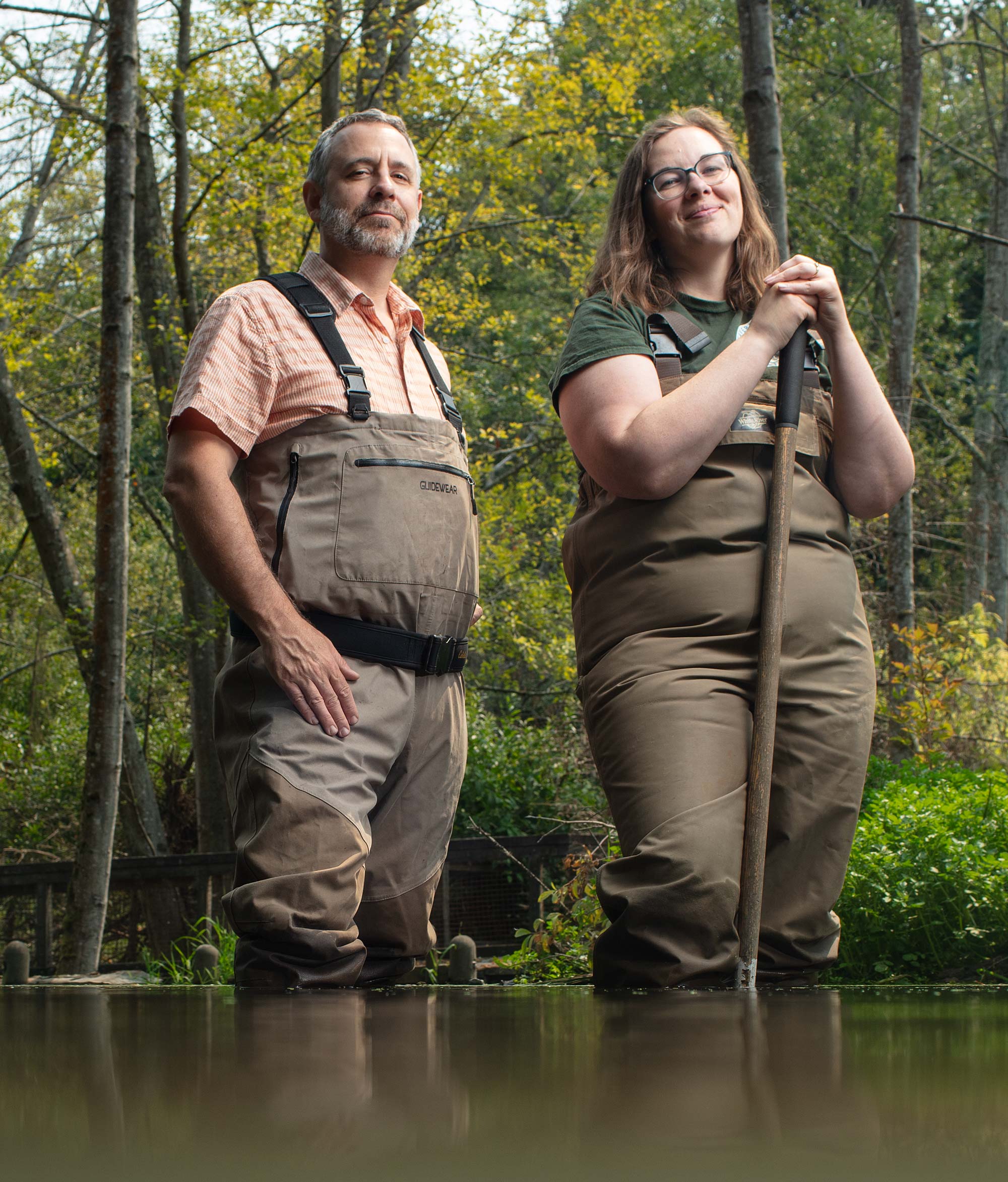

Betsy Dennis had been battling the beavers at her Key Peninsula vacation home for a year when she reached out to Pamela Adams, a West Seattle beaver obsessive and subject of a local documentary which Dennis had watched.
Dennis had three ponds on her property and beavers were building dams in the upper one, causing water levels to rise. For a year, Dennis breached these dams herself, but eventually it got to be too much and her neighbor’s property began to flood.
“My neighbor was fabulous about it, but I needed to deal with it,” says Dennis.
As she began working with Dennis to mitigate the situation, Adams says “it progressively got more outside my lane.” Ensuring that the surplus water would flow into another body of water rather than Dennis’ neighbor’s driveway would require the installation of a pair of pond levelers, cage-and-pipe contraptions that needed to be permitted.
Fortunately, Adams knew just the outfit for the job: Beavers Northwest.
Across the course of American history, the way humans have typically dealt with nettlesome beavers is to trap them, kill them and harvest their pelts for clothing and other materialistic endeavors. Until recently, that is: It turns out beavers do a whole lot of good, contributing to the efficiency and safety of ecosystems that allow myriad species, including salmon and birds, to thrive. Simply getting rid of beavers has largely given way to a focus on keeping them alive and in harmony with their human neighbors.
Ben Dittbrenner, ’19, is an assistant professor of environmental and forest sciences at the University of Washington who earned his Ph.D. at the Montlake institution. Before he embarked upon his doctoral work, he worked in surface-water management for Snohomish County.
“We were doing a lot of work helping to relieve the amount of conflict beavers were causing for the county,” he explains. “Beavers come into these areas and they find a spot where a stream goes under the road through a culvert, and they can easily plug that up and cause big problems. For a long time, the standard approach was people would just trap out the beavers. In the past 20 years, beavers have really returned to the Northwest in a big way. It was less effective to trap; another beaver would fill the void almost instantly.
“We were doing non-lethal beaver management and it turned out to be much more cost-effective. The cost of hiring guys to trap beavers and clean up the mess in the culverts cost a bunch of money.”
While Dittbrenner was working for the county, he realized “there was just as much of a problem on private land” and along with co-worker Mike Rustay, ’05, founded Beavers Northwest to fill the void. Without advertising, the organization quickly got referrals from local government agencies and others who knew the type of expertise that Dittbrenner and his organization possessed.
Around 2012, Beavers Northwest got its 501(c)(3) recognition and began applying for grants.
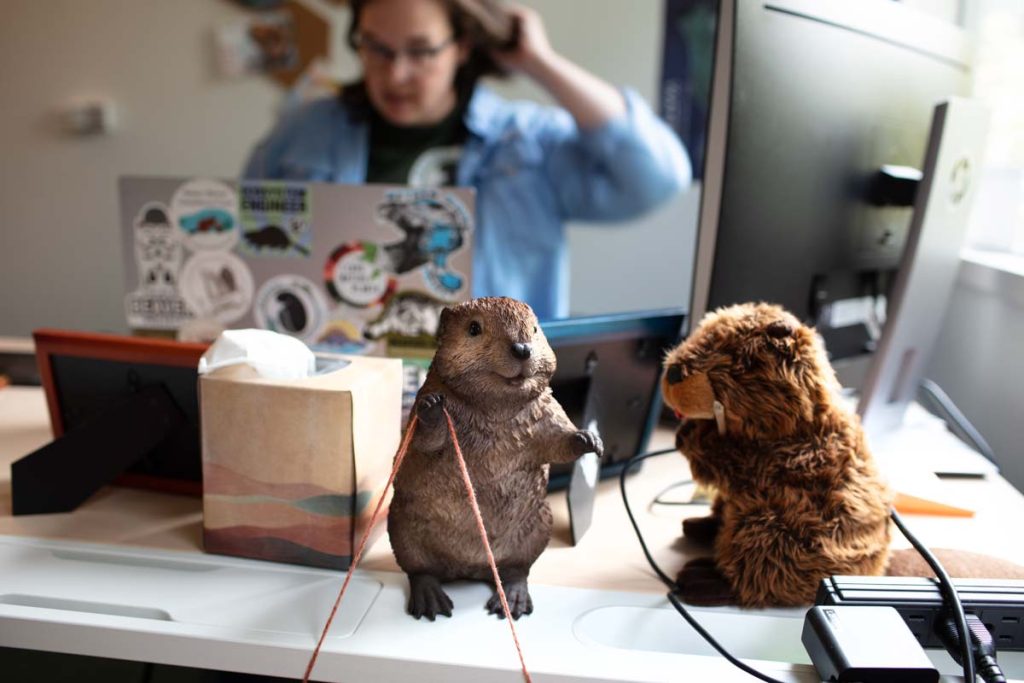
Elyssa Kerr, executive director of Beavers Northwest, works at her desk along with a few beaver toys.
“The news spread that there were these guys managing beavers and maybe doing it effectively,” recalls Dittbrenner. “All of a sudden, all these local cities like Bellevue started to get interested. Many cities have pretty small environmental crews, so having an external NGO they could hire was really advantageous. Soon we were doing as much work with individuals and even the feds. WSDOT has a lot of places where they have beavers on their roads or do mitigation on a wetland.”
Eventually, Dittbrenner started working on his Ph.D., which gave him “a lot of access to undergrads who were familiar with my research on beavers.” Beavers Northwest needed part-time workers, so Dittbrenner dutifully hired as many UW students as he could—to the point where his nonprofit became a sort of outgrowth of the University’s environmental sciences program.
One of those students was Elyssa Kerr, ’14, ’20, who was soon elevated to full-time status.
“She was really scrappy, doing all these different jobs and piecing them all together,” says Dittbrenner. “Not long after that, I started getting toward the end of my Ph.D. and it was really clear that she could do a great job running the organization.”
In 2019, Dittbrenner accepted a job at Northeastern University and sold Kerr his house. At that point, she also stepped into his job as executive director of Beavers Northwest.

When Adams got in touch with Beavers Northwest about Dennis’ situation, she was asked how she wanted the collaboration to go. Adams replied, “I want your A-Team.”
Enter Madison Newton, a 2021 UW grad who, in keeping with the Beavers Northwest tradition of putting undergrads to work, started out with the organization in 2020. She rose to the full-time position of program manager after graduation; Adams says “She’s got that sweetness and she’s badass.”
When Beavers Northwest arrived on the scene, Dennis recalls, “I didn’t know initially how it would be. They were astounding. I got an accurate estimate, which seemed fair enough. They got the permits, worked around my schedule of being in and out of town.
“They came and it took them about four hours for each leveler. They did it over two days. They were really lovely, really nice people.”
Laurie Devereaux, who works for City of Bellevue Utilities as its Stream Team program administrator, has had a similarly positive relationship with Beavers Northwest. The Stream Team has been around for almost 40 years, and Devereaux has worked for the city for 24.
“I think since the dawn of our stormwater utility in the ’70s, Bellevue has been managing beavers in one way or another,” she says. “Since time has gone on, there’s been this increased interest in working with beavers rather than against them.”
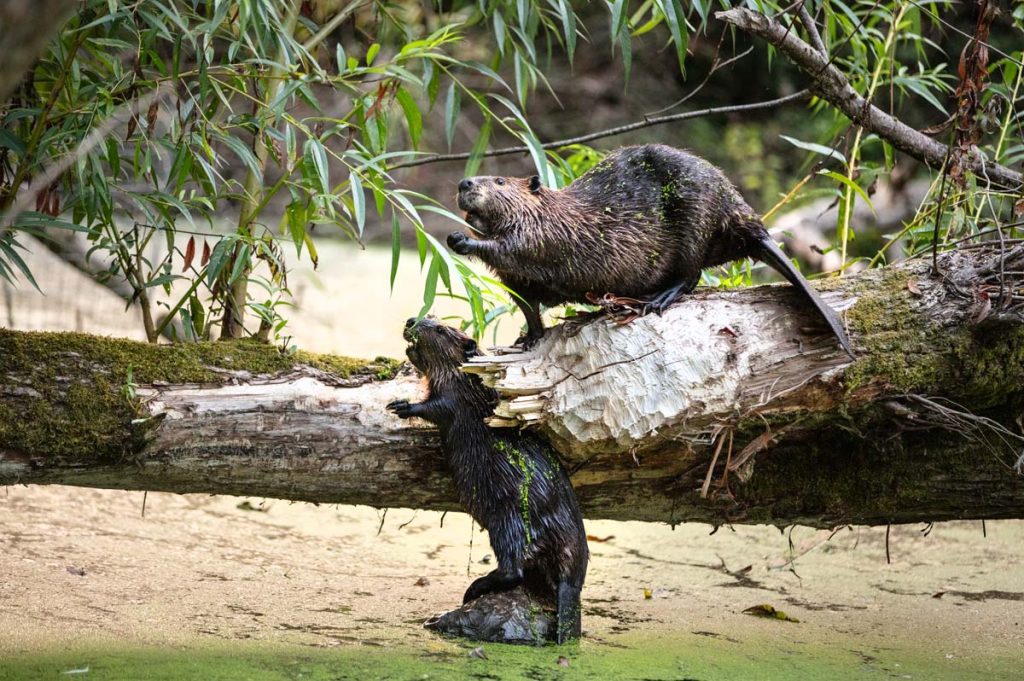
Beavers do their thing at Carkeek Park.
Supporting fish and wildlife habitat and protecting the environment are part of the Stream Team’s mission, so in 2006, the city employed some beaver management tactics like wrapping certain trees in mesh to prevent beavers from chewing into them and putting up raptor perches on dead trees. A few years later, the city entered into a contractual relationship with Beavers Northwest to help take them to the next level.
“We’ve been managing beavers on our own for a long time, but working with Beavers Northwest can help us with expertise and with capacity,” says Devereaux. “Beavers Northwest comes weekly or every other week to do those site inspections. The real expertise happens when we have trouble spots, when we have persistent beaver activity in an area and it’s causing problems in our stormwater areas. They come up with a plan to help us design and manage that. And all the reporting that comes with getting that permit is part of their expertise. It kind of has everyone doing what they do best.”

When asked to encapsulate what she does for a living, Kerr describes herself as “like a beaver-human therapist.”
“I’m mediating these relationships,” she says. “That’s a big part of what we do because I think, more often than not, we’re getting the call from someone that’s worried about this future problem. That’s really where we become this mediator. Just having that expertise and being able to alleviate fears and present people with a solution goes a long way.”
Earlier this year, Beavers Northwest’s staff, which includes five UW grads, went to see the well-reviewed Pixar movie “Hoppers,” which is all about beavers. A short while after that, communications manager, Joe Mouser, ’18, ’24, hosted a beaver-centric event where 100 people showed up. The same event a year earlier drew 40.
“Beavers are having a moment,” says Kerr. “We’re just seeing more and more people excited about beavers. There’s an appetite for this information. I do think, generally, people have a pretty poor understanding of beavers, but I think that is changing and we’re just seeing more and more people interested in learning more about them.”