Charles E. Odegaard Award honoree Ana Mari Cauce has made diversity and inclusion her life’s work
Cauce’s recognition comes after recently concluding a decade of presidential service at the UW, a tenure defined by a deep belief in the dignity of every individual and the transformative power of education.
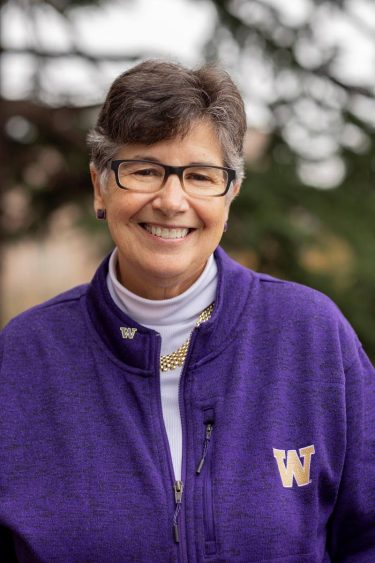 When Ana Mari Cauce reflects on her life’s work, she often returns to a lesson learned early from her parents: education is the one possession no one can take away. It’s a belief that traveled with her from Cuba, through exile and loss, and into a presidency that reshaped the University of Washington.
Now that lifelong commitment to equity and opportunity is being recognized with the 2026 Charles E. Odegaard Award, the University’s highest honor for leadership in diversity, equity and inclusion.
Cauce’s story begins in Havana, where her father served as minister of education before the family fled the Cuban Revolution. In Miami, he worked as a custodian; both parents later took factory jobs. The experience of starting over—and of not always being fully seen or welcomed—left a lasting impression. “My parents believed that education was the one possession no one could ever take from you,” she has said. “That belief is the foundation of my life’s work.”
That foundation was tested by tragedy. Her brother, César, a young community organizer, was killed during an anti-Ku Klux Klan rally in North Carolina. The loss profoundly shaped Cauce’s understanding of injustice. For a time, she considered leaving her doctoral studies in psychology to pursue activism full time.
Instead, guided by mentor Edmund Gordon, she found a path that bridged scholarship and social change. At the UW, her research on risk and resilience among youth of color helped define her academic career and informed a broader vision of equity in higher education.
Cauce’s leadership reached its fullest expression during her decade as UW president. In 2015, she launched the Race & Equity Initiative, calling on every member of the University community to confront bias and take responsibility for change. “We cannot wait for someone else to remove barriers,” she said. “Equity happens because we commit to the work.”
Her impact extended beyond dialogue into tangible change. As a key architect of the Husky Promise, Cauce helped ensure that low-income Washington students could attend the UW tuition-free. She championed inclusive hiring, supported scholarships for students facing systemic barriers—including one honoring her brother—and advocated for spaces like wǝɫǝbʔaltxʷ-Intellectual House to strengthen Native student belonging.
Throughout, Cauce has led with a rare openness about her own identity as a Cuban American and a lesbian, shaping a leadership style grounded in empathy and authenticity. She has long argued that institutions become stronger when people are empowered to bring their full selves to the table.
For colleagues like UW Vice President Rickey Hall, that approach has been transformative. Cauce, he notes, “has expanded opportunity, opened conversations many once feared having,” and she has “led with both head and heart.”
As debates about diversity and inclusion continue nationally, the Odegaard Award arrives at a moment of renewed urgency. For Cauce, the stakes remain clear. “You cannot have true excellence without equity and inclusion,” she has said.
It’s a principle that has guided her life—and one that continues to shape the University of Washington.
OMA&D Celebration
Join faculty, students, alumni and staff for the Annual Celebration Gala at 5 p.m. on May 20 at the HUB.