People before profit People before profit People before profit
A chemistry alum and Vietnamese coffee shop owner reflects on five years of community and coffee.
By Aleenah Ansari | Photo by Truong Nguyen | February 5, 2026
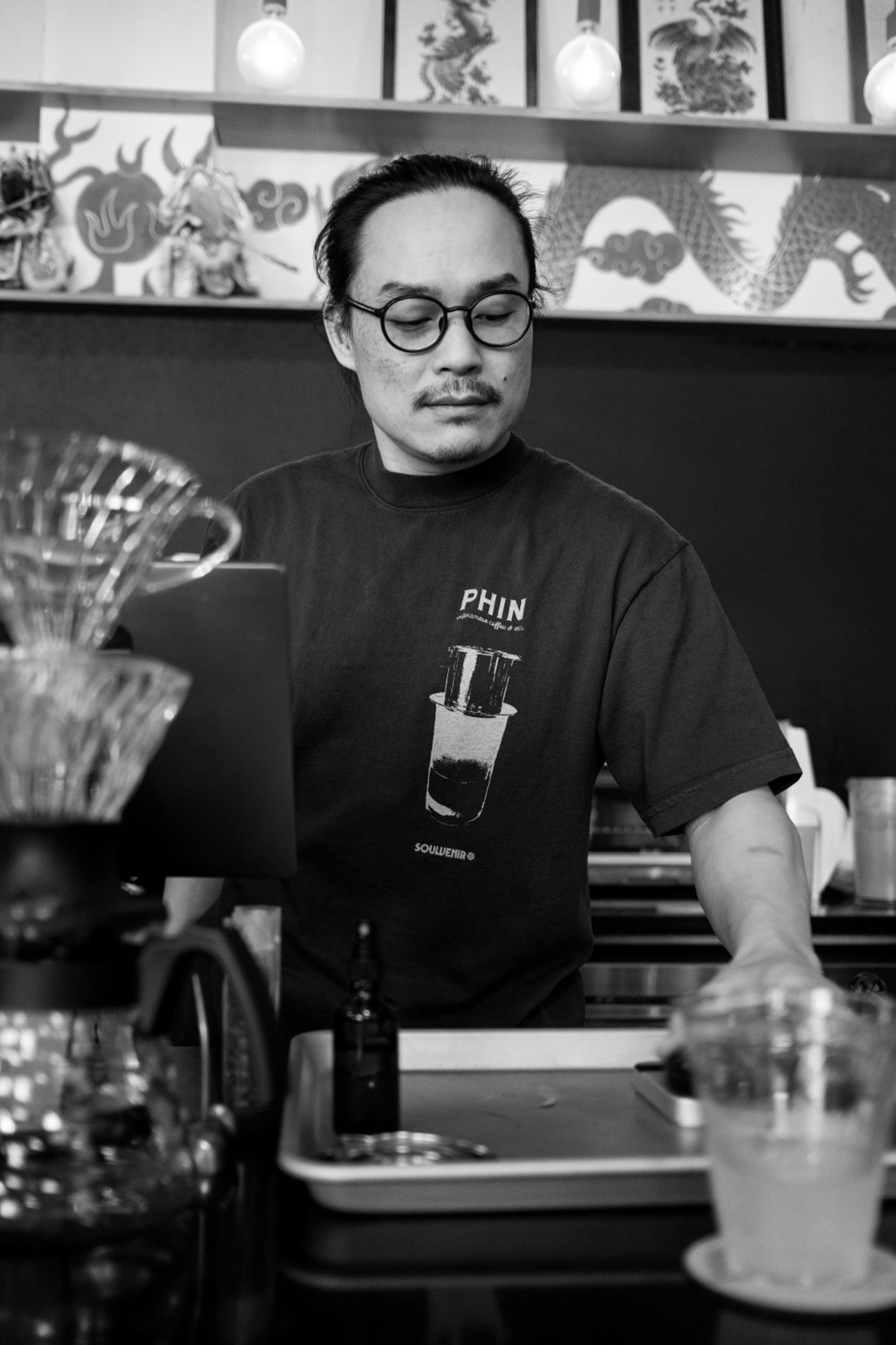
Above: Bảo Nguyễn works at his coffee shop, Phin.
Bảo Nguyễn, ’08, started Phin as a place for Vietnamese coffee and community, one where traditional and new methods of preparing coffee are embraced. It’s intentionally located in Seattle's Chinatown-International District and has continued to be a place where people can slow down, gather and enjoy a cup of coffee. Drinks can be made with oat milk or their homemade condensed oat milk at no additional charge, a decision informed by Nguyễn’s background in community-centered work.
When Phin started five years ago, it was one of the few Vietnamese coffee shops in Seattle. Now, it’s one of many alongside cafés like Hello Em, Voi Cà Phê and Phê.
I talked with Nguyễn about how his work in nonprofit administration and community building eventually led him to opening Phin, what it means to build a business according to your values and his advice for current students and the next generation of entrepreneurs.
You studied chemistry at the UW. What was your college experience like, and how did it lead you to pursue the community-centered work you do at Phin?
As a child of immigrants, I knew my parents made sacrifices for me and wanted me to pursue a career that would provide financial security. I was also the first in my family to go to college, so I couldn’t look to my parents for guidance. This realization came much, much later, after more life experiences and further understanding of how things work. I didn’t know this while at the UW, which was part of the struggle.
While at the UW, I got a job at the White Center Teen Program, a community center with a drop-in program for high school students. My supervisors taught me what community building and social justice are, and why schools in working-class Black and brown neighborhoods are often under-resourced compared to schools in other areas.
After I got my bachelor’s degree at the UW, I wanted to be as far from a beaker as I could. I built a career in nonprofit administration, first at the community center and then as a program coordinator for a local nonprofit. Working for mission-based organizations gave me a sense of purpose.
What did your work teach you about community building and social justice?
I went to Evergreen High School, and I realized it was completely different from schools in other districts, which didn’t happen by coincidence. The community center and program where I worked existed because it was an under-resourced neighborhood where schools don’t have a lot of after-school programs. There are systemic structures and inequities that create these differences, and they can contribute to students like me feeling lost, lacking mentorship, and not having access to as many opportunities.
Seattle’s Little Saigon in the Chinatown-International District and Chinatowns across the U.S. were also formed out of survival and injustices like these. Early on, Chinese migrant laborers needed a place to live but were prohibited from settling in existing White neighborhoods—and at times were violently displaced—so they banded together to protect each other, and thus formed ethnic enclaves that still exist today.
My work also taught me about the history of activism in Seattle, and it helped me build a strong relationship with my neighborhood. That’s why Phin is here, and it’s why I do things with the goal of centering people in this neighborhood. I’m grateful for the things that led me here and the experiences that have shaped me. It has all made me a stronger and more confident leader and business owner.
-
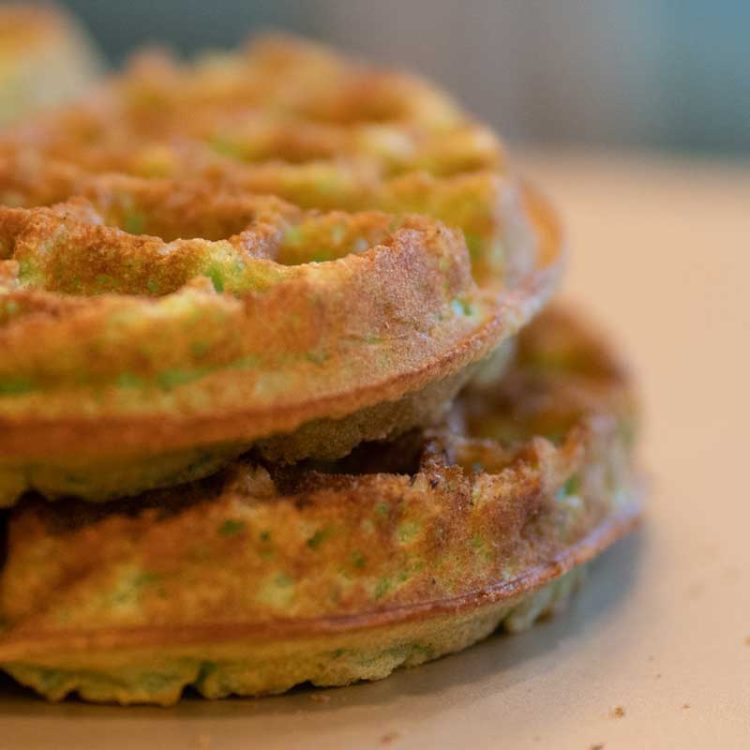
- Vietnamese pandan waffles, or bánh kẹp. Photo by Vivian Vo.
-
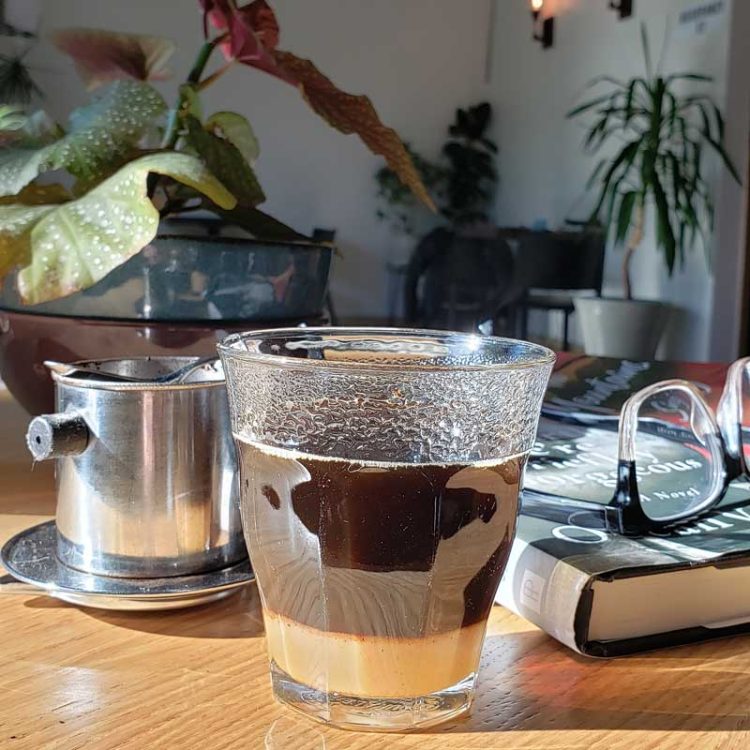
- Photo by Bảo Nguyễn.
Your social justice and nonprofit work taught you how to build a business that’s aligned with your values. What does that look like at Phin?
It taught me to think bigger than myself, which is part of why my commitment to this community informs a lot of the decisions I make. At Phin, we envision a world where Vietnamese culture is celebrated, and where slowing down allows us to connect with ourselves, each other, and the environment we’re in. We prioritize giving people the chance to take a breath and be present, even if it’s just for five minutes.
In community-building and social justice work, relationships are our currency. That’s why I’m committed to building relationships with customers, who often become friends. They come in not just to enjoy a cup of coffee, but to see a familiar face and be seen in both their struggles and joys, and I’m here to hold that space for them.
We also care about the larger context where we operate, and I want my shop to be a resource for the neighborhood, not something that extracts from it. That’s why I always offer the space for community groups who may want to gather or have a meeting.
It seems radical to run a business focused on community over profits, especially at a time when the cost of running a business is higher than ever.
It is. Like a science experiment, I’m testing a hypothesis about how to run a business that’s both financially sustainable and value-aligned. I lead with my core principles while knowing that this business is my livelihood and has to work financially. This means that I’m always tracking my vision along with market trends and sales data because I know that every penny counts.
It’s like there’s a scale balancing my values and money. What’s important here is that I put my values on the scale first, and then I make business decisions that balance them out. Every decision I make, big or small, is a combination of what our values are and what works for the business. And when I’m confronted by challenges, it’s an opportunity to innovate.
What made you decide to offer oat milk at no additional charge?
Alternative milks cost more than regular milk but as part of our values, oat milk has always been free since we opened. It’s my way to support different types of bodies and ways of living. It’s also a way we distinguish ourselves. Customers who are vegan or dairy-free are happy to find a coffee shop that doesn’t up-charge. Now, we’re seeing more coffee shops offering the same thing, like Andytown in San Francisco, all the way up to national chains. It’s a reminder that small businesses can take risks and innovate, which makes it a better experience for customers.
How has your chemistry degree informed your business today?
My chemistry background has helped me develop recipes and quickly learn coffee brewing techniques, which often involves weighing everything versus relying on volume. When you use the exact amount you need, you don’t waste ingredients. The brewing station is at the front of Phin so people can see that I’m doing chemistry in front of them, and it adds to the uniqueness of the shop.
What advice do you have for current or aspiring small business owners?
Build a business that’s true to who you are and the values you hold. The more you challenge yourself to hold tight to your values, the more creative you can be when you solve problems. Be honest with yourself and the people around you so they can hold you accountable.
What’s next for you and Phin?
Phin is continuously changing, and so am I. Phin will continue to evolve, but it will still keep its essence. We’re a part of the community, and the community will always be a part of us.
Read more from Nguyễn about his inspiration for Phin, subscribe to Phin’s newsletter, and visit Phin in Chinatown-International District.
About the author: Aleenah Ansari (she/her) is equal parts storyteller, creative problem solver, and journalist at heart who’s rooted in the stories of people behind products, companies, and initiatives. She writes about travel, entrepreneurship, mental health and wellness, and representation in media for Insider, The Seattle Times, Byrdie, and more. You can usually find her searching for murals, reading a book by a BIPOC author, or planning her next trip to New York. You can learn more at her website.