Writer in transit Writer in transit Writer in transit
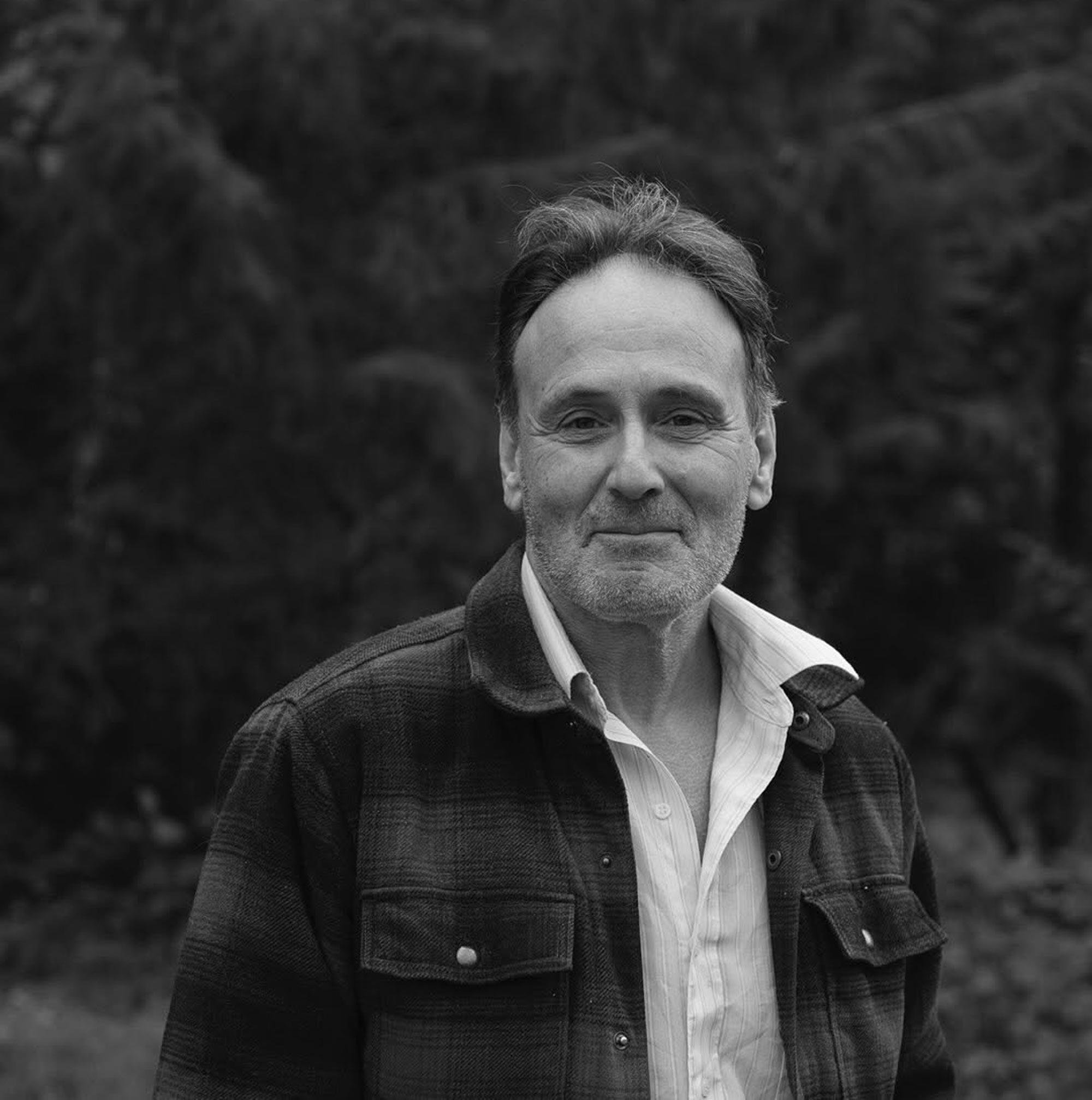
David Guterson finds new life in every story he tells.
By Shin Yu Pai | Photos by Eirik Johnson | March 2026
Best known for his debut novel, “Snow Falling on Cedars”—a 1994 national bestseller that won the Pen/Faulkner Award and was adapted into a feature film—writer David Guterson, ’78, ’82, ’83, has resisted being defined by a single book. Over a 40-year career, he has moved across genres and subjects, guided by curiosity, place and moral complexity.
In his latest novel, “Evelyn in Transit” (W. W. Norton & Company), Guterson widens his focus beyond the Pacific Northwest to imagine the life of a Tibetan spiritual teacher. Inspired in part by the true account of Dezhung Rinpoche III, a Tibetan lama who traveled to Seattle to participate in a UW-based research project and taught at the UW for nine years, Guterson’s novel traces the teacher’s reincarnation into the body of an American boy who is born to the titular Evelyn.
Guterson’s connection to Tibetan Buddhism began in childhood. He grew up in Seattle’s Bryant neighborhood not far from the Sakyas, a prominent religious family who followed the Dalai Lama into exile in India after the Chinese invasion of Tibet in 1959. The family later relocated to Seattle after meeting an Asian studies professor from the UW who helped arrange their immigration.
As a child, Guterson played basketball with Ani Sakya, ’79, whose uncle, Dezhung Rinpoche III, co-founded the Sakya Monastery in Seattle. Sakya himself was identified as the most recent incarnation of Khangsar Khen Rinpoche, a revered teacher, and as a manifestation of Manjushri, the Buddhist deity of wisdom. He would later study law at UW but eventually left his life and practice in Seattle to work as chief legal counsel for the Dalai Lama and the Tibetan government-in-exile, authoring its charter.
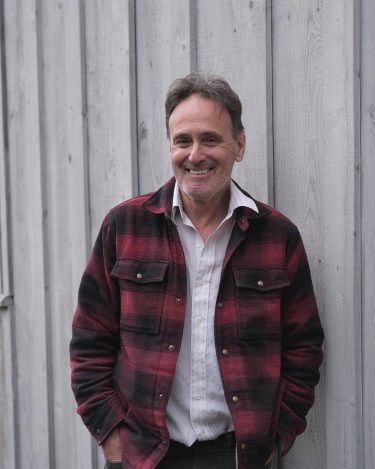
Surrounded by stories, David Guterson finds inspiration in people, places and the lives he imagines—most recently in his new novel, “Evelyn in Transit.”
While researching “Evelyn in Transit,” Guterson interviewed Carolyn Massey, the real-life mother of the boy formally recognized as the fourth reincarnation of Dezhung Rinpoche. He also consulted his childhood friend, Sakya, who sent his son to be raised in a monastery in Nepal.
As a father of five, Guterson found himself returning to the emotional weight of that decision. As a novelist, he tried to imagine his way into the situation. “Are you going to send them thousands of miles away to only have that be your entire relationship with them until adulthood?” he wondered. The question was unimaginable for him as a parent, but intriguing for him as a writer.
Guterson honed his craft at the UW while studying with writing faculty Charles Johnson, Jack Brenner and Lois Hudson. Half the stories from his first book were written during his time on campus. Reflecting on his mentors, “It was never the pedagogy, it was always the person.” He recalled Hudson’s generosity in particular. “Lois always opened her office door to me—she read my work closely and looked me in the eye,” he says. To this day, he remains close friends with Johnson.
As part of his Master of Arts studies in English, Guterson taught freshman composition and quickly realized how much he enjoyed teaching. He spent another nine months at the UW completing a teaching certificate in 1983, and landed a job at Bainbridge High School, where he taught for a decade. During that time, Guterson finished the manuscript that would become his short story collection “The Country Ahead of Us, the Country Behind.” Gradually, he phased out teaching and writing became his priority. Then, in 1994, “Snow Falling on Cedars” catapulted him to bestseller status.