50 years of fighting cancer 50 years of fighting cancer 50 years of fighting cancer
Founded in 1975 and named to honor a brother, the Fred Hutch Cancer Center became a world-class biomedical research and clinical care institution.
By John Higgins | December 2025
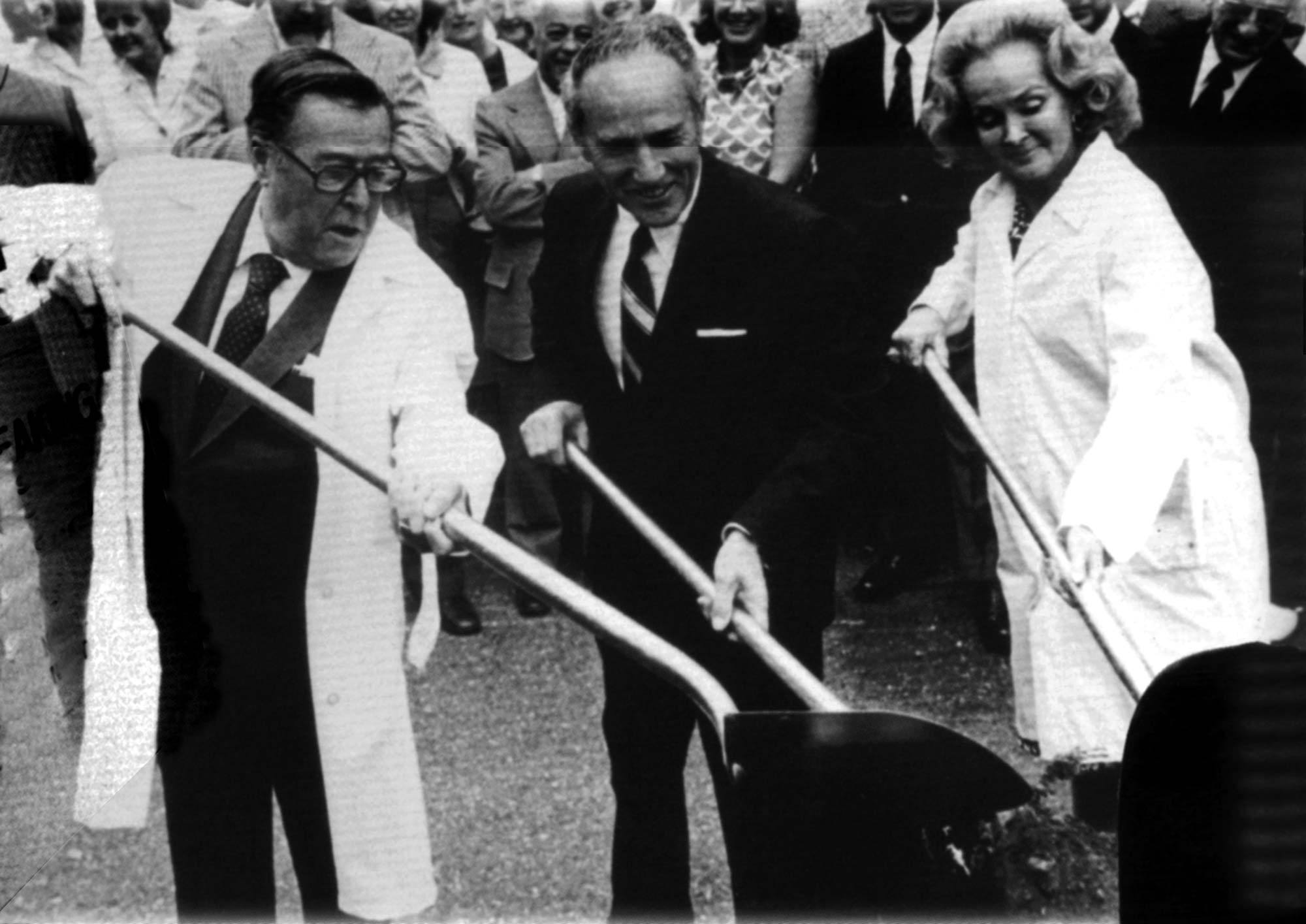
Above: From left, Sen. Warren Magnuson, Dr. William Hutchinson, and Magnuson’s wife Jermaine at the 1973 groundbreaking of the Fred Hutchinson Cancer Research Center on First Hill. Courtesy Fred Hutch Cancer Center.
Fred Hutchinson Cancer Center blazed an unusual path when it opened its doors 50 years ago as one of the first eight comprehensive cancer centers authorized by the 1971 National Cancer Act.
Seattle oncologist and surgeon William Hutchinson, ’31, founded the center, naming it in honor of his younger brother, Fred, a one-time UW student and major league baseball pitcher and manager who died of cancer in 1964 at the age of 45.
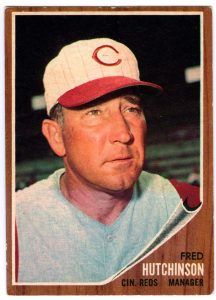
The baseball card for Cincinnati Reds manager Fred Hutchinson. Courtesy Fred Hutch Cancer Center.
Hutchinson assembled a team of doctors and scientists around three ambitious missions: to investigate the fundamental biology of cancer, study the spread, control and prevention of disease, and achieve a cure for leukemia and other blood diseases through the then-perilous therapy of bone marrow transplantation.
The experimental procedure had a poor track record, thanks to thorny complications that many experts had deemed unsolvable.
But when a Seattle team finally succeeded, they established a reproducible cure for blood diseases that today saves the lives of thousands of patients worldwide. The team also launched an era of medicine that seeks to harness the power of the human immune system.
In just 50 years, Fred Hutch has grown from a regional cancer center into a world-class biomedical research and clinical care institution, recognized for its expertise in molecular biology, tumor virology and infectious diseases, as well as the coordination of large-scale clinical and epidemiological studies.
Today, Fred Hutch performs leading-edge research and offers clinical care that has evolved from lessons learned solving the hard problem of bone marrow transplant, driven by an enduring commitment to continue taking on hard challenges on behalf of patients and their families.
The foundation for these breakthroughs was laid decades earlier. In 1957, E. Donnall Thomas, who would later become Fred Hutch’s first director of medical oncology, published a landmark study in The New England Journal of Medicine detailing the treatment of six patients with end-stage leukemia using radiation, chemotherapy and an intravenous infusion of bone marrow. While the grafts had been established in only two patients and all six had died within 100 days, Thomas demonstrated for the first time that human bone marrow could be safely collected, stored and transfused.
In 1960, Thomas achieved his first success in Seattle: a 6-year-old girl with aplastic anemia, a disease that was otherwise fatal. Using bone marrow from the girl’s identical twin, Thomas performed a transplant that likely marked the first patient ever cured with a bone marrow transplant.
Meanwhile, Hutchinson sought a director of clinical research for the new cancer center emerging from the research foundation he established in 1956—the first private, nonprofit, biomedical research institute in the Pacific Northwest. Hutchinson and Thomas’ partnership became official in 1975 when the Fred Hutchinson Cancer Research Center opened in Seattle’s First Hill neighborhood.
In 1990, Thomas was awarded the Nobel Prize in Physiology or Medicine, the first of three Nobels awarded to Fred Hutch researchers.
As of 2024, more than 1.5 million bone marrow transplants have been performed at more than 1,500 transplantation centers around the world.
While the clinical team solved the hard problem of bone marrow transplant, Fred Hutch pursued Hutchinson’s other two missions: providing local physicians and researchers with scientific expertise in fundamental biology and population-based studies of disease.