From Montlake to Vietnam From Montlake to Vietnam From Montlake to Vietnam
Many Husky football players we cheered for in the 1960s went off to fight in the Vietnam War. It’s time we paid tribute to them.
By Jon Marmor | December 2025
The young men who suit up for Husky football always have their hands full: hours of football practice in addition to their classes, traveling to away games, studying, and trying to fit in a social life. But in the 1960s and early 1970s, the background to college life was anything but normal as the Vietnam War started and the U.S. got involved. In addition, there were social upheavals over civil rights, soon to be joined by fierce protests against the war in Southeast Asia. Some Husky student-athletes were about to have their lives affected in profound ways. Interestingly, however, Vietnam was not a topic of discussion in the locker room.
Many Husky football players who went into the military around that time joined the Marine Corps. I did not learn about any Huskies who were killed in action, although former Husky split end Greg Peters was the only survivor when his Army unit was overrun by the North Vietnamese. I was unable to track him down.
Several Huskies who served in Vietnam are no longer with us, but they returned home and went on to live long, productive lives after participating in the most contentious war in U.S. history.
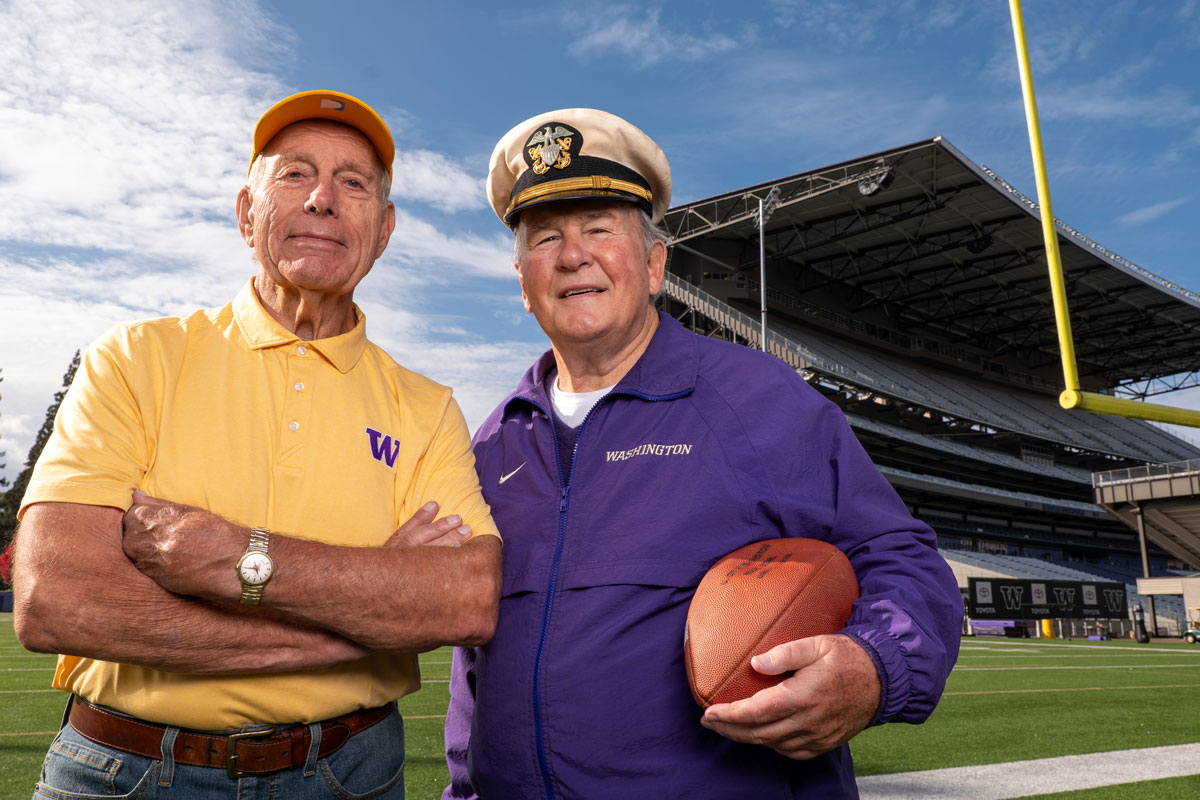
Husky football players and Vietnam veterans Gunnar Koll Hagen, ’65, and Dan Spriesterbach, ’69, reunite on a fall day at Husky Stadium.
“My tour in Vietnam was all about the good, bad and ugly,” says Gunnar Koll Hagen, ’65, a Husky lineman who as a lieutenant served as a Marine rifle platoon company commander. “It was a rewarding and challenging billet for sure, with plenty of cussing, ranting and longing for home. All in all, you met some great guys and friends for a lifetime.”
Hagen was all of 24 years old when he joined the Marines in 1966. He saw combat soon after landing in Da Nang and shipping out via helicopter to join Operation Prairie to prevent North Vietnamese forces from reestablishing bases of operations south of the Vietnamese Demilitarized Zone at the 17th parallel in Quang Tri province; that was the dividing line between North Vietnam and South Vietnam. He tells me that his memory isn’t as sharp as it once was and he can’t recall many details during our phone call from his home in Anacortes. Then he says, “You could smell the stench from the blood.” He becomes emotional and needs to pause a moment. “When you talk about this,” he says haltingly, “memories come back. And they are not all good.”
“When you talk about this, memories come back. And they are not all good.”
Gunnar Koll Hagen, ’65
Hagen, 83, emigrated from Norway and arrived in Ballard with his family in 1957. He didn’t speak English very well, picking up what he could by watching Tarzan movies. The Ballard High School grad “struggled all four years when I was at the UW,” he recalls. “Especially with language skills. I thank the UW for providing me with tutors.”
But those challenges didn’t compare to his time in country. “I don’t dwell on [thinking about the war],” he says. “You don’t remember the gore or the details.” He does, however, remember contracting malaria and spending several days in the hospital covered by ice bags when his temperature hit 105 degrees. It was, he says with typical calmness, “the only real ordeal besides being ambushed and being in firefights.”
I ask him if he was ever scared. “You didn’t have time to be scared,” he says. “Longing for home was a powerful motivator to stay positive. And I had to think of my unit.”
-

- Former Husky teammates Paul Skoog and Steve Sanford were photographed by James Wood in Rio Verde, Arizona on Oct. 10.
-

- Skoog was a Marine field commander who led nightly patrols in Vietnam while Sanford was a fighter pilot who performed 208 combat missions supporting Marines on the ground. Photo by James Wood.
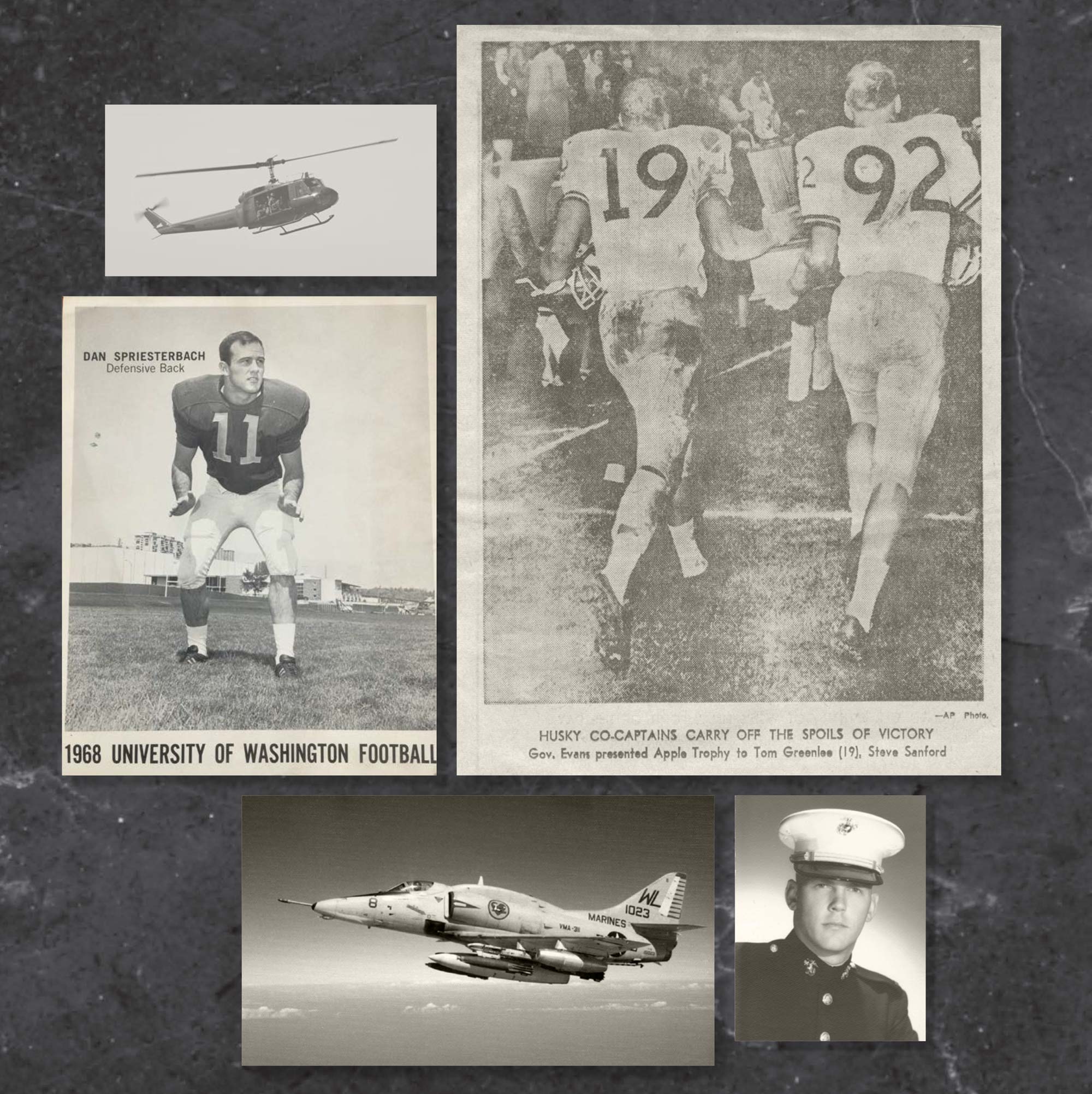
Former Husky running back, split end and special teams player Steve Sanford, ’67, can identify with that. As a UW senior who didn’t play often, he caught a touchdown pass against Oregon State in the next-to-last game of the 1966 season and was rewarded by being named a co-captain for the 1966 Apple Cup (a 19-7 Husky victory in Spokane). “My hard work finally paid off,” he recalls.
Sanford enlisted as a Marine reservist while in college and he had only one goal in mind. The son of a navigator on old Pan-Am flying boats, he wanted to fly. So he became a Marine fighter pilot and flew A-4 Skyhawks, completing 208 combat missions, providing close air support for ground troops. At just 23 years old, he performed his first combat mission in support of fellow Marines on the ground and was ultimately awarded 11 Strike/Flight Air Medals. “I was doing what I was trained to do,” he says from his home in Green Valley, Arizona, a town south of Tucson.
“For me, [serving in] the war wasn’t controversial,” says Sanford, who went on to enjoy a long career in aviation, ultimately retiring as a FedEx pilot. “I knew what I was going into. I was destined to be a Marine fighter pilot.” Sanford retired as a colonel in 1991 after 26 years of service to our country.
The Oakland, California, native was only 17 years old when he came to the UW on a one-year football scholarship, wanting to get away from home. His hands full with engineering studies, joining a fraternity and playing football, he got off to a rough start in college. He was placed on academic probation after his first quarter of freshman year and changed his major to geography. Even though he didn’t play that often, he enjoyed success as his Husky teams had winning records, going 6-4 every year he was on the team. He also overcame a dislocated elbow. And while he didn’t quite live out the football dream he had for himself, his connection to Husky football and his teammates remain strong as ever. Likewise, his devotion to his fellow veterans has never waned in the years since he left the military. He has helped raise $400,000 for Semper Fi & America’s Fund, which supports veterans who were severely wounded in Iraq and Afghanistan.
Dan Spriesterbach was featured on the cover of the 1968 UW Football program. Photo courtesy of Dan Spriesterbach.
Dan Spriesterbach, ’69, was a three-year starter at defensive back for the Huskies after earning JC All-America honors during his one year at Pasadena City College in California. While he was in Southern California, the Pasadena native received a call from the draft board. He was dispatched to Seattle to take his military physical and he was able to earn a deferral by joining the Navy ROTC at the UW. He transferred to the UW after one semester of junior college and then he redshirted for his first year in Seattle. But the following year, he became a stalwart for the Husky defense. He enjoyed a fulfilling playing career in purple and gold (and later as a Pac-10 football official). And earlier this year, he was even featured in a Big Ten TV spot.
“During the season, there was not much talk about the war among the players,” Spriesterbach says from his home in Lakewood in Pierce County. “We were really busy with football, installing offenses and defenses, and concentrating on that.” Hagen, the Marine rifle platoon company commander, echoes that. “Politics and the Vietnam conflict were debated and discussed more at my fraternity, the ‘Fiji House,’ ” he says. “At this juncture, it all seems like a blur.”
While most Huskies chose the Marines, Spriesterbach felt the Navy was the best fit for him. A natural leader, he became the Boat Group commander for the Amphibious Ready Group, which handled ship-to-shore boat movements of troops and equipment. His boats took Marines, military vehicles and river boats from one shore to another and even took Marines to such far-off destinations as Camp Pendleton in California or Okinawa, Japan.
In that role, Spriesterbach didn’t face live fire. He easily recalls one experience in Vietnam that made him smile: “Feeding the Marines [we picked up] ice cream for a few days.” Even though he and his group were never attacked, he knew the possibility was always there. He wasn’t exactly scared, but “I was alert, let’s put it that way.”
After he was released from the Amphibious Ready Group, he conducted independent missions. And after a year in Vietnam, he returned to a military base in Southern California and recalls that despite the heart-wrenching war protests happening on American soil, he never was hassled when he was in uniform. “Everyone knew we were in the military,” he says. “And they knew us in the local watering holes in Seal Beach.”
Spriesterbach, whose son is a UW graduate who served in Bosnia and Iraq, and whose daughter earned Husky All-America honors in the javelin, enjoyed a fulfilling two-headed career since leaving the military. He moved back to Seattle after the war and has spent the past 50 years in the forest products business—he still is working at 79 years of age. But he is probably better known for his 30-year career as a field judge for the Pac-10 and Pac-12, which earned him induction to the Pac-12 Football Officials Hall of Fame. Now that he is no longer on the field calling penalties, he takes his grand kids (ages 13, 12, 11, 10 and 7) to Husky football games. He particularly loved bringing his kids onto the Husky Stadium field for the Husky Blanket Parade at the Homecoming game.
While Spriesterbach, Sanford and Hagen came to Washington from far-off places, 220-pound halfback Paul Skoog, ’66, was a local, born and raised in Seattle. He was the best player on his West Seattle High School team that won the city title, so coming to the UW was a natural next step. While he enjoyed playing for Coach Jim Owens, he recalls the day he caught the coach’s eye—and not in a good way—by finishing last when the team was running wind sprints. That earned him a move from running back to tight end and linebacker.
He played Husky football for three years but decided to take a break after that because he wanted to fully enjoy his final year of college. He knew full well that when he graduated, he would get drafted. But instead of waiting for that to happen, he decided to enlist in the Marines in 1964 and sign up for officer training. Commissioned as a second lieutenant, he was assigned to the First Battalion, 7th Marines as a platoon commander at the age of 23. He got married on Nov. 4, 1964, and then was shipped off to Vietnam.
“I’m a very positive person,” he says. “I knew I’d be back home. I had a feeling it’d be OK and I’d do a good job. It was never a fact that I was not going to come back from Vietnam.”
His positive outlook really helped as he took on a high-risk position as a field commander of 15 men. Every night, he led his troops on hair-raising routine patrols to stop the North Vietnamese from coming into rice paddies so they could fire rockets into allied airfields. “We would go out and set up a defense line, silently,” he recalls. “About every third time, you would hear branches breaking, and you would engage the enemy.”
Was he scared? “You can’t afford to be scared,” he told me. “Maybe inside you were, but you had to do your job. And as a commander, I couldn’t be scared, or my men would be scared.”
There was every reason to be scared. One corporal who served with Skoog, Larry Smedley, posthumously received the Medal of Honor for his selfless courage and bravery leading a six-man squad to an ambush site at the mouth of Happy Valley near Phuoc Ninh in Quang Nam Province in late December 1967. There, an estimated 100 Viet Cong and North Vietnamese Army regulars moved toward Hill 41 to threaten the vital Da Nang complex. Smedley was severely wounded in action but kept firing until he was mortally wounded.
“It was a scary night but no more than any other night,” Skoog says. “I was one of few who suffered no injuries. I got shot at a lot, but I wasn’t shot.”
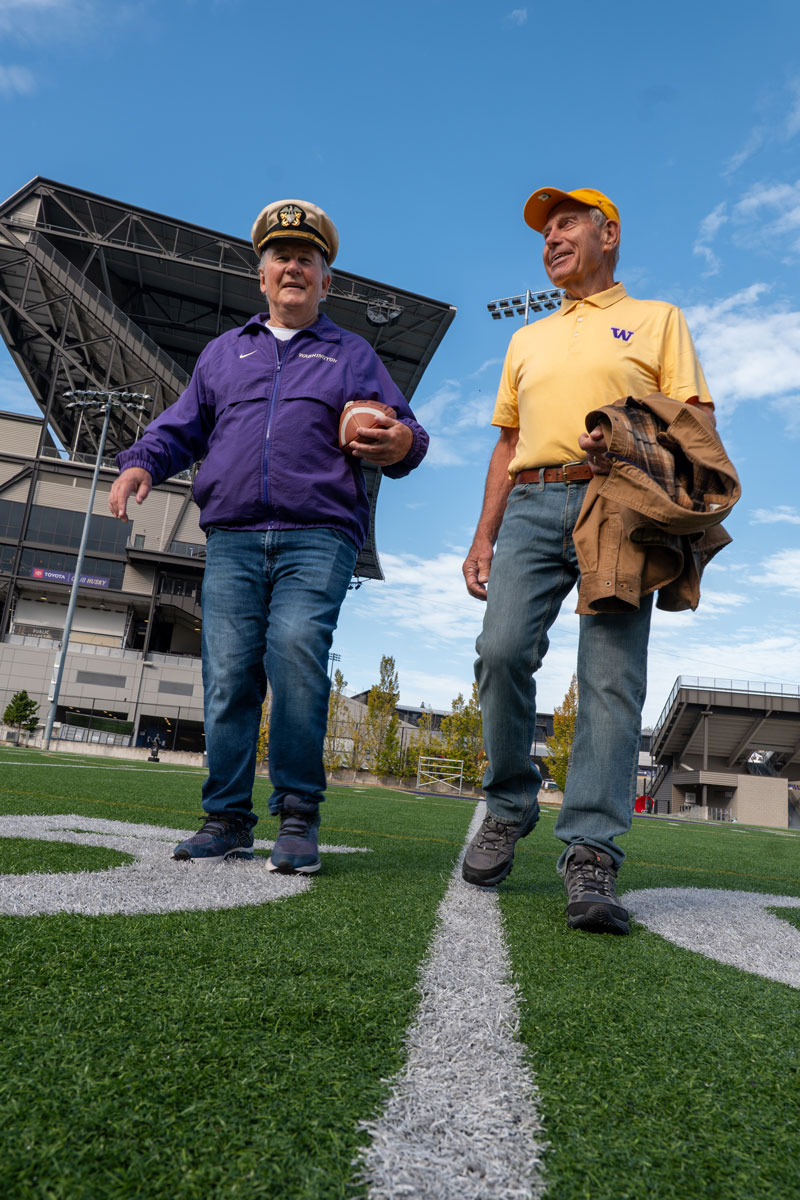
Gunnar Koll Hagen (left) and Dan Spriesterbach were photographed by Dan Lamont outside Husky Stadium on Oct. 17, 2025. Hagen saw combat as a rifle platoon commander in Vietnam while Spriesterbach headed up an Amphibious Ready Group taking Marines and equipment in country.
From all of the mayhem he experienced, Skoog took away a great lesson: “You have a job to do and it’s no different than any other managerial job,” he explains. “It taught me what I can and can’t do under pressure. But you know you must carry out the job.”
Back home after serving in Vietnam from January 1969 to June 1970, Skoog found adjusting to life was a real challenge. “It was a little horrific,” he states. “We were told not to wear our uniforms in public. When I came home and landed at Los Angeles [International Airport], there were a lot of protests going on, and we had crew cuts. It was such a tough situation, doing the job we were there to do, but people here were looking at you, spitting at you. We were just doing our job.”
He went into business after coming back to American soil, working for Xerox, Gretag and finally for PACCAR, where he was assistant general manager in charge of sales. In 2007, he relocated to Rio Verde, Arizona.
He knew full well that when he graduated, he would get drafted. So, he decided to enlist.
Other Husky student-athletes went off to Vietnam as well, but I was unable to track them down. L. Dale Stephens, ’65, served in the Army and later had a long career at Costco. Cliff Coker, ’69, was a Husky linebacker who served in the Marines and later held leadership positions at the renowned Cleveland Clinic and other hospitals in Ohio. Trev Sarles, ’65, threw the javelin for Husky track and field before serving in the Marines. Larry Cochran, ’67, was another veteran whose service branch I didn’t learn. Jan Johannes, ’67, from tiny Elma, Washington, was a Marine who earned a Purple Heart. He lives in Southern California. Brian Biggs, ’64, a Husky running back who went into the Marines.
Army private first class Rank Baty, ’76, served in the First Infantry Division. He was a Husky football walk-on who made the varsity in 1968 and 1969, received a Bronze Star for heroism in combat in Bu Dop, and became a chiropractor with a practice just north of University Village.
The Huskies who served in Vietnam but died after the war are linebacker Vince Janowicz, ’69, a Marine who became a personal trainer. He died May 20, 2018, at the age of 72. Cornerback Dave Dillon, ’63, served in Vietnam but I didn’t learn what branch of the service he was in. He died Feb. 23, 2012. Linebacker Steve Hinds, ’65, died June 26, 2025, at the age of 81. A former Marine, he was buried in tiny Big Pine, California. Charlie Bond, ’63, of Puyallup was a tackle whose father was a Husky All-American. Bond, who joined the Marines, ran a well-known blueberry farm in Puyallup and died April 10, 2023, at the age of 81. Another big name was two-way tackle Kurt Gegner, ’61, a Marine who worked as an engineer and died of cancer at the age of 43 in June 1981. He was an Scholastic All-American. And there were the Bullard brothers: Tackle Barry Bullard, ’62, served in the Air Force. He died March 26, 2012, at the age of 73; His brother Tim Bullard, ’62, a guard and center, died April 7, 2022, at the age of 81.
Of course, not all Huskies who served in the military in the 1960s and 1970s went to Vietnam. Al Worley, an All-American defensive back who set an NCAA record with 14 interceptions in 1968, served in the Navy but was assigned to Hawaii during the war. He died Dec. 14, 2020, at the age of 74. Frank Etter, ’67, served in the Army in Korea, and Bill Parker, ’67, was a Navy dentist stateside. Etter and Parker didn’t go to Vietnam, either.
And there was defensive end / offensive tackle Tim Johnson, ’67, who joined the Marines and became a Naval radar intercept officer. He fully expected to go to Vietnam but was instead sent to Japan. But that didn’t prevent him from experiencing the sadness of losing three of his colleagues out of a squad of 10 Naval aviators in flight training accidents. He was in the same Marine Platoon Leadership Class with Paul Skoog and in the same fraternity with Steve Sanford and Brian Biggs.
It’s hard to imagine that the Vietnam War ended 50 years ago, and the young men in purple and gold we cheered for on the football field went off to serve our country. Thank you, sirs.
In Memoriam
Vince Janowicz, ‘69
Linebacker
Marines
Died May 20, 2018 at age 72
Dave Dillon, ‘63
Cornerback
Died Feb. 23, 2012
Barry Bullard, ‘62
Offensive Tackle
Marines
Died March 26, 2012 at age 73
Tim Bullard, ‘62
Guard/Center
Marines
Died April 2, 2022 at age 81
Kurt Gegner, ‘61
Offensive Tackle, Defensive Tackle
Died June 1981 at age 43
Charlie Bond, ‘63
Offensive Tackle
Died April 10, 2023 at age 81
Steven Hinds, ‘65
Linebacker
Marines
Died June 26, 2025 at age 81