Garden of the mountain king Garden of the mountain king Garden of the mountain king
Alcohol, a Viking ship and Scandinavian support led to a Norwegian composer’s bust on the UW’s campus.
By Caitlin Klask | Photo by Ron Wurzer | December 2025
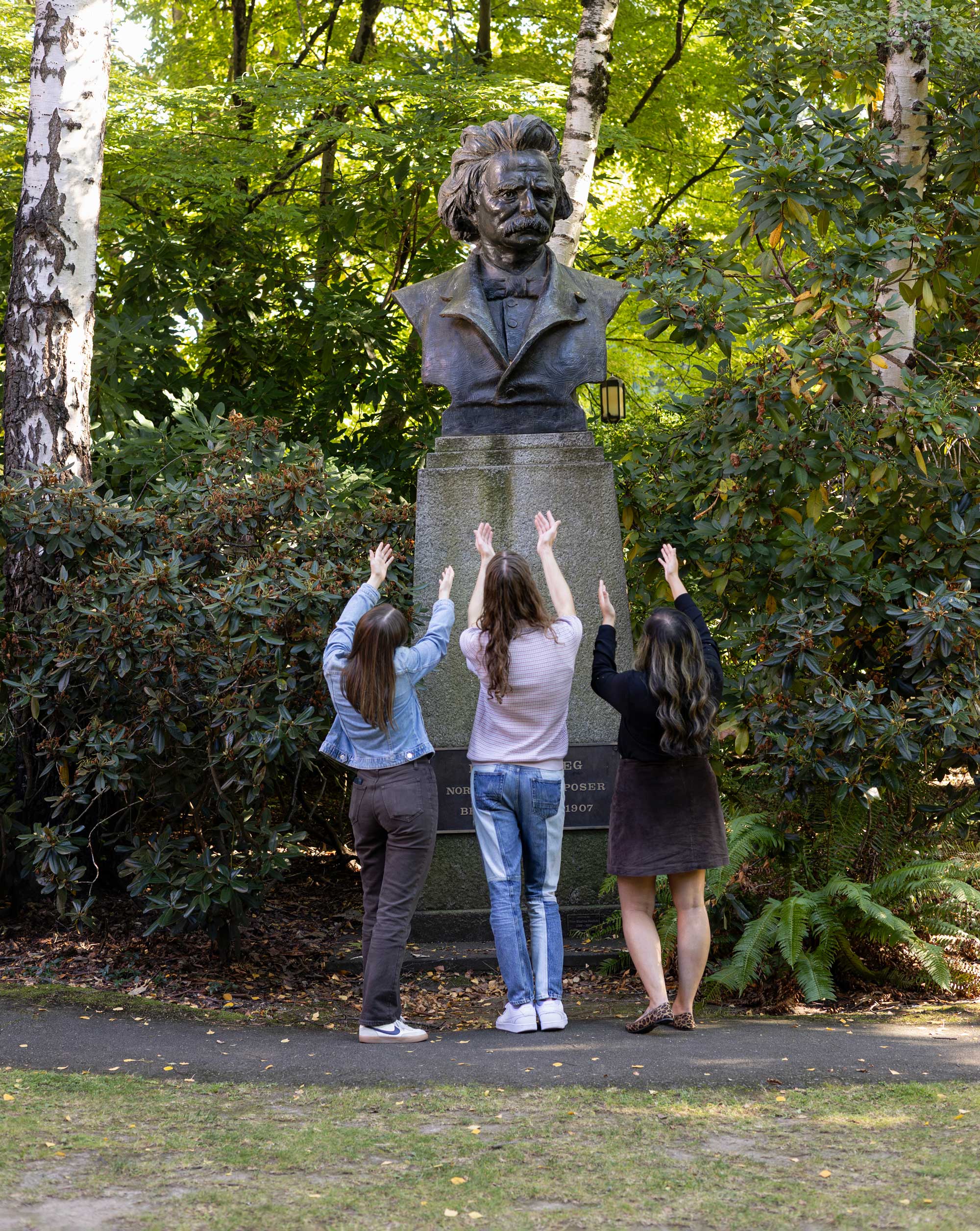
Have you ever stumbled into the serene garden tucked between the Quad and the HUB Lawn and thought, “Who is that man in the bow tie with no arms?” You might be in Grieg Garden, looking at a 116-year-old statue of Norwegian composer Edvard Grieg.
The year Edvard Grieg came to the University of Washington was a memorable one for public art in Seattle. The pianist and composer himself—perhaps most famous for writing “In the Hall of the Mountain King”—had died two years earlier, but a bust of his likeness was created by sculptor Finn Frolich for the 1909 World’s Fair, the Alaska-Yukon-Pacific Exposition.
That same year, the UW also dedicated the George Washington statue. Frolich also designed the bust of James J. Hill, the “Empire Builder” who brought railroads to the Pacific Northwest, which sits in front of More Hall on Stevens Way.
Born in Oslo, Norway in 1868, Frolich left his well-to-do family at age 9 to work on ships. He began his sculpting career in Brooklyn at age 18, studying under Daniel Chester French (creator of the Lincoln Memorial statue) before enrolling at the École de Beaux Arts and École Nationale in Paris. He sculpted work for the World’s Fairs in Chicago, St. Louis and Paris, establishing a name for himself in the art world.
Drunk, recently divorced and potentially disoriented, Frolich wandered into a Brooklyn train station early one morning in 1908 and asked for a ticket to the “farthest [place] away from here you got,” and that’s how he ended up on the Empire Builder train to Seattle.
His experience at prior World’s Fairs helped Frolich earn a position as director of sculpture for the Alaska-Yukon-Pacific Exposition in Seattle in 1909. At the Norwegian Day ceremonies that August, Frolich unveiled the statue of Edvard Grieg, a Norwegian composer, commissioned by local Scandinavians (who paid Frolich for his work by building him a Viking ship).
Grieg’s statue bounced around campus, from the old Meany Hall to Governor’s Grove to its current location in its eponymous garden on Skagit Lane. In 1990, Grieg Garden (which, until the renovation of the HUB Yard, had been a parking lot) was dedicated, sponsored by the Seattle-Bergen Sister City Association. Not only was the dedication ceremony held on Grieg’s birthday, June 15, but the ground around the statue contains dirt and water from Grieg’s homeland of Bergen, Norway.
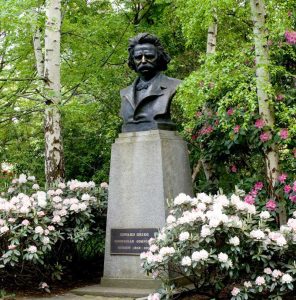
A shinier-nosed Grieg from a bygone time. Photo by Mary Levin.
For many years, the nose on Grieg’s statue featured an odd golden patina, as if it were rubbed with mineral oil. Statues around the world—from Greyfriars Bobby in Edinburgh to Il Porcellino in Florence—experience a similar phenomenon, where visitors rub the animals’ noses for good luck (though their noses are much closer to the ground than Grieg’s bust, which stands atop an 8-foot marble base).
Mysteriously, Grieg’s nose now appears untouched. It’s just another twist in the story of this old statue that now lives in a gorgeous, secluded, quiet spot on the UW campus.
Do you know what happened to Grieg’s nose? Email us at magazine@uw.edu.