Caring for an aging America Caring for an aging America Caring for an aging America
Inspired by her family and informed by her research, nursing grad Antonia Cai brings her whole self to her career.
By Chelsea Lin | Photo by Dennis Wise | December 2025
Antonia Cai’s medical homework started long before she was a University of Washington nursing student. Cai, ’25, was just 14 when her mother developed a health concern and Cai began accompanying her to doctors’ appointments; the family had moved to Bellevue, Washington, from Guangzhou, China, the year prior, and they spoke mainly Mandarin and Cantonese. Teenaged Cai used translation software to stumble through the medical terminology, “which is its own language,” she says. “I remember preparing a script every time we headed to the hospital—looking up words so I could understand the doctors’ questions and be able to answer them.”
With Cai’s help, her mother was finally able to get the procedure she needed, after months of anxious waiting on translators, appointments and surgeon availability. “It was a struggle, but it motivated me: What if I could be someone who understands everything in this system better?” Cai says. “I chose nursing because I want to support people and connect them to the help they need.”
Pandemic fallout has led to a nationwide shortage of nurses and faculty to train them. And as the Baby Boomer generation ages—with a projected 20% of the U.S. population over age 65 by 2030—we’ll see a substantial need for nurses trained in geriatric care. Yet only 5% of nurses in Washington state specialize in gerontology, the study of aging. In fact, the Health Resources and Services Administration has projected that by 2035, the country’s worst nursing shortfall will be in Washington.
As Cai enters a workforce where nurses are in greater demand than ever, she feels ready: She’s spent the last five years building a body of professional experience that includes both bedside care and undergraduate research, thanks to a scholarship from the UW’s de Tornyay Center for Healthy Aging. The center, established in 1999 to support innovative and much-needed research in healthy aging, funds promising students like Cai, encouraging them to apply what they learn for the well-being of the population.
“It was a struggle, but it motivated me: What if I could be someone who understands everything in this system better?”
Antonia Cai, '25
But Cai’s journey hasn’t been easy. When she first applied, as a UW sophomore, to the highly competitive UW School of Nursing, she wasn’t accepted—so in her junior year she focused on coursework to turn a minor in nutrition into a major and planned to try again the following year. She worked night shifts as a certified nursing assistant at EvergreenHealth Medical Center in Kirkland, juggling her overnight duties, daytime classes and on-call responsibilities as a resident adviser for Alder Hall, the UW’s Living Learning Community for pre–health sciences students.
Working as a nursing assistant turned out to be a formative experience. “It was a great year of learning for me, where I was able to put myself in other people’s shoes and figure out how different providers do their job,” she says. “It truly reshaped who I am.”
She applied to the School of Nursing again—and was accepted. In addition to nursing coursework and hands-on clinical experience, a Healthy Aging Undergraduate Scholarship from the de Tornyay Center gave her the invaluable opportunity to conduct research. Examining data from a large study funded by the National Institutes of Health that followed 800 people living with HIV, she looked for symptoms like fatigue, pain, sleep issues and depression, and per-formed statistical analysis to see how physical activity and diet affected those symptoms.
The experience gave her a firsthand understanding of the importance of research in the nursing profession. “As an undergrad,” Cai says, “it’s been incredibly valuable to have the opportunity to connect with so many people from different fields, to see people working on different projects and getting to know the entire process of scientific research.”
Just as important as the hands-on experience was what she learned through that research: “Exercising, eating and moving all have a bigger impact toward a person’s health outcome than the hospital does.”
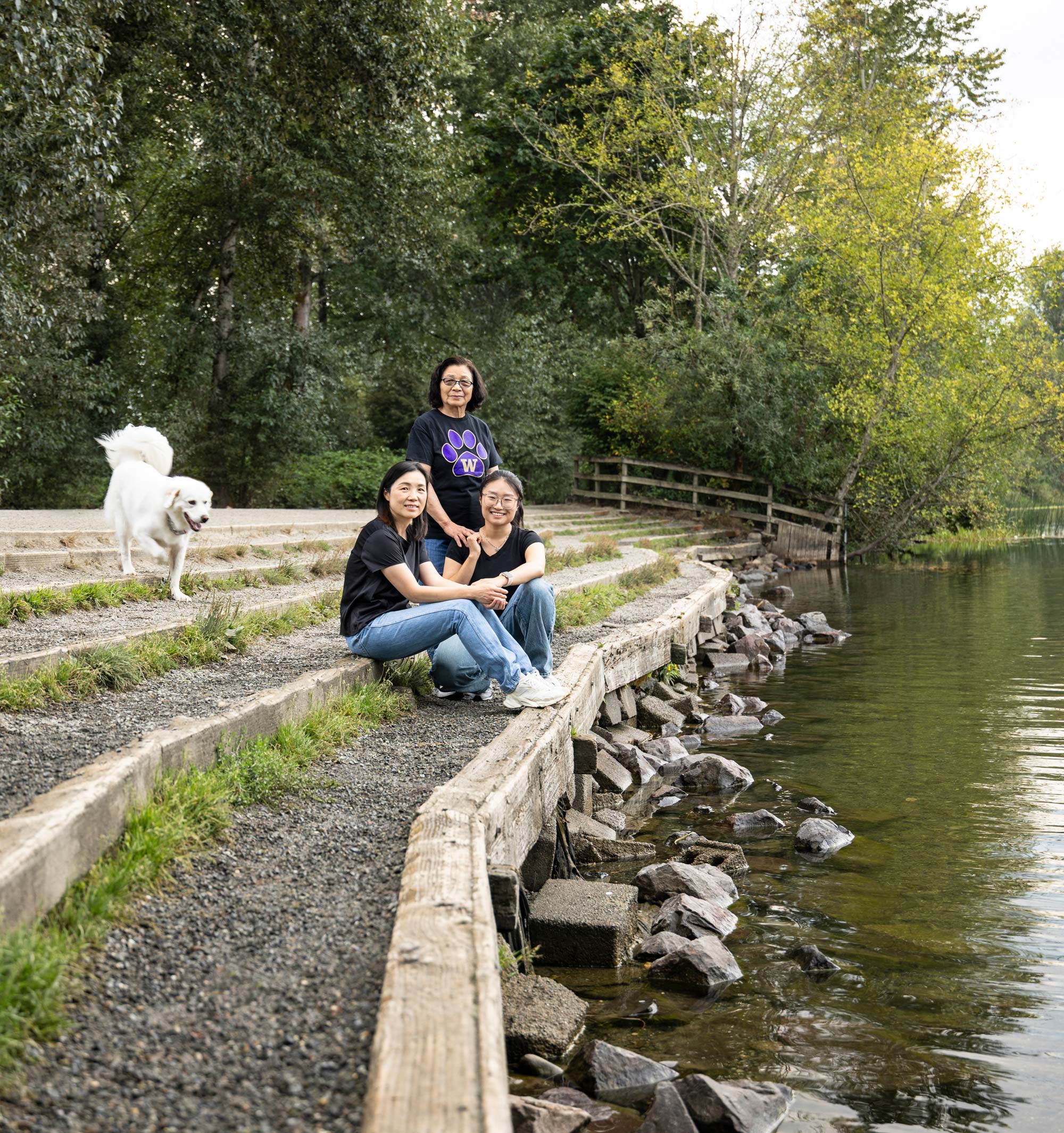
Healthy aging is of particular interest to Cai, whose grandmother stayed in Guangzhou when the family moved to the U.S. After helping her mother navigate the medical system here when Cai was a teen, she says it’s been difficult watching her elderly loved one age from afar, missing her and feeling the sense of familial obligation.
Her grandmother visited recently, to attend Cai’s UW graduation ceremony this spring, and Cai had the chance to put her research into action. “I’m trying to share a little every day: ‘Hey, do you want to try to eat more protein? Maybe we can go for a walk?’ These are the small things I’m trying to do to change her lifestyle a bit.” Cai adds, laughing: “We have these research outcomes, but actually having people accept it is another thing.”
Cai’s currently applying for positions in critical-care nursing, “to develop my skills in critical situations, be able to represent my culture and support families like mine in their most vulnerable moments.” As she forges her career in health care, she’ll be making a difference with that empathy, her UW training, and the hands-on skills gained thanks to scholarship support and a drive to help others.