Brunkow's brilliance Brunkow's brilliance Brunkow's brilliance
Mary Brunkow, ’83, helped uncover the gene that keeps the immune system in check.
By Hannelore Sudermann | Photo by Lindsey Wasson/AP Photo | December 2025
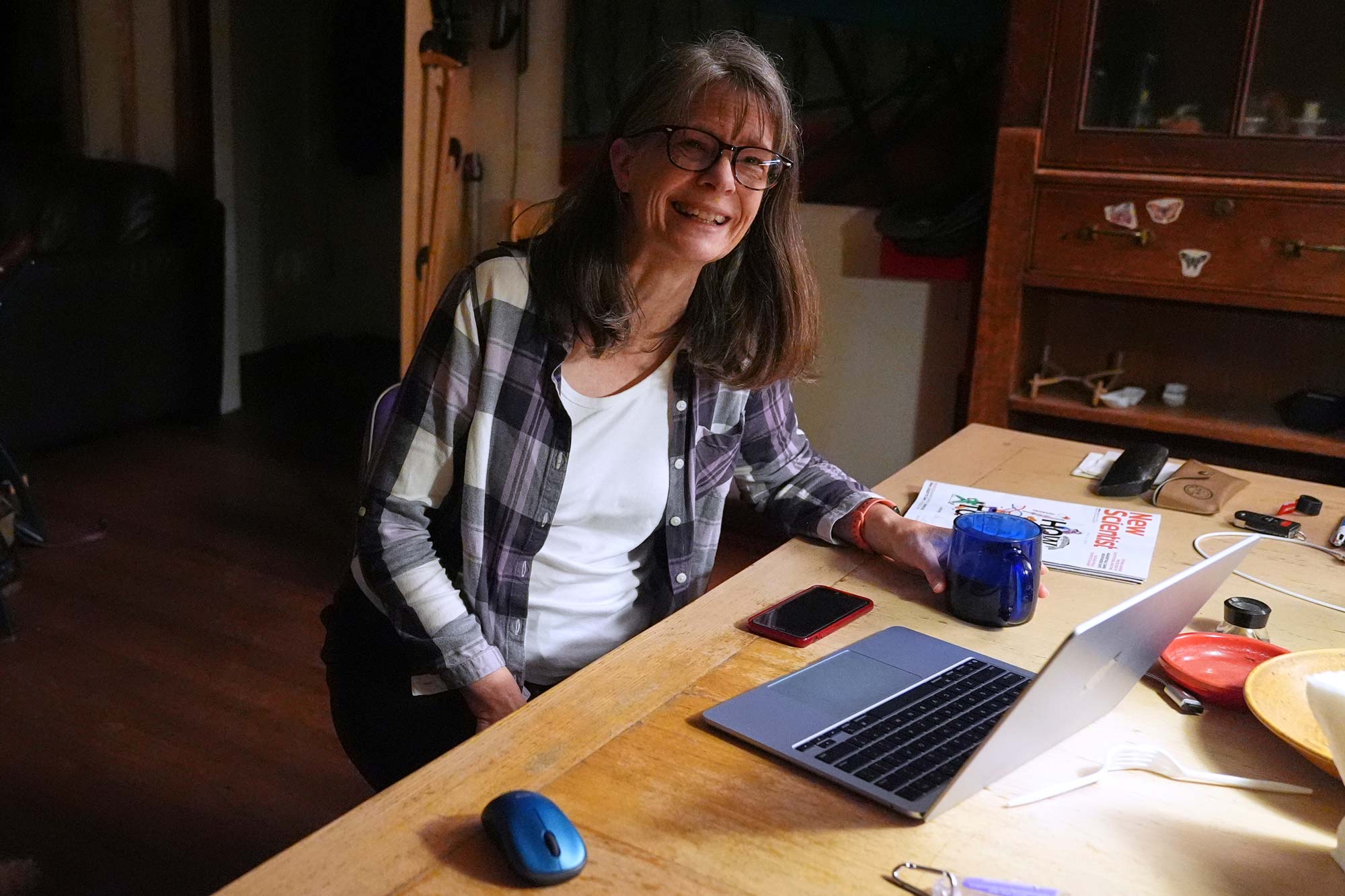
Early one October morning, when a photographer knocked on her door to deliver the news that she had just won a Nobel Prize, Mary Brunkow’s first reaction was disbelief. The UW science alum wondered what part of her research career merited the recognition. After a phone call with Adam Smith, the chief scientific officer for Nobel Prize Outreach, and some coffee, the reality began to sink in.
In 2001, while working at a Seattle-area biotechnology startup, Brunkow, ’83, and her colleague Fred Ramsdell published the breakthrough discovery they made while studying mice afflicted with a mysterious and fatal autoimmune disorder. They traced the disease to a mutation in a gene called Foxp3.
“It was really a molecular slog to get to that exact mutation, because it was just a very small genetic alteration that results in quite a profound change in the immune system,” she told Smith on the phone. “You’re an amazing geneticist,” Smith replied, adding that “finding that gene back [then] was a very different business than what it is now.”
Half a world away in Kyoto, Japan, Shimon Sakaguchi had been investigating a similar phenomenon. His lab showed that Foxp3 governs the development of regulatory T cells—immune cells that stop the body from attacking its own healthy cells.
Together, the pivotal discoveries opened a new frontier in immunology. And now the world knows.
Originally from Portland, Oregon, Brunkow enrolled at the UW in the late 1970s, majoring in molecular and cellular biology. As a senior, she worked in the lab of genetics professor Laurence Sandler. The lively, collaborative environment inspired her to pursue research in graduate school. She earned her Ph.D. at Princeton University under the mentorship of molecular biologist Shirley Tilghman and carried out postdoctoral research in Toronto with University of Toronto molecular genetics professor Alan Bernstein.
In 1994, Brunkow joined a Seattle-area biotech startup exploring genomics, immunology and bioinformatics. “We were using gene discovery to identify potential drug targets,” Brunkow says. When the company closed in 2003, Brunkow shifted her focus to science communication and program management. Today, she works at the Institute for Systems Biology in Seattle, overseeing large-scale, interdisciplinary projects integrating human genetics, computational biology and systems medicine.
But it was her early work at the Bothell startup that helped uncover one of immunology’s most fundamental mechanisms: how the immune system learns to tolerate its own tissues.
The Nobel Committee for Physiology or Medicine has recognized Brunkow, Ramsdell and Sakaguchi “for their discoveries illuminating the mechanisms of peripheral immune tolerance.” Their work transformed the understanding of how the body distinguishes between “self” and “non-self,” with implications spanning autoimmune disease, cancer treatment and organ transplantation. The three laureates will share prize money of nearly $1.2 million.
It’s incredibly important foundational work, Jonathan Schneck, a cellular immunology expert at Johns Hopkins University, told the Associated Press. “We’re reaping the benefits now—but there’s much more to come.”
Though her lab work concluded more than two decades ago, Brunkow’s influence continues to ripple across the biomedical world. For a scientist who once described herself as “just doing the work,” the recognition feels surreal. She has told reporters that we often don’t grasp the full potential of basic research when it is happening; sometimes it takes decades for its importance to become visible.
As messages of congratulations arrived from former colleagues and peers, Brunkow has reflected on her journey—from curious undergraduate to Nobel laureate. “It’s humbling, and I’m so proud of what we did,” she told The Daily in November. “It really did kind of open doors in the field of immunology, and it’s turning into potentially amazing new treatments for human disease. And I couldn’t ask for anything more.”