"I want to make history" "I want to make history" "I want to make history"
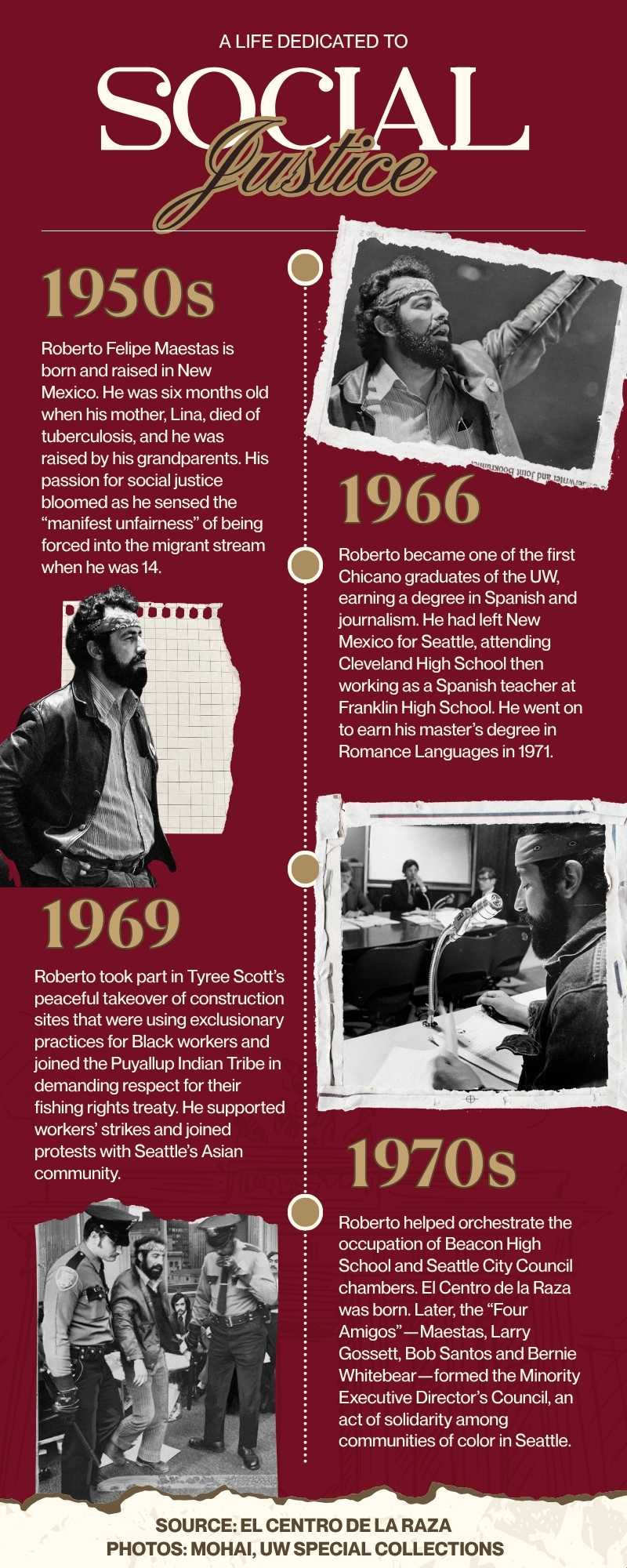
Roberto Maestas grew up in a small New Mexico town but became a Seattle legend as a UW student and social-justice leader.
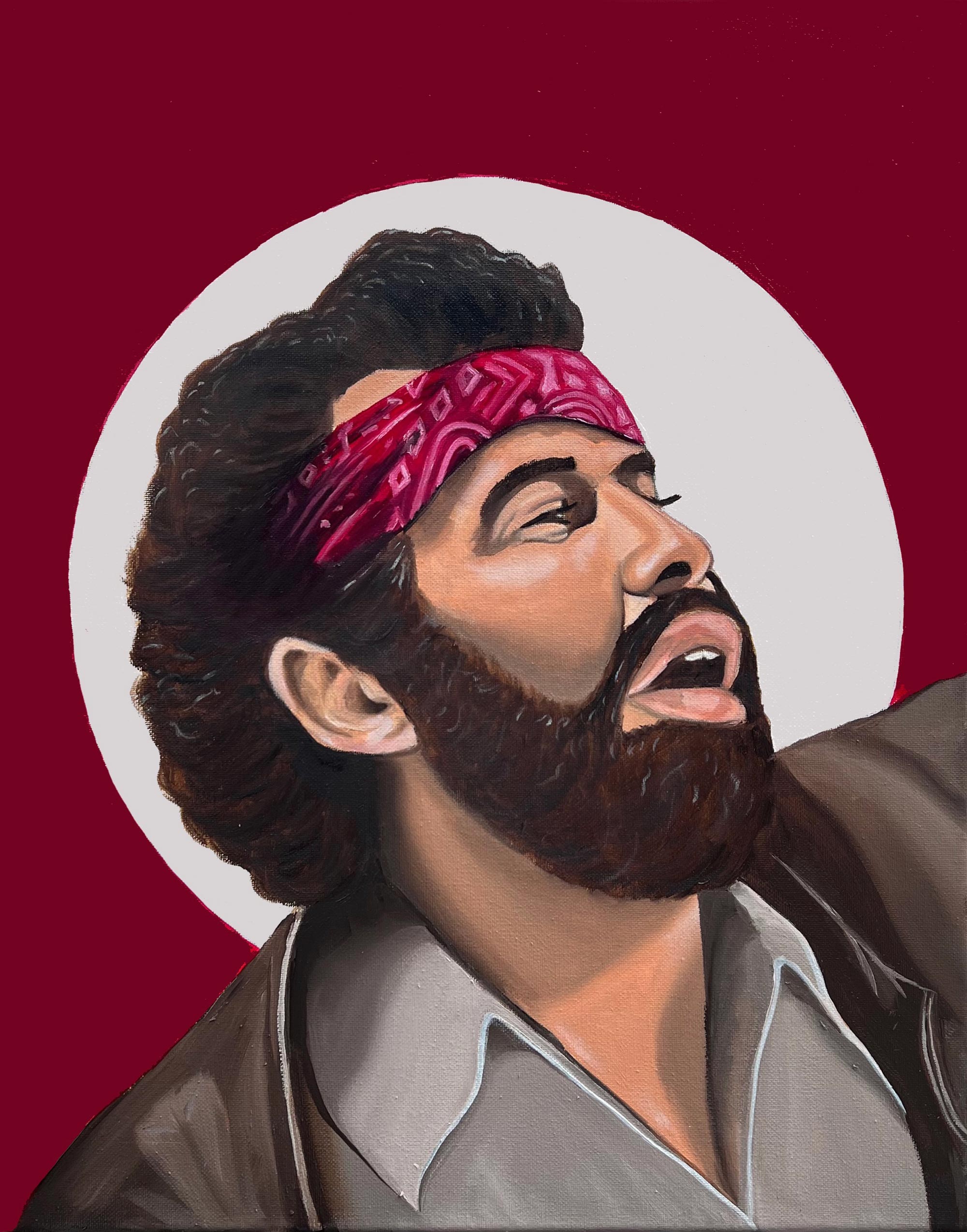
By David Volk | Illustration by Jake Prendez | June 2026
If you’re a Seattle newcomer, you could drive the Evergreen Point Floating Bridge for years before discovering that it’s named the Gov. Albert D. Rosellini Bridge and even then, you might not know that he got the honor because he advocated for its construction. Or you could marvel over the fact that the Smith Tower was once the tallest building west of the Mississippi River without knowing it was named after the typewriter and shotgun manufacturer who paid for its construction.
You can’t say that about Beacon Hill’s El Centro de la Raza, however. Even though El Centro’s campus isn’t named after him, it’s almost impossible to visit the center of Seattle’s Latino community without learning who Roberto Maestas, ’66, ’71, was. More than a decade after his death, many of the people who regularly visit the campus still remember the civil rights leader.
It’s hard not to and it’s not just because there’s an altar on the main floor with a large poster featuring the likeness of the bearded founder sporting his trademark tinted sunglasses and black hat cocked at a jaunty angle. After all, children in neighborhood schools are taught about his contributions to the community, a nearby street is named after him, and there’s a statue of him on the campus and even a corrido (Mexican ballad) about him.
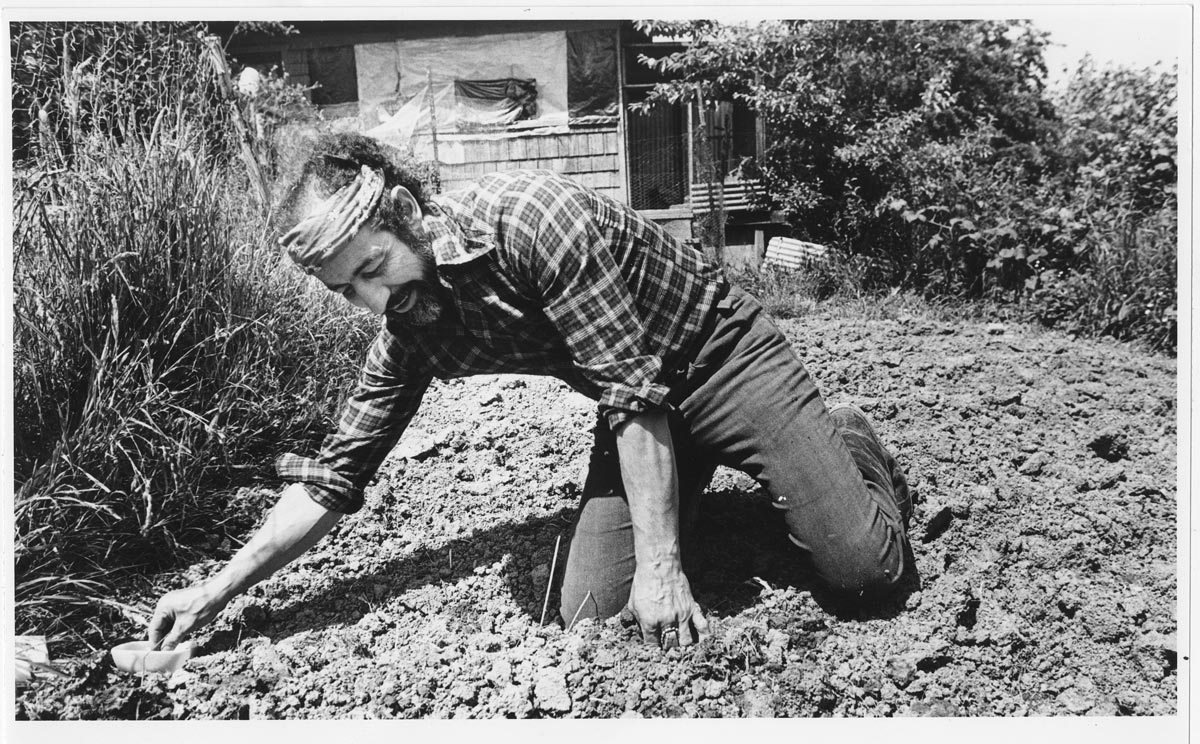
From the ground up, Roberto Maestas worked with underrepresented communities on social justice and equity. An admittedly “OK” student, he was most excited about what was happening in the political arena on the UW campus. Courtesy MOHAI, Seattle Post-Intelligencer Collection; photo by Tom Barlet
The funny thing is, Maestas himself probably wouldn’t have wanted his name or likeness on any of it, says his widow, Estela Ortega.
“My board of directors wanted to change the name of El Centro to Roberto Maestas whatever and I said, ‘I know for a fact he would not want that to happen,’” says Ortega, the current executive director of the center.
It’s not that Maestas doesn’t deserve the recognition. It’s just that he wasn’t interested in the limelight, his daughter, Adriana Maestas, says. She still recalls one of the pearls of wisdom he shared with her as she grew up: “All the glory in the world can fit in a kernel of rice. I think what he was meaning to say is that all the glory really doesn’t matter.”
A high-powered attorney with a multinational corporation, Adriana still remembers asking him why he didn’t eventually take a more lucrative, private-sector job after years of running El Centro. His response: “I don’t want to make money. I want to make history.”
He accomplished that goal many times over.
Rewriting history
In his youth, the kid from a disadvantaged Mexican family in rural New Mexico didn’t seem the most likely candidate to have an impact on the history of a city so far away. His father left before he was born, his mother died of tuberculosis before his first birthday and he grew up in a three-room house where his grandparents raised him and 16 other children. Then, they lost their subsistence farm in the New Mexico village of San Agustin del Valle de Nuestra Señora de Lourdes, a town so rural that the nearest big town was Las Vegas, New Mexico, with a population of 14,000.
“We were pushed off our land and then became essentially slaves in the fields,” the El Centro website quotes Maestas as saying. “It was clear to me that I needed to learn as much as I could about this system.”
His education also came from the school of hard knocks with him working as a migrant laborer throughout Kansas, Colorado and Wyoming before making his way to Seattle at 15. He became one of the first Chicanos to attend Cleveland High School, where classmates frequently asked him to speak Spanish because it amused them. He loved school but had to drop out to take a series of jobs before finally graduating with a diploma from an adult education program. He then went on to the UW, where he earned a bachelor’s degree in history while working evening shifts at Boeing.
Even his 1965 graduation and decision to teach Spanish at Franklin High School in 1966 seemed conventional until a series of events on campus in March 1968.
“The only teacher in the whole school that stayed in the hallways because he was not scared was Roberto Maestas.”
Larry Gossett, '71
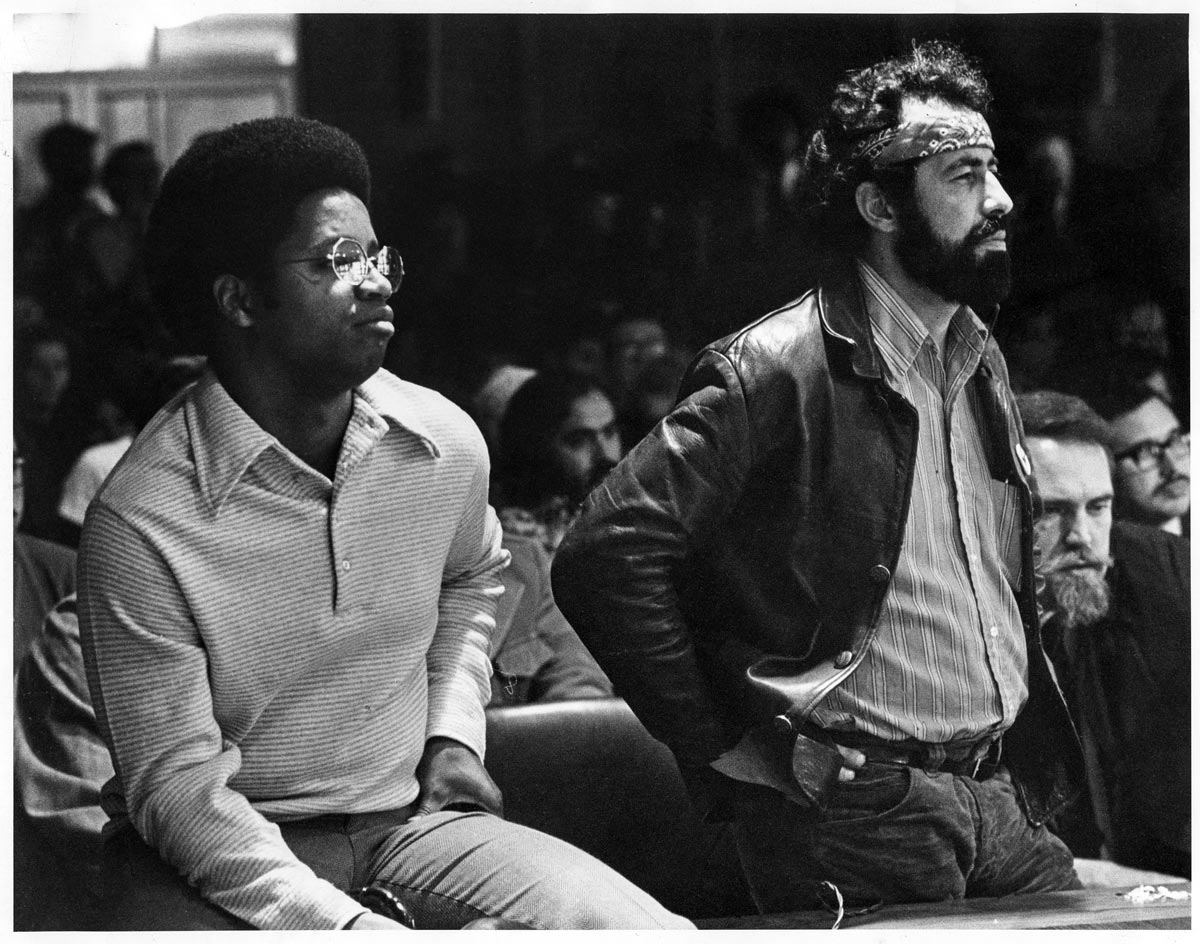
Larry Gossett (left) and Roberto Maestas were two UW alumni who were part of the famous “Four Amigos” who pushed the University and city of Seattle to address inequity and social justice. Courtesy MOHAI, Seattle Post-Intelligencer Collection; photo by Tom Barlet.
Maestas might not have considered himself political until two male African American students were suspended for fighting with a white male student one day and two female African American students who came to school wearing their natural hair were sent home the following day. Larry Gossett, ’71, then-head of the UW’s Black Student Union (BSU) and a future friend, said the girls were sent home with notes that said, “Your daughter will not be able to attend Franklin High School until she looks like a lady again.”
In response, the BSU and many of the school’s Black students staged a sit-in, demanding the suspensions be withdrawn, portraits of famous African Americans be hung on the walls, an African American history class be added and the school district hire a Black principal. The school canceled classes in the middle of the day and sent students and teachers home.
“The only teacher in the whole school that stayed in the hallways because he was not scared was Roberto Maestas,” says Gossett, who became a civil-rights advocate and politician.
In his 2015 book “Gang of Four,” which told the story of Maestas and three other Seattle civil-rights leaders, another future civil rights activist, Bob Santos, said that Maestas had already felt a kinship with students of color in his classes and had reached out to them. The protest gave the Spanish teacher the opportunity to talk to students and Gossett about their concerns.
Looking back on his meeting with Maestas, Gossett jokes, “He looked like a white boy to me. The students said, ‘No, he’s Mexican, he’s our teacher, we love him and he’s really cool.’”
It wasn’t the last time the students would discuss Maestas with Gossett.
“The next morning, the Black students called me at the BSU office and said, ‘Mr. Gossett, Mr. Maestas has done gone crazy.’ They meant his consciousness was awakened because he went into the teachers’ lounge at Franklin and announced, “From this day forward, I will no longer respond to Bob or Robert. When addressing me, my name is Roberto.”
From that point on, many of the things he did reflected his politics.
He spent the following summer teaching in the Upward Bound Program in Bellingham, where he helped low-income and minority students prepare for college. It wasn’t long before two students who were members of the Nisqually Tribe told Maestas and their classmates about the Native Fishing Rights movement. He was so intrigued that he met with leaders of the movement to find out more.
Along the way, he also met UW professor Joseph Sommers, who pushed Maestas to focus on Latino issues, according to the book “Gang of Four.” The creator of the University’s Latin American Studies Program found a grant to send Maestas to a Latin American education conference in California as well as a fellowship to cover his UW graduate school costs.
“For the first time in my life, I could study without having to work,” Maestas said in an interview with Frank Chesley for Seattle’s history website, HistoryLink. “I did OK with my academic work, but the most exciting things were happening in the political arena on campus—the anti-war movement, the Mexican American Student movement, the Black student movement, the Asian student movement.”
While a radicalized Maestas was returning to the UW, one of the first groups of Chicanos on campus was experiencing it for the first time during the great upheaval of the late 1960s. Even the group that represented their interests, the United Mexican American Students, was changing its name to MEChA (Movimiento Estudiantil Chicano de Aztlan) to match its members’ growing ethnic pride.
It was an exciting time for the new arrivals, but also intimidating, recalls Rogelio Riojas, ’73, ’75, ’77, executive director of Sea Mar Community Health Centers, which provides comprehensive health, housing, educational and cultural services to diverse communities, specializing in serving Latinos in Washington state.
“I didn’t know anything about the University of Washington. I didn’t know anything about what I was going to do. I just came,” Riojas says. He was thankful that the school had placed Chicano students together on the same floor of Lander Hall, so they wouldn’t get lost. The dorm placement also made it easier for leaders like Roberto to organize them and ensure an active minority-student association.
Riojas first heard Maestas speak about injustice and discrimination at one of the group’s many gatherings in a dorm lounge. “He was very active and very vocal talking about the injustices and discrimination that were happening around the country,” he recalls. “He was very articulate. He spoke with a lot of confidence. We weren’t used to that.”
Maestas looked beyond Chicano community issues. He supported a wide range of minority and ethnic causes. He protested at job sites when local trade unions refused to hire workers of color, he supported International District community leader Bob Santos’ effort to create good, low-income housing for seniors in the International District as the Kingdome was being built and he supported Native American activist Bernie Whitebear’s attempt to take over Fort Lawton to get a tribal community center.
The four civil rights leaders—Gossett, Maestas, Santos and Whitebear—worked together so closely that they came to be known as the Gang of Four or the Four Amigos.
After graduating from the UW with a master’s degree in 1971, Maestas returned to teaching with a side of social justice when he began teaching English as a second language at South Seattle Community College. The program became a de facto Latino community center until budget cuts forced the program to close in 1972.
Maestas then turned his eyes to Beacon Hill Elementary, an abandoned building owned by Seattle Public Schools, and hatched a plan to turn it into a community center where Latinos could receive social services rather than driving all over for assistance, according to the book “Gang of Four.” As the story goes, someone called to inquire about leasing or buying the property and wanted a tour. When a district staffer unlocked the building on the morning of Oct. 11 (Columbus Day), 70 people who had been in hiding rushed in and occupied the school. Once they took over, Santos’ book says, they filed articles of incorporation and called their nonprofit organization El Centro de la Raza.
The group knew it was in it for the long haul and occupied the building in shifts for months. Riojas remembered spending two or three days at a time despite the building’s lack of electricity and plumbing. “There weren’t any beds. So, we laid on the floor. It was cold,” Riojas says. There were also rats throughout the building.
“He was the type of individual who never stopped until the mission was accomplished.”
Rogelio Riojas, ’73, ’75, ’77, Executive Director, Sea Mar Community Health Centers
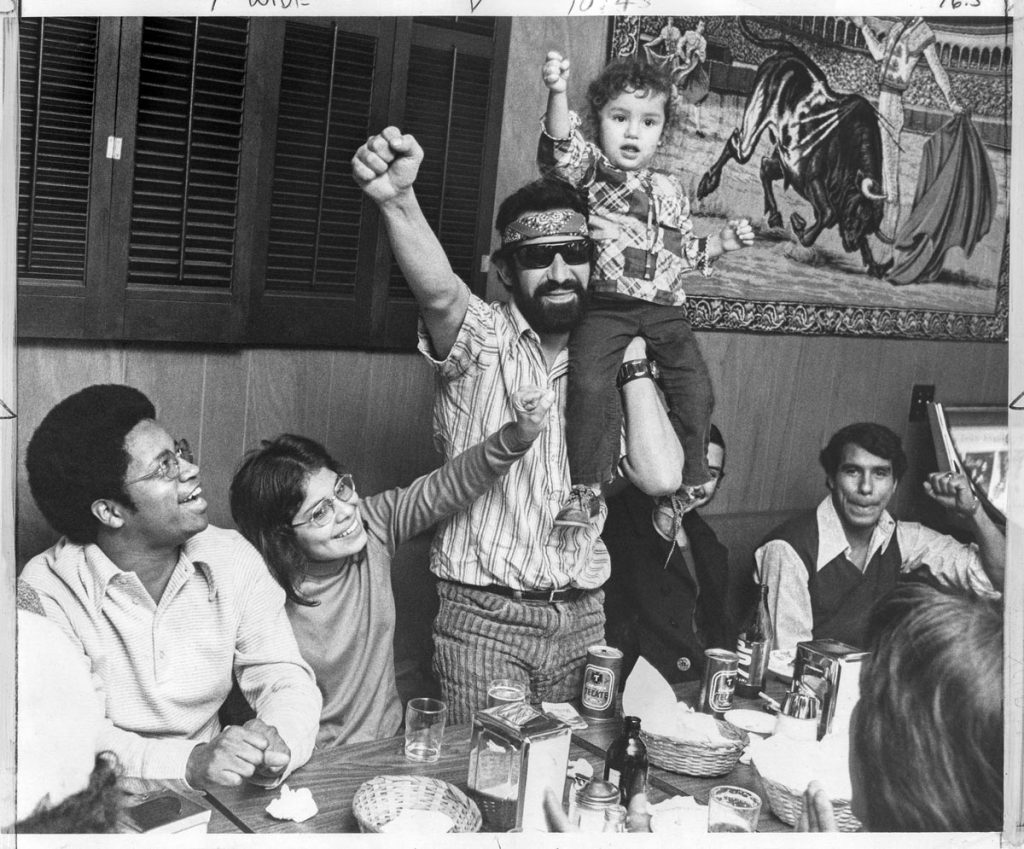
Social change, not personal riches or glory, drove Roberto Maestas. He worked his way through college while earning two degrees and leading the efforts to convert an abandoned school into a center for all people. Courtesy MOHAI, Seattle Post-Intelligencer Collection; photo by Jeff Larsen.
What the group lacked in comfort, it made up for in fun, says Ortega, Maestas’ wife.
“It was joyful. People were excited about what was happening and being together. There was a sense of solidarity and joy being in that struggle together,” Ortega says. She and Maestas added an extra element of celebration when they were married in the building two months later.
Oddly enough, Ortega isn’t sure why she gave Maestas the time of day. They first met at a conference in Houston, where Chicanos were discussing forming a national political party. She had taken time off from her job at a dental office to attend and wasn’t impressed with the company he was keeping.
“I don’t like these people, they’re too noisy and obnoxious,” she recalls thinking as the group introduced themselves to her. “Nice to meet you, but I’ve got other people to meet.”
Even now, she’s still not sure why she accepted his lunch invitation when she was waiting for someone else. Or why she agreed to marry him after they went to a Native American wedding and he waffled on his proposal.
At the same time, the city also waffled in its negotiations with Maestas and his group. The city council first rejected a proposal to lease the building but relented after activists occupied council chambers. Mayor Wes Uhlman, ’56, ’68, refused to sign off until the group secured funding to run the center. He, too, eventually relented, but not before he met with Maestas and a small contingent from El Centro, many of whom were arrested for refusing to leave the mayor’s office.
The city eventually agreed to lease the facility to El Centro for $1 a year.
Maestas’s choice of the organization’s name was deliberate, Ortega says. El Centro de la Raza is Spanish for the center for people of all races. “We didn’t want to create just a place for Latinos. We didn’t want a place that was also only going to be for poor people. We wanted people to feel they can come to El Centro de la Raza and have them feel that it is their home,” Ortega says.
It was also Maestas’ home away from home.
The work on the building continues to this day in much the same way that Maestas’ civil rights work continued after the occupation ended. As Riojas put it, “He was the type of individual who never stopped until the mission was accomplished. And obviously the mission was never accomplished because there’s still a lot of issues affecting social change.”
Because he was involved in so many different social movements, he was many things to many people from his office on the third floor of El Centro. Some neighbors saw him as the guy they could honk and wave at as they drove by. El Centro board member Victoria Kill, ’84, ’89, ’90, saw him as the teacher who showed her how we could learn from one another and teach one another. People in crisis saw his office as the place where they could camp out until they were heard and their problems addressed, with some ending up briefly living with Maestas’ family.
Old-timers might remember him as a member of the Four Amigos/Gang of Four. Fellow protestors recollect his sense of humor and his ability to get things done. And many can’t forget his love of trash-talking on the basketball court, where he was an OK player who loved the game and was at least good enough to get former Gov. Jay Inslee, ’73, to admit to Maestas’s daughter, Amalia Maestas, that her dad had beaten him.
All agree that he made friends everywhere he went, had the energy of a shooting star and left everyone with the same feeling when they spent time with him.
“You felt like the sun was shining on your face when you were talking to him,” his daughter Adriana says.
The children who benefit from his life’s work still remember him without his name being on the building. The staff still holds impromptu celebrations on his birthday without being reminded, a Mexican tune sings his praises and people come from miles away to decorate his bronze statue on holidays.
Given all that, a statue with his likeness might not seem necessary, but it’s significant nonetheless, Ortega says, even if it’s only because it’s one of the only ones in Seattle memorializing someone who isn’t white.
Her daughter, Amalia, agrees, saying it’s especially important to people who grew up like she did, not seeing many representations of famous Latinos to serve as role models.
As she puts it, “It’s definitely worth it to have a statue of someone who made our whole life visible.”
LEAD PHOTO: “Roberto Presente,” a portrait honoring civil-rights leader Roberto Maestas, was painted by Seattle Chicano artist Jake Prendez, ’00, who drew inspiration from a 1972 newspaper photograph of Maestas at a Seattle City Council meeting.