Dancing on air Dancing on air Dancing on air
Rachael Lincoln's students trade textbooks and tablets for harnesses and ropes.
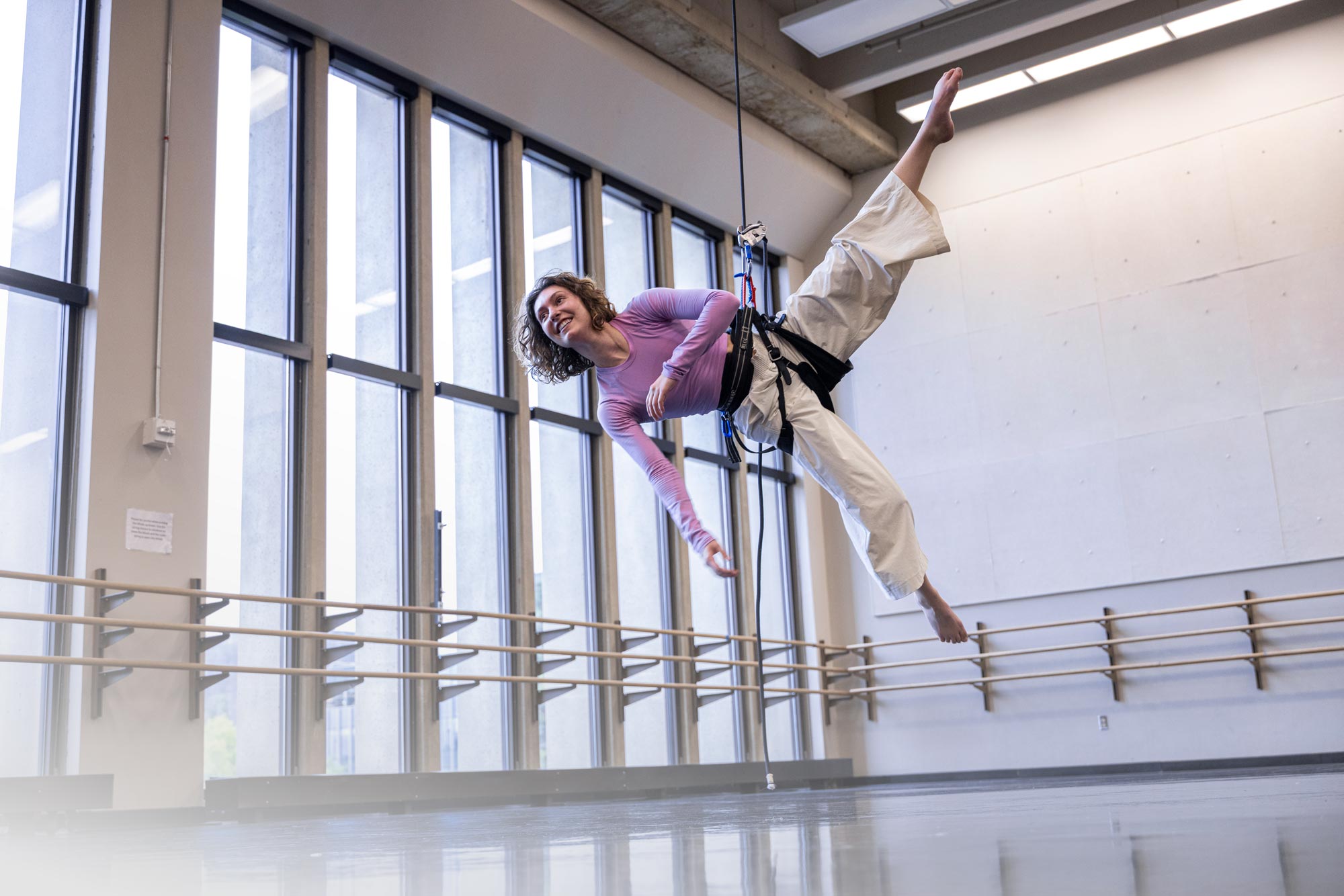
Rachael Lincoln's students trade textbooks and tablets for harnesses and ropes.
Students at the University of Washington often ground their course load with electives like music appreciation, 20th century theater or a foreign language. A special few, however, take flight exploring how the body moves through space and responds to momentum and gravity.
In Associate Professor Rachael Lincoln’s Movement Practices: Special Topics class, students try out Low Fly, a vertical dance technique pioneered by choreographer Amelia Rudolph of the BANDALOOP dance company. Using harnesses and ropes, the dancers learn to navigate momentum and gravity, allowing for greater creative risks. Flying several feet above the floor can feel both freeing and terrifying, it can also evoke a childlike joy while demanding complete trust in the harness and in one’s own physical abilities.
Long-time vertical dance practitioners, including Lincoln, often perform on vertical surfaces like cliffs and sides of buildings, using the vertical plane as a stage. At the UW, students like biology major Sophia Jenes stay closer to the ground but build improvisation skills and deepen their awareness of gravity through the form. Jenes grew up training in ballet, a discipline defined by upright posture and controlled upper body placement. Low Fly, she found, provided a striking contrast.
“When I started Low Fly, I was unfamiliar with the release of the upper body that contributes so much to the aesthetic of the dance style,” Jenes says. “Through warmups and practice on the ropes, I began to understand how release of the upper body can inspire new movements and create an image of softness.” Through Low Fly, Jenes came to understand that grace doesn’t always come from control.
“Low Fly taught me that inspiration for movement can come from anywhere,” she adds. “Even a simple standing position, when shifted off center, can inspire a dynamic sequence of spins through the air. This idea reshaped how I think about where movement originates, both on and off the harness. It deepened my awareness of how the possibilities for movement are intrinsically connected to the space and plane in which we are dancing.”
Low Fly will be offered as part of Dance 376: Movement Practices/Special Topics in Winter and Spring quarters in the 2026-2027 academic year. Explore other dance classes with the UW Department of Dance.