Richard Colella Sr. had been selling concrete in the Seattle area throughout the 1950s when his company decided to get him a membership to Sand Point Country Club. Along with the requisite venues for schmoozing, a golf course and a bar, there was a newly constructed swimming pool.
Colella swam recreationally in Green Lake as a child, back when doing so didn’t put the swimmer at immediate risk of an algae infection. To him, it was nothing more than a fun thing to do, and when his kids first splashed into the Sand Point pool, that was their take, too.
Swimming is still fun for most of Colella’s four children, all of whom graduated from the University of Washington and who today range in age from 58 to 75. But it wasn’t long after taking their first competitive strokes that each realized they had a serious gift for the sport, one which would propel the two oldest Colella kids to Olympic podiums and the youngest pair to All-American honors at the UW.
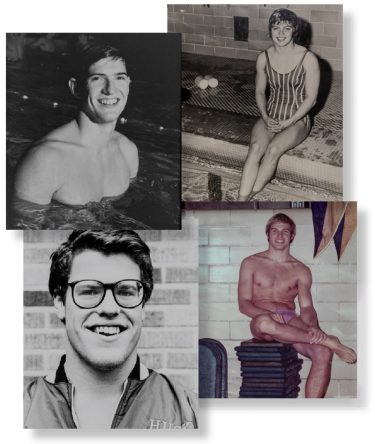
Clockwise from top left: Rick Colella, Lynn Colella, Steve Colella, Pete Colella
The Colellas grew up in Wedgwood and attended Nathan Hale High School. By the time baby brother Pete got there, swimming was a sanctioned high school sport, but his older siblings were restricted to swimming for Cascade Swim Club, one of the area’s oldest year-round programs that operates out of facilities like Edmonds’ Yost Pool, which Pete now manages in conjunction with his duties as a Cascade swim coach.
Rick Jr., now 74 and an accomplished masters swimmer, recalls that, as a kid, he was “good at swimming and never anything else.”
“It was a stroke of luck that I fell into that,” he says, wading his way into a pun.
Rick made the U.S. Olympic team in the 200-meter breaststroke in 1972, finishing a heartbreaking fourth at the Munich Games. After graduating with an engineering degree, he stayed on to pursue a master’s degree and, critically, kept on training. When he competed in the Montreal Olympics in 1976, he made it to the podium, earning breaststroke bronze.
Rick’s big sister, Lynn, was ahead of him at the UW, where she was also an engineering student. A testament to the athletic sexism of the times, women’s swimming was merely an intramural sport at the UW while Lynn attended.
“We sold peanuts to make some money to go to a swim meet at Stanford one year,” recalls Lynn, now 75, who would train with the men’s team at the old pool in Hec Edmundson Pavilion.
As a senior at Nathan Hale, Lynn missed making the 1968 Olympic team by three-tenths of a second. Four years later, in Munich, she avenged this disappointment, earning a silver medal in the 200-meter butterfly.
“When I was 10 years old, swimming for Sand Point, it was the 1960 Games,” she says. “I saw the swimmers on the podium during ‘The Star-Spangled Banner,’ and that was when I made a goal to make the Olympics. [Munich] was the culmination of 12 years. It actually came true.”
While Rick still swims competitively and Pete coaches at Cascade, Lynn viewed training as “a necessary evil” and shifted her sporting interest to soccer after her prime years in the pool. Meanwhile, Steve Colella, now 71 and formerly on the brink of making the Olympics in the 400-meter individual medley, considers swimming his “form of meditation.”
“Swimming’s kind of like a fraternity, and I didn’t join a fraternity in college,” he explains. “Swimming always gives you an outlet to talk to people about various things, to network well, to learn how to connect with people emotionally and intellectually. Lynn and I tended to be more of the mathematical, scientific people. We would always talk about how we would solve our math problems while we were swimming.”
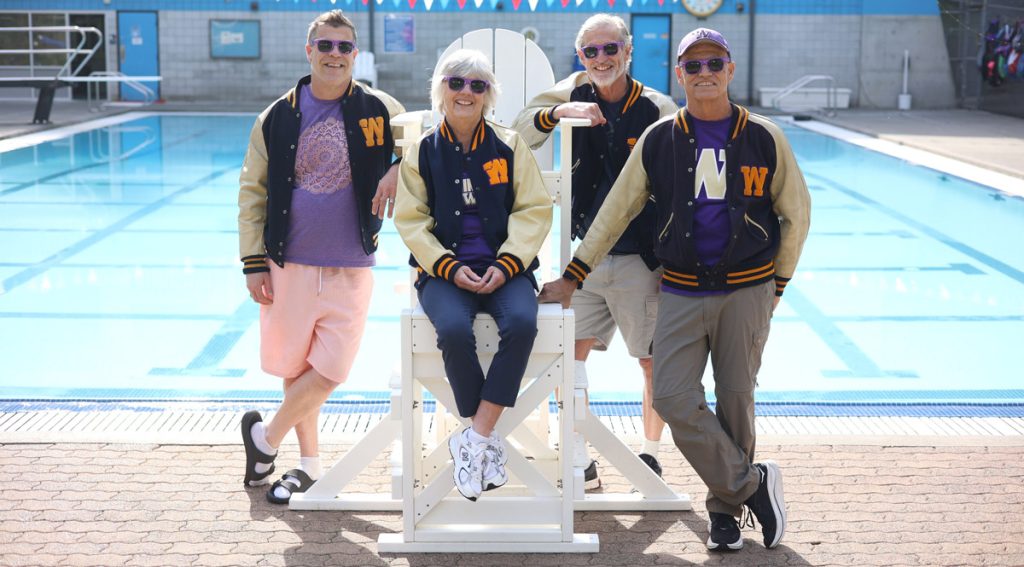
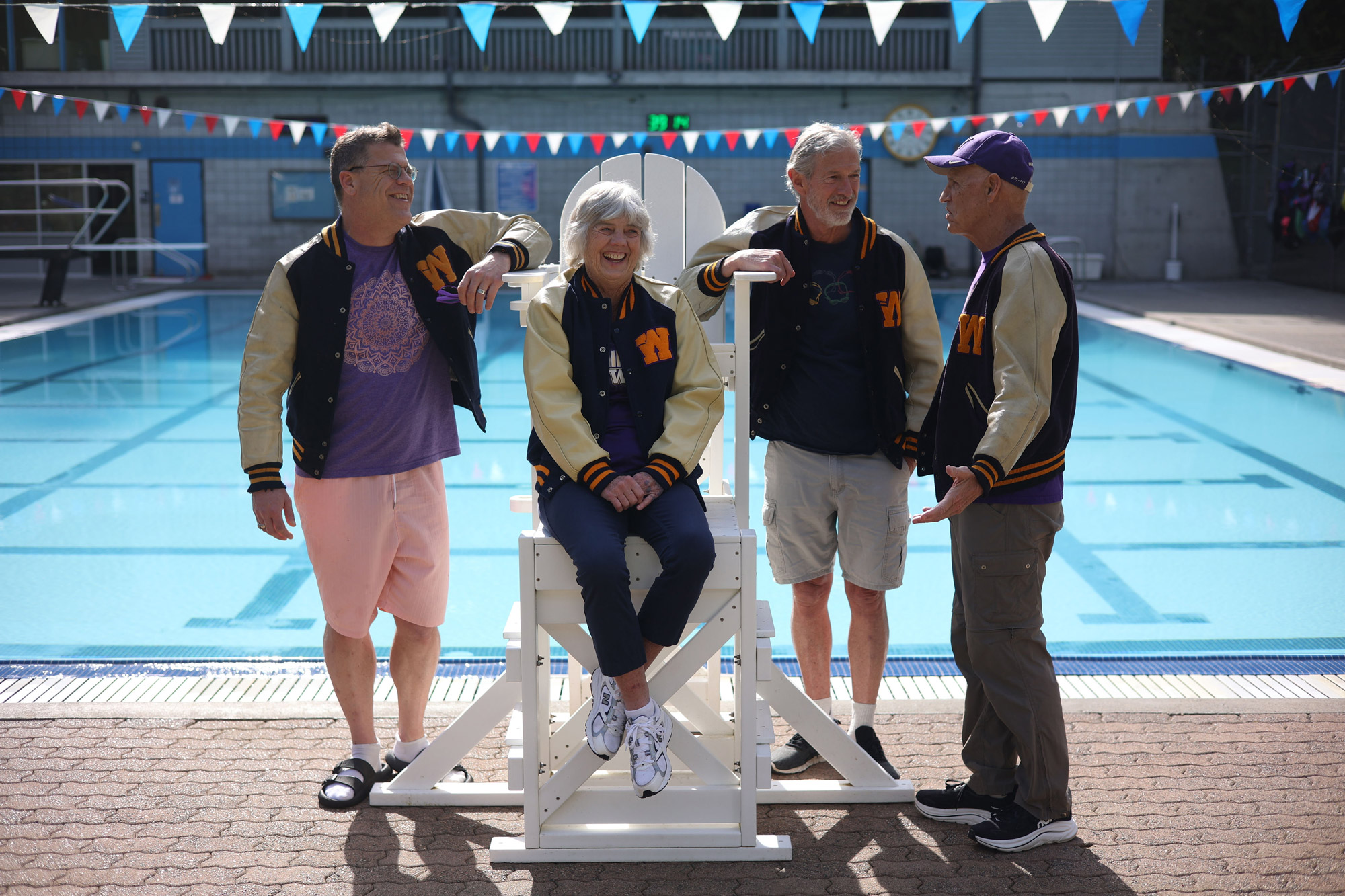
These sibling swimmers had quite a run at the University of Washington gather at an Edmonds pool. From left are Pete, Lynn, Rick and Steve Colella. Lynn and Rick went on to win Olympic medals.
It runs a little deeper than that for Steve, who retired to Tacoma after working in the energy industry in Texas.
“I just got through cancer treatment at Fred Hutch—I spent two years on a trial program and swam all through that,” he says. “I kind of feel like swimming saved my life. When I was going to face this health issue, I was able to survive it much more readily because of swimming.”
Pete, 58, is the lone English major among the swimming Colellas and the least likely to take things too seriously. When he was 7, he broke his elbow ice skating at a birthday party and couldn’t straighten his arm out. His doctor gave him the choice to have it rebroken or to start swimming as a form of physical therapy.
“It wasn’t a hard decision for me,” quips Pete, who specialized in sprints. “I won the city championship for 8 and under and figured, ‘Well, this is a pretty good thing to do.’ I was a little more of a goof-off in workouts than my siblings. At the UW, I became a hard worker. I was a more natural talent, which irritated a lot of people who work very hard.”
Of his upbringing, Pete says, “We were so far apart, it was almost like having extra parents. I was 13 years behind Steve and 16 and 18 behind Rick and Lynn. Growing up, I just thought everybody had Olympians in their household and got to wear Olympic medals around to show and tell.”