Pitch purple Pitch purple Pitch purple
The UW joins the world's biggest sporting event—the World Cup.
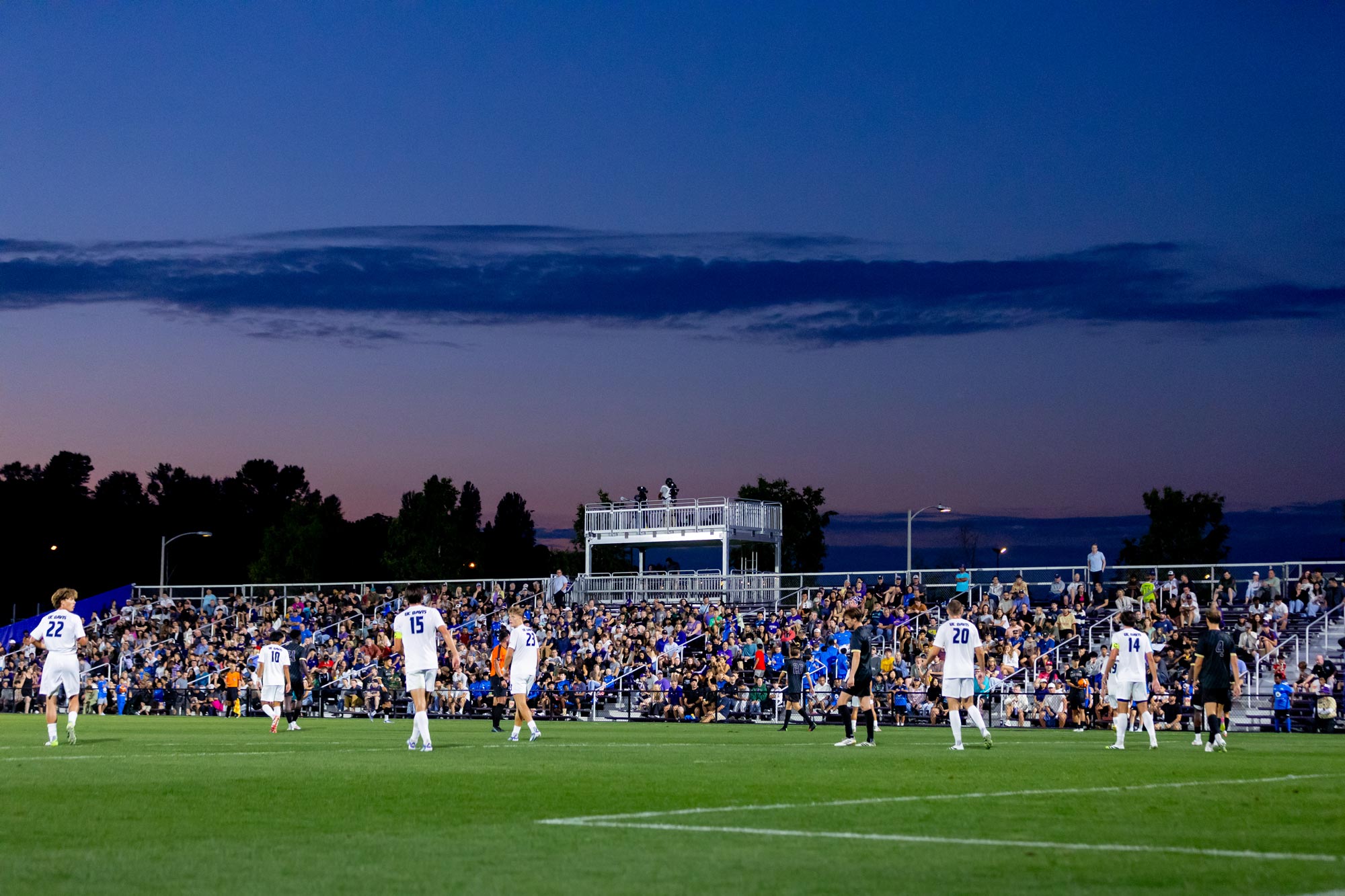
The UW joins the world's biggest sporting event—the World Cup.
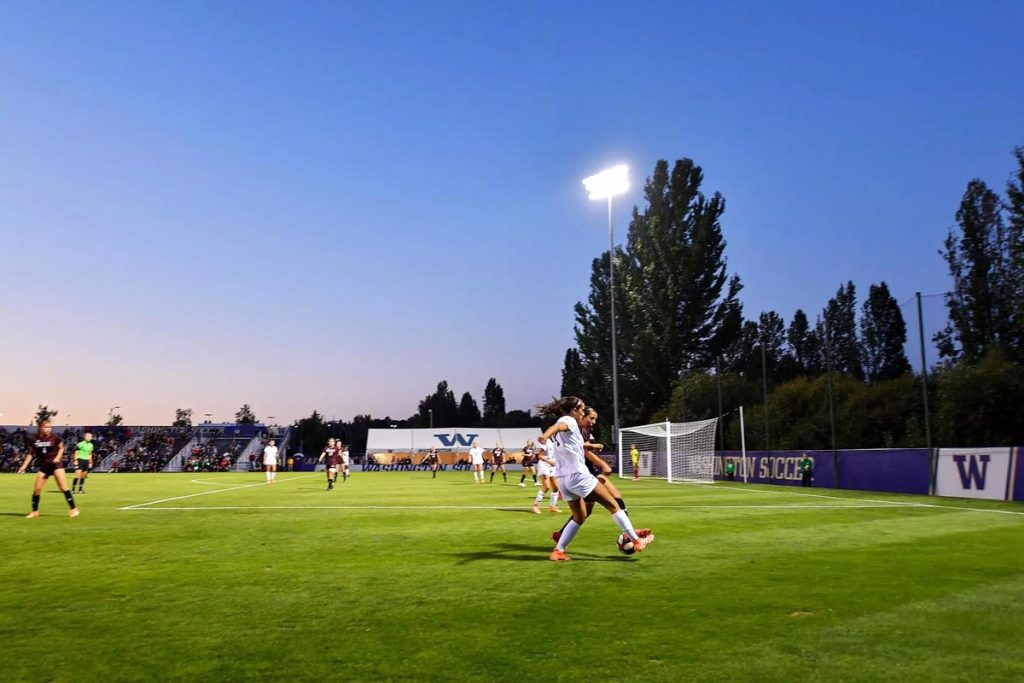
One of the first visible signs that the FIFA World Cup was coming to Seattle appeared last summer just east of Husky Stadium, where crews began transforming the University of Washington’s well-worn soccer field into a world-class training facility.
The $3.8 million renovation will allow the UW to serve as a venue-specific training site for visiting international teams during the 2026 FIFA Men’s World Cup. Teams practicing at the UW will then head downtown to compete at Lumen Field.
“There was a full reconstruction of the playing surface and sub-grade drainage and a new sprinkler system,” says Dan Erickson, UW associate athletic director and the project manager. The upgrades also included retrofitting the field’s four light poles with LED fixtures—though one pole was delayed because of a uniquely Seattle complication. “It had an osprey nest, so we had to wait until they cleared out,” Erickson says.
Additional improvements include a new covered bench area and ball-control netting. Along the Lake Washington side of the field, it will keep stray shots out of the water. The renovated facility is expected to host 10 to 12 practice dates during the six matches scheduled from June 15 to July 6, with some teams sharing the venue on the same day. The practices will be closed to the public, but Erickson says the opportunity is still remarkable.
“It’s really cool that we’re going to have some of the best players in the world on our field,” he says. “Just to play a small role in the World Cup being here in Seattle, with Seattle being such a soccer city, it’s great to have this legacy gift.”
But the UW’s connection to the World Cup extends far beyond the pitch. Across all three campuses, faculty, students and alumni are engaging with the global event through research, civic partnerships and cultural programming.
Law professor Anita Ramasastry, an expert in business and human rights, became an independent adviser on FIFA’s Human Rights Subcommittee following concerns surrounding the welfare of workers supporting the 2022 World Cup in Qatar.
Meanwhile, several UW alumni hold leadership roles on the Seattle FIFA World Cup 2026 Organizing Committee, including Ann Romero Kawasaki, ’83, Leo Flor, ’13, ’15, and Felipe Mendez, ’05.
At UW Bothell, Professor Ron Krabill teaches courses on the cultural studies of global sport and is co-leading an interdisciplinary summer program focused on Seattle’s World Cup experience. Organized through the Office of Undergraduate Research, Seattle’s World Cup: Storytelling Through Community Mapping will deploy students to document the social and cultural impact of the tournament through podcasts, photo essays, video, journalism and digital-mapping projects.
As excitement builds around Seattle’s role as a host city, students have signed up to volunteer for opening ceremonies and fan events throughout the region. UW Medicine physicians are also working with World Cup organizers to prepare for the arrival of players and visitors from around the globe. And the University itself is a Host City Supporter of the local organizing committee’s efforts.
The tournament is also creating opportunities to spotlight alumni-owned businesses across the region. This spring, small UW alumni-owned businesses received illuminated “Sea Beacons”—neon whale-tail displays signaling their connection to Seattle’s World Cup celebrations and local community partnerships. Among them are Top Pot Doughnuts, Tai Tung Restaurant and the Georgetown Brewing Company.
As Seattle prepares to welcome the world this summer, the UW has helped shape what that welcome will look like—on the field, in classrooms and throughout the broader community. The tournament also offers the University an opportunity to demonstrate its role as the region’s global academic and knowledge engine, connecting research, innovation and public partnership on an international stage.