For the global good For the global good For the global good
Lawyer leaders from around the world come to the UW's Barer Institute for the tools they need to make a difference back home.

Lawyer leaders from around the world come to the UW's Barer Institute for the tools they need to make a difference back home.
Against the backdrop of mountains and forests on Mindoro island in the Philippines, Jonathan Jo spent a week providing legal advice to members of the Mangyan Indigenous communities. A third-year law student at Ateneo de Manila University, he wanted to help people better understand their legal rights.
This immersive experience illuminated for Jo the challenges facing many of his country’s 200+ Indigenous communities, which are not treated as sovereign nations. One of the biggest sticking points is land rights. “Although our laws recognize ownership of land by Indigenous peoples,” says Jo, he notes that Indigenous owners often experience conflicts with developers and businesses.
Jo’s interest in Indigenous rights shaped his career path; after many years in the private sector in the Philippines and Singapore, he became the clerk of the commission, a leadership role, for the Philippine National Commission on Indigenous Peoples. That path led him to the Barer Fellowship at the University of Washington School of Law—where he’s deepening his understanding of Indigenous law and learning from local tribes, so he can bring that expertise back home.
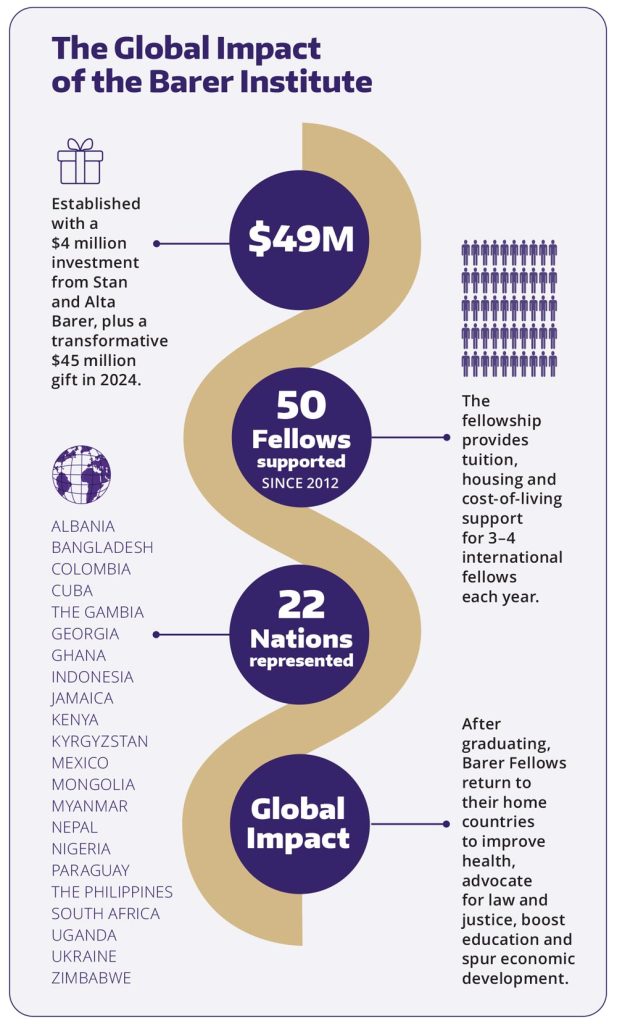
Each year, the UW’s Barer Institute for Leadership in Law and Global Development selects four fellows like Jo from around the world—midcareer lawyers, judges, civil servants and human rights advocates—for a yearlong postgraduate degree in sustainable development. Their studies are fully covered, thanks to the generosity of the late Stan Barer, ’63, a UW Law alumnus and former UW regent, and his wife, Alta. (Learn more about Stan and Alta.)
In 2024, the Barer estate made a transformative $45 million gift—one of the largest bequests in UW history—to increase the institute’s impact through scholarships, mentorship and career advising. In addition to supporting the international fellows who are here for a year, this gift creates a new cohort of J.D. Barer Scholars: current UW law students who show leadership skills and an interest in global issues.
The Barer Fellows have “demonstrated their passion and commitment to being change agents, not only for themselves but for the global common good,” says Professor Anita Ramasastry, faculty director of the graduate program and inaugural Barer Institute chair. Most come to the UW with impressive resumes and decades of experience, looking to develop new ideas and bring home practical solutions to pressing global challenges.
After a lengthy career as a lawyer, Victoria Katamba, ’25, was appointed to the Ugandan High Court and is now head judge for the Masaka High Court Circuit, presiding over civil and criminal cases. She’d been considering a postgraduate degree in the United States, and a visit to a Seattle-area relative brought her to campus and introduced her to the Barer Institute.
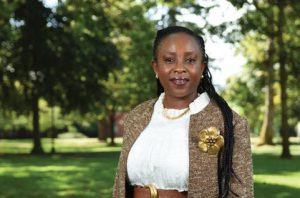
“I saw the institute as a place for anybody who wants to advance the cause for justice, for rule of law and for governance,” says Victoria Katamba, ’25.
“I saw the institute as a place for anybody who wants to advance the cause for justice, for rule of law and for governance,” says Katamba, who found these topics especially relevant having grown up in Uganda under the brutal dictatorship of Idi Amin Dada. In 2024 Katamba came to the UW eager to answer big questions, like how to distinguish whether the law is serving its citizens.
What she discovered—through classes, conversation with other fellows and internship experience—is that “good governance is an issue that affects everybody, even in the United States,” Katamba says. It’s one of the many ways her judicial approach and understanding of law were shaped by her year at the University.
That year at the institute looks different for each participant. All students take a foundational class that Ramasastry teaches, then choose from courses in the law school and electives in the UW’s Jackson School of International Studies and Evans School of Public Policy & Governance. The fellows also spend time with mentors (fellow legal professionals) and intern at local organizations, from the King County Circuit Court to nonprofits like Landesa, which advocates for land rights. “Lawyers often think that just changing the law is the answer,” Ramasastry says. “We’re trying to teach them that they need other tools and to work effectively with other policymakers and disciplines.”
Turning knowledge into practical action is the priority for Stella Wangechi Ngotho, ’14, now a business and human rights consultant for United Nations Human Rights in Africa. “The UW was one of the few universities with grounding in sustainability, business and human rights,” recalls Wangechi Ngotho, who was working at Kenya’s National Commission on Human Rights when she sought out the fellowship. At the UW, she worked with sustainable business consultants and learned how to identify and assess conditions that might hurt workers—like exploitative labor practices or gender-based violence—and design strategies to prevent or reduce harm. The fellowship gave her the tools to navigate complex business challenges back in Kenya, where she coordinated the country’s first national action plan on business and human rights. She went on to become the first human rights manager for a large agribusiness, creating a human rights framework and a system for raising and addressing grievances. Today, she’s working to integrate responsible business practices into policy and the private sector across sub-Saharan Africa. “
There’s a difference between what you read and what you actually need to do to support businesses to integrate human rights,” Wangechi Ngotho says. “I came out of the UW with a confident understanding of what I’m expected to do.”
At the Barer Institute, practical opportunities are customized to match each fellow’s interests and background. For example, Jo is externing at the Puyallup Tribal Court this summer to learn about its judicial practices, while Katamba was mentored by a King County Circuit Court judge.
As a cohort, fellows are encouraged to discuss their areas of interest with each other, helping them see issues from different perspectives and find similarities. “One thing the diversity of the program showed me,” Katamba says, “is that our problems are not unique, that they are shared.”
From Uganda to Ukraine, Cuba to the Philippines, Barer Fellows put their UW education to work promoting good governance, human rights and corporate responsibility— making a difference on a global scale.
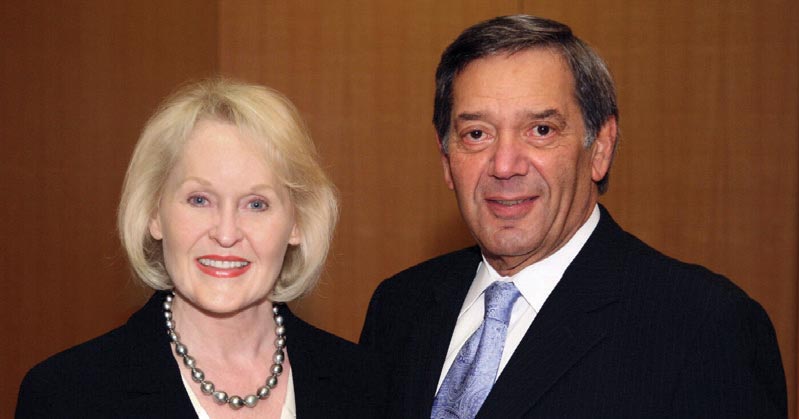
Driven by a desire to help others and a global vision for shared prosperity, Stan and Alta Barer were two of the UW’s most generous and involved supporters.
Stan Barer, ’63, was a world-renowned Seattle attorney who started his career working for U.S. Senator Warren Magnuson, helping draft what would become the landmark Civil Rights Act of 1964. He enjoyed a lengthy career in law and politics, later serving as a UW regent. Alta, who traveled the world for two decades as a fight attendant, was also actively engaged in politics and championed higher education, the arts and women’s issues.
Together, the Barers were instrumental in the creation of William H. Gates Hall, the home of UW Law, and they endowed faculty positions and helped launch new programs that connected the UW to the world. Alta passed away in 2019; shortly before Stan died in 2021, the UW Foundation honored him with the Gates Volunteer Service Award, recognizing his lifetime of service to the University.
The Barers took an active interest in all the Barer Fellows and made a point of getting to know each one. Stella Wangechi Ngotho, a Barer Fellow alumna, remembers engaging conversations with the couple over dinner in their home. “Stan and Alta are very close to my heart,” she says, “because they gave us this opportunity.”
Support global changemakers. When you give to the Barer Institute, you help legal professionals around the world create innovative solutions to pressing global challenges.