More than a game More than a game More than a game
In the Global Sport Lab, students examine international affairs and local impact through the lens of sports.
In the Global Sport Lab, students examine international affairs and local impact through the lens of sports.
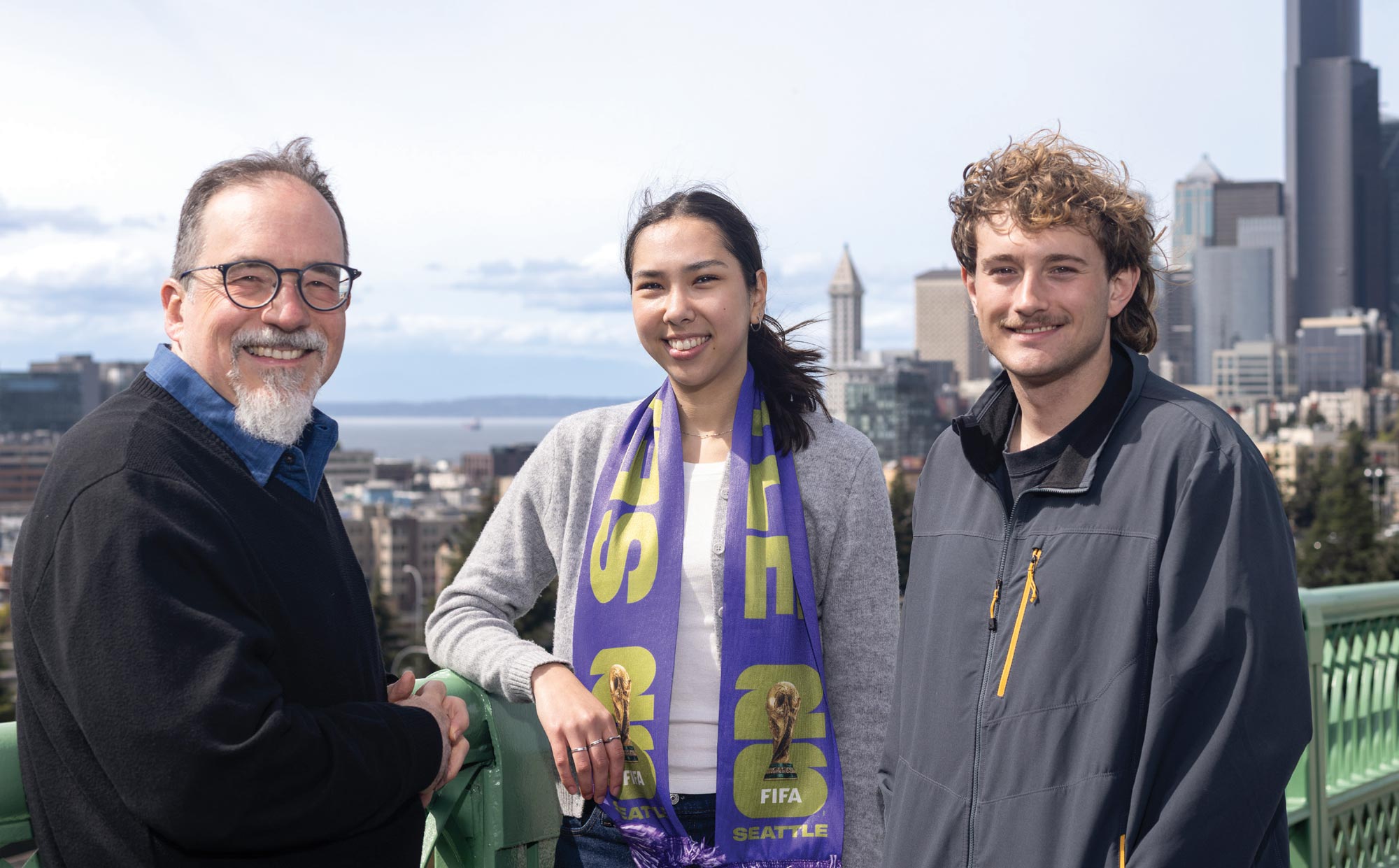
Above: Professor Ron Krabill and UW students Maggie Keenan and Sam Hurst (from left) study how sports shape Seattle—and vice versa.
Like many Pacific Northwest kids, Sam Hurst, ’27, grew up a competitive player deeply embedded in local soccer culture. As a preteen in his Oregon elementary school, he ran a cost-benefit analysis of being a national host of the FIFA World Cup. Just for fun.
Fast-forward a decade or so, and last year the University of Washington sophomore had a hole to fill in his schedule. He found a class called “Shut Up and Play? Sports, Politics and Media in Global Perspective”—and couldn’t sign up fast enough.
The course was taught by Ron Krabill, a professor of interdisciplinary arts and sciences at UW Bothell. Like Hurst, Krabill is a lifelong soccer fan. For the last 15 years, he’s been finding creative ways to weave that passion into his work: leading study-abroad trips on the politics of soccer, and teaching classes like Shut Up and Play. His efforts leveled up in 2024, when he was tapped to lead the Global Sport Lab, a collaboration of international experts engaging students in a look at how sports shape the world—and vice versa.
The Global Sport Lab is based at the UW’s Henry M. Jackson School of International Studies, in partnership with experts from many disciplines across the University. It was established through support from generous community donors with passions for sport and engaging students in global topics—and an appreciation for Seattle’s unique moment as a host city for the 2026 FIFA Men’s World Cup. “We called it a lab for a reason,” says Jackson School Director Daniel Hoffman. “It gives students, and faculty too, an opportunity to experiment with thinking dynamically across lots of different kinds of spaces.”
Using the World Cup as its anchor point, the Global Sport Lab explores how sport can reflect and provide context for international relations, politics, economics, human rights, social issues and more. One example: The weekend of the June 26 match in Seattle coincides with major LGBTQIA+ Pride events throughout the city, including a planned Pride-themed game—but the competitors are Egypt and Iran, and concern has arisen about those countries’ oppressive antigay laws. (Although Iran’s participation has been in question due to an ongoing military conflict, at press time Iran had confirmed that it would compete.)
The lab helps students explore weighty topics like these in a variety of ways. They’ve added 15 new classes across the UW campuses in Bothell and Seattle, fostered research projects, hosted public lectures looking at everything from workers’ rights to World Cup lessons from Qatar, produced an interview podcast, and shared much of this work publicly with the community.
“These programs have helped me rediscover the joy I find in sports. It's made me want a career in sports, even though I know that's difficult to achieve. I never would have considered that before I found the Global Sport Lab.”
Maggie Keenan, '27
The lab isn’t just for students like Hurst, who’ve been thinking about the implications of sports since grade school. Junior Maggie Keenan comes to soccer as a devoted fan. A Seattle native raised on the city’s local sport teams, she fell in love with FC Barcelona in high school. She found the lab through a public lecture it sponsored; there she got a flyer for its study-abroad trip to Rwanda, co-led by Krabill, on nation building through sport development.
Rwanda was transformative for both Keenan and Hurst, who also went. Hurst came back and changed his major from law, societies and justice to sociology. “We don’t often think of sport as a lens through which to view sociology or ethnography—that possibility changed my perspective on the field as a whole,” he says. “I could see myself going into sport sociology.”
“These programs have helped me rediscover the joy I find in sports,” Keenan says. “It’s made me want a career in sports, even though I know that’s difficult to achieve. I never would have considered that before I found the Global Sport Lab.”
The different entry points for students to get involved is a testament to Krabill’s intentional, intersectional design. “One of the main goals of the Global Sport Lab was to connect people across campus who were doing different kinds of research, interested in different things, but could learn from and support one another,” he says. “You can look at sport like you can look at any other cultural phenomenon—through industry, artistry, how people make meaning in their lives, or form identities and collective representations.”
Though the lab’s scope is international, its focus is uniquely on how these issues play out locally in Seattle. “This is a city that’s cognizant of just how multilayered soccer is,” Hoffman says. “The World Cup puts a spotlight on it, but there’s a sophisticated culture in Seattle around soccer, where people recognize what it brings to a community, what questions it opens. It’s exciting to be doing something on campus that taps into that.”
This month, the Global Sport Lab takes over the UW Summer Institute in the Arts and Humanities (cosponsored by the UW Office of Undergraduate Research and Simpson Center for the Humanities). Hurst and Keenan were among the 21 undergraduate applicants awarded Mary Gates Research Scholarships to take part in the 10-week institute, conducting research under the theme “Seattle’s World Cup: Storytelling Through Community Mapping.”
Both Hurst and Keenan are excited about spending their summer analyzing how the global games and influx of fans may affect Seattle’s communities and neighborhoods. Hurst’s proposed research examines how cultural identity in local immigrant communities may change based on the games; Keenan’s involves disparities in impact between more affluent north Seattle and south Seattle, where the games are held. The cohort will present their work at a symposium in August.
Building on the foundations made possible by the original donors’ generosity, Hoffman hopes to secure additional philanthropic support to make the lab a permanent part of the School of International Studies, taking on the next global sporting events—the 2027 FIFA Women’s World Cup in Brazil, the 2028 Summer Olympics in Los Angeles, and beyond—and continue cutting-edge research in critical sports studies.
“The proof of concept is there,” Hoffman says. “The number of students who have been like, ‘Wow, I never imagined I could think of one area through the lens of this other thing and potentially make a career out of thinking that way’— that’s the cool part. That’s why we want to keep it going.”
Play it forward. When you support the Global Sport Lab, you help inspire and educate students to draw big-picture connections in the world around them.