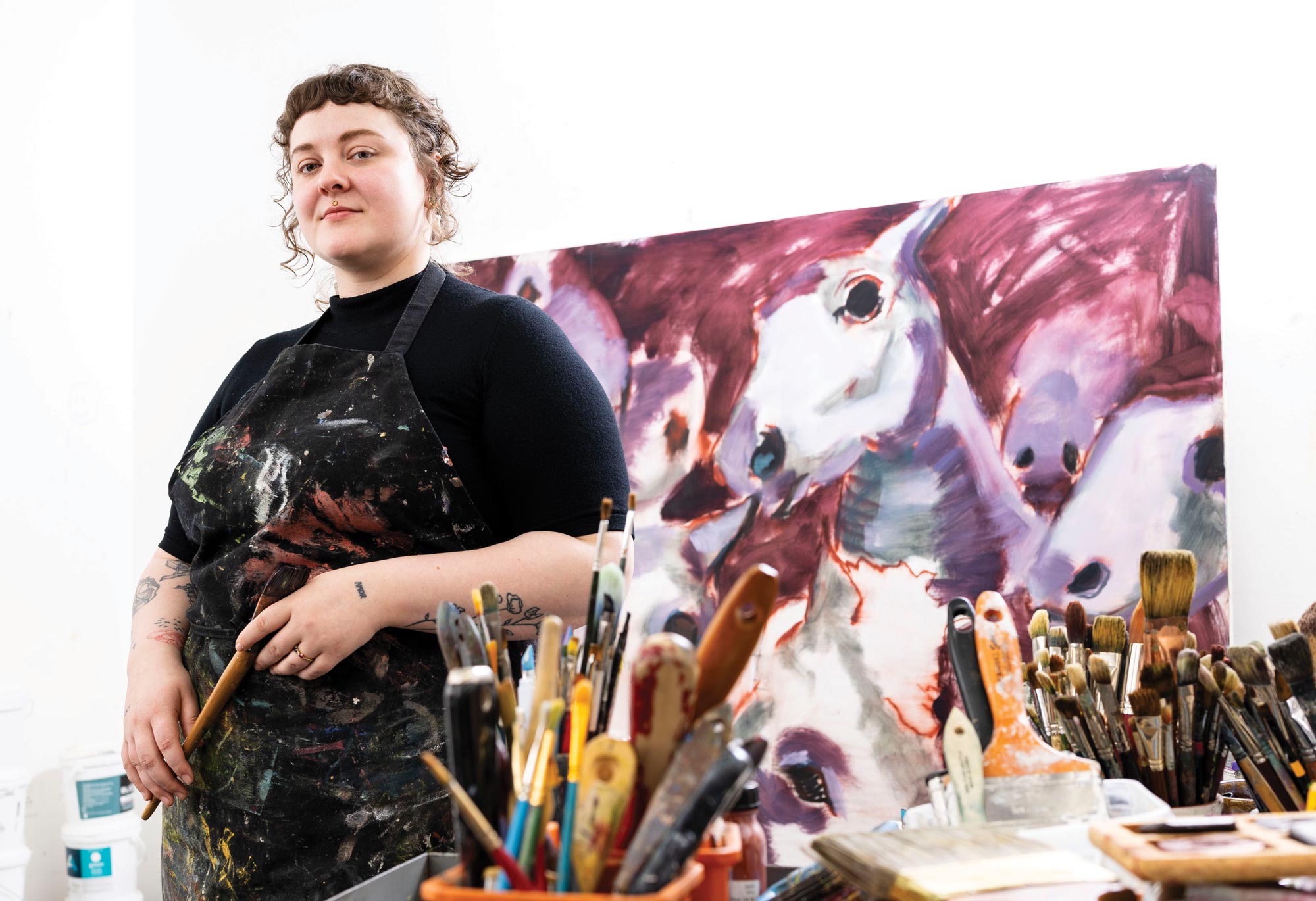
Victoria Mackender, '26, stands near an assortment of paintbrushes, ready to create art that behaves like time—fleeting, blurred, ghostly. Using layers of sheer organza fabric, transparent oil paint, glycerin and wax, the interdisciplinary artist begins crafting without a fully formed vision, exploring themes of grief, existence and disorientation in time.
As a young girl in Kansas City, Missouri, Mackender spent hours staring at the rich details of Caravaggio’s painting “Saint John the Baptist in the Wilderness” at the Nelson-Atkins Museum of Art. She had no idea she’d one day be teaching art or standing on a paint-speckled floor creating her own works of oil on canvas.
Mackender had always dreamed of living in the Pacific Northwest, so after earning her Bachelor of Fine Arts in Missouri, she moved to Seattle for the University of Washington’s rigorous master’s program in painting and printmaking in the School of Art + Art History + Design.
“Having access to incredible facilities and dedicated faculty has shaped the way I work and opened my mind to what’s important to my practice,” says Mackender, who has found community in her graduate-student cohort over the last two years. Philanthropic support, like the Boyer and Elizabeth Bole Gonzales Scholarship and the Endowed Program Support FUNd in Art, expands access to even more opportunities, like making it possible to purchase art supplies and engage in a two-week residency in Singapore, where she learned how to cast hands in glycerin using molds. “Now, more than ever, we need the arts and the people who support them,” Mackender says, “so I’m incredibly grateful.”
“Now, more than ever, we need the arts and the people who support them.”
Victoria Mackender, '26
Mackender’s thesis exhibit opened this spring at the Henry Art Gallery on campus, exploring how humans and animals experience similar and unrelated grief. After graduation, Mackender hopes to teach at the UW and eventually have her own art space where she can provide opportunities to underserved contemporary artists.
Cultivate the arts. Help support future artists and give graduate art students opportunities to develop their art through travel, learn from other artists and expand their practice.