News briefs: A Rhodes Scholar, a new tradition and a mark made in postal history
Catch up on stories that demonstrate the reach of the UW community.
This spring, Viewpoint Magazine and Vice President for Minority Affairs & Diversity Rickey Hall invite you to be in community.
“Being in community is a value we actively choose, one that informs our path forward, especially in times of uncertainty and challenge,” Hall says.
Reflect on the individuals and communities who shape the UW with these stories.
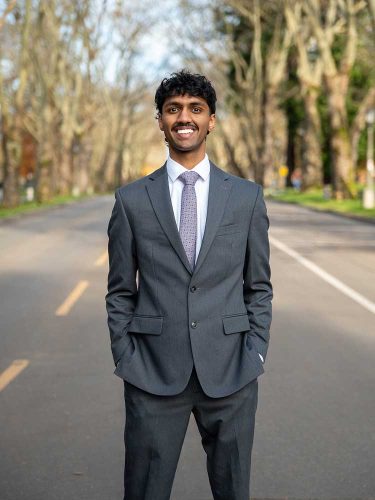
Shubham Bansal, the UW’s most recent Rhodes Scholar, grew up in Mukilteo and entered the UW at age 16. Photo by Jayden Becles.
The Rhodes ahead
Shubham Bansal, ’26, a neuroscience major, is the UW’s 38th Rhodes Scholar and the first since 2012. The world-renowned scholarship funds graduate study at the University of Oxford and includes programs in leadership, service and character development.
Bansal, who grew up in Mukilteo, started college at 16 through the UW’s Robinson Center for Young Scholars. He says the honor “feels like a vote of confidence in the work that I have been doing in my community.”
Bansal’s research spans neuroscience and anthropology, from analyzing T-cell responses in autoimmune disease at the Linsley Lab to studying neurodevelopmental disorders at Seattle Children’s Research Institute. Combining lab work with community-based projects, he founded Narcare, a national nonprofit that provides lifesaving naloxone, trains responders and advocates for overdose prevention policies.
Starting at Oxford this fall, Bansal plans to pursue physician training in addiction medicine while designing programs to expand access to evidence-based care. He says the scholarship is “one small way to reflect back the mentorship and trust UW has shown me.”
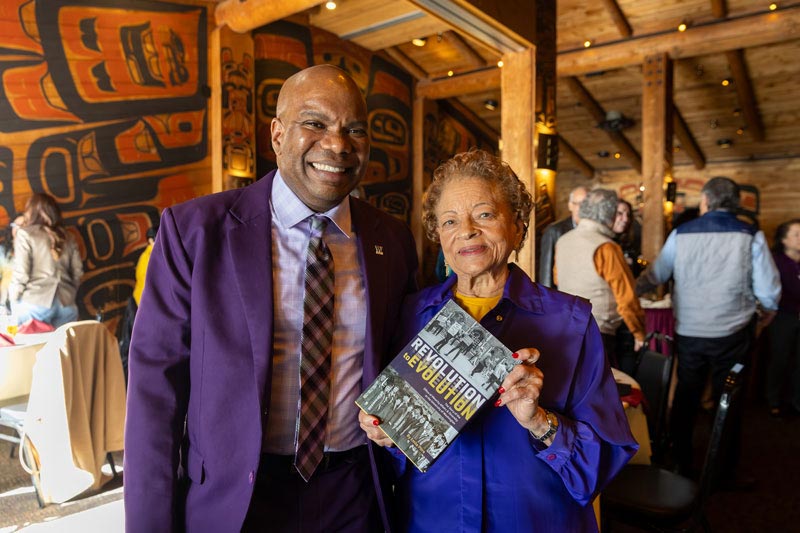
The Office of Minority Affairs & Diversity, in partnership with the Friends of the Educational Opportunity Program Board of Trustees, hosted a new luncheon honoring recipients of the Charles E. Odegaard Award. Here, Rickey Hall stands with Vivian Lee, who holds a copy of “Revolution to Evolution” by Emile Pitre; Lee and Pitre sparked the idea for this event. Photo by Raymond Smith.
Legacy lunch
Past and present Charles E. Odegaard Award honorees joined campus and community leaders and partners in February for conversation and celebration at the inaugural Odegaard Legacy Luncheon, hosted by the Office of Minority Affairs & Diversity at Ivar’s Salmon House. The dining room buzzed as guests reconnected, shared stories and honored a legacy of advancing equity at the University of Washington. They were also among the first to learn that this year’s Odegaard honoree is President Emerita Ana Mari Cauce, the UW’s 33rd president. She will be formally honored at the OMA&D Annual Celebration Gala on May 20.
Organizers hope to make the luncheon an annual tradition. “This is your space, our space—a community of wisdom, courage and legacy,” said Rickey Hall, vice president for minority affairs and diversity.
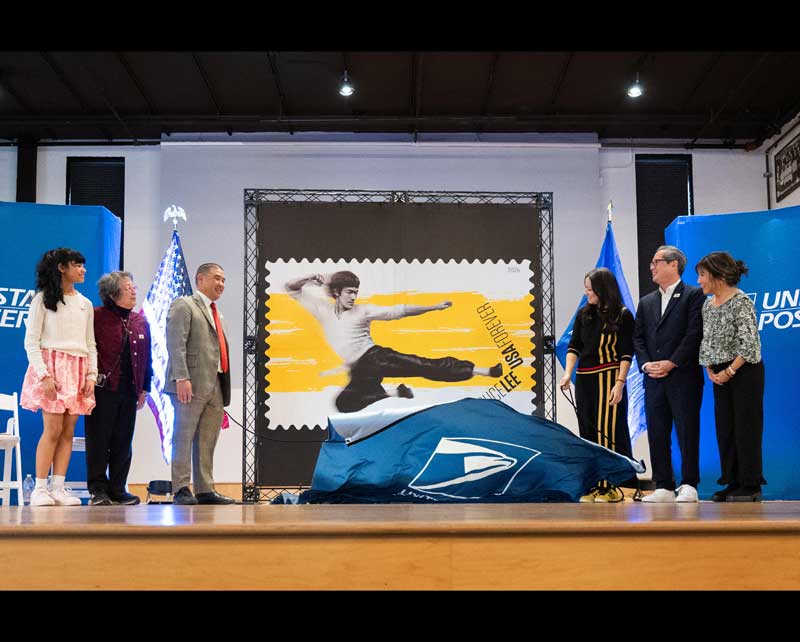
Bruce Lee’s Forever stamp was unveiled in February at Seattle’s Nippon Kan Theatre. From left are Genelia Lai, Sue Ann Kay (a friend and former student), Ben Kuo of the USPS, Lee’s daughter Shannon Lee, writer Jeff Chang and journalist Mimi Gan. Photo by Daniel Afzal, courtesy of USPS.
Bruce Lee forever
This winter, the U.S. Postal Service honored former University of Washington student Bruce Lee with a Forever stamp. More than 150 people gathered in February at the Nippon Kan Theatre in Seattle to celebrate the unveiling. The painting on the stamp captures Lee mid-flying kick, a fitting tribute to his enduring legacy as a groundbreaking Asian American actor, philosopher and martial artist.
Lee, who was born in San Francisco and raised in Hong Kong, enrolled at the UW in 1961 to study drama and philosophy. Around that time, he opened his first kung fu school, the Jun Fan Gung Fu Institute, where he taught a racially diverse group of students in both the University District and the Chinatown-International District. His future wife, Linda Emery, was also a UW student.
A pioneer in education and martial arts, Lee challenged convention and expanded cultural representation on and off the screen. Though he died in 1973 at age 32, his influence continues to resonate, and memories of his UW years remain deeply significant.
At the ceremony, his daughter, Shannon Lee, reflected on the honor. “He was a connector of people,” she said. “He brought cultures together.”