Calling the shots
Elise Woodward, the first woman to do play-by-play for the Huskies, has been a sports broadcaster for more than 30 years.
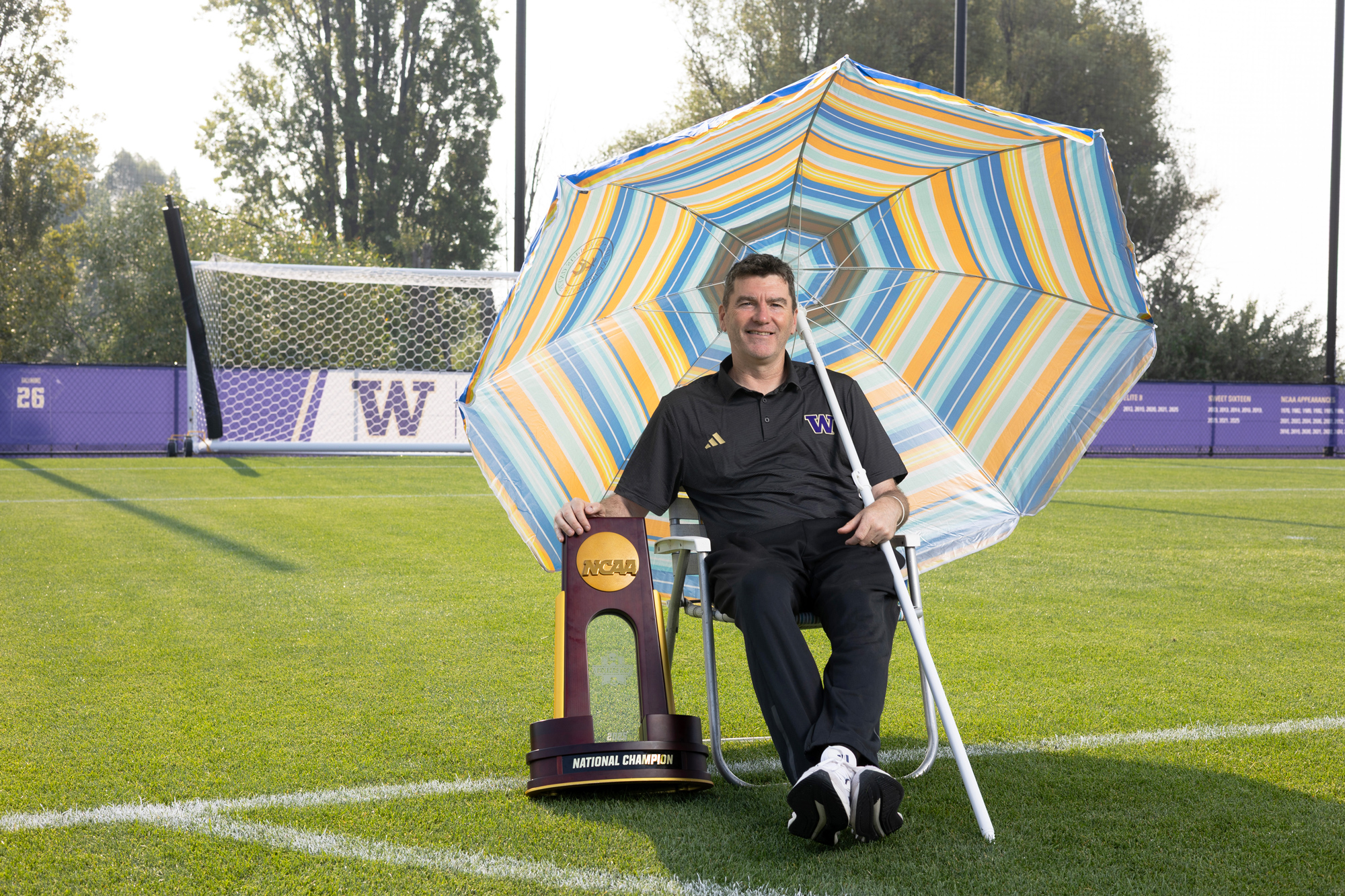
UW men’s soccer coach Jamie Clark wants his team to have fun. And there’s nothing more fun than winning it all.
If you ain’t first, you’re last. The NASCAR legend in “Talladega Nights: the Ballad of Ricky Bobby” might have believed that, but Jamie Clark doesn’t.
Three times—once as a player, twice as a coach—Clark had made it to the NCAA men’s soccer national championship game and lost. He was disappointed, sure, but he still felt those three losses were the best experiences of his life. “I just want to play to the last day, and whatever happens, happens,” says Clark, the head coach of the University of Washington’s men’s soccer team since 2011.
Clark was an All-American defender at Stanford, playing for his father, Bobby, when the Cardinal lost in the NCAA championship game to Indiana in 1998. He was an assistant coach at the University of New Mexico when the Lobos lost to Maryland in the 2005 final. He was head coach at the University of Washington when the Huskies lost, 2-0, in the 2021 national championship final to Clemson. “I’m not really a huge championship or results guy,” insists Clark. “I just love the experience of being with the guys. Honestly, that’s what I enjoy.”
To a person, everyone you talk to about Jamie Clark will vouch for this statement. He cares at least as much about his players’ holistic satisfaction with their lives than he does about the score of yesterday’s game. His dad, a legendary player and coach in Scotland and the U.S., was the same way. If the wins came, the wins came. If they didn’t, there was more important work to do and more fun to be had.
But then, when everyone—including Clark—least expected it, the Huskies won it all. And that’s when he realized what he’d been missing.
The line between a nightmare and a sweet dream was razor thin, really. Clark’s Huskies were expected to make the NCAA tournament in 2025, but they came out of the box flailing and never really found a groove although they went 11-6-2 in the regular season and finished second in the Big Ten with a 7-3-0 record. Still, the Huskies’ topsy-turvy season included enough hot spells to prove that the team could play with anyone on their best day, but a three-game losing streak to close out the regular season put them squarely on the tourney bubble.
Had enough underdogs weaseled their way through their conference tourneys, the Huskies would have been on the outside looking in. But the teams that were supposed to win won. Clark had a feeling the Huskies were fine, but he didn’t express this emotion to his charges.
“It became pretty clear halfway through the week when NCAA tournament selections were being made that we were going to probably be pretty safe,” he says. “But we never really said anything and we just left guys out there, you know, kind of sweating it. We thankfully stopped sweating it in the office a little bit more because we knew we were probably in.”
Making the playoffs by the slimmest of margins meant the Huskies had to hit the road for all of their playoff games. First came a 3-2 win at Oregon State in double overtime, then a 1-0 victory in Dallas against No. 5 Southern Methodist. Then came Stanford, Clark’s alma mater, with the Huskies prevailing, 1-0.
“Oregon State was probably the very best team that wasn’t seeded, so we had to deal with them,” says Clark. “SMU just won the ACC, which people argue is the best soccer conference in the country. Then we go to Stanford, who I think has been our historic rival and is the hardest out in the NCAA tournament every year.”
Next, playing for a Final Four berth, the Huskies traveled 2,322 miles across the country to College Park to take on the University of Maryland, a team they had lost to 1-0 on Halloween night. The rematch would prove both trick and treat, as the Huskies prevailed, 3-1, to advance to the national semifinals in Cary, North Carolina.
After four road wins, the Huskies would finally be playing on neutral turf—but not really. In the semis, they faced No. 16 Furman, a school located in nearby South Carolina. Despite a loyal alumni contingent that traveled to the East Coast to cheer on the purple and gold, the University of Washington crowd was massively outnumbered. But it didn’t matter: The Huskies won, 3-1, to earn a berth in the final.
On the other side of the bracket, the 15th-ranked North Carolina State Wolfpack advanced to the College Cup final. The Raleigh school had not won a men’s sports championship of any kind since Jim Valvano guided the men’s hoopsters to the ultimate Cinderella run in 1983 to win the national championship.
The shoes were on the Huskies’ feet now. Cary is just 4 miles from Raleigh. From the opening kickoff, the Huskies were subjected to a veritable snake pit of hunger and hubris, the smug Wolfpack gaping and gasping with every red-and-white touch.
Toward the end of the first half, the Huskies shut the crowd up, scoring off a deflection of a long clear to take a 1-0 lead heading into the break. The lead would swell to 2-0 midway through the second half, but then the Pack came back, leveling the score at 2-2 by the end of regulation on a pair of spectacular goals that ace Husky goalkeeper Jadon Bowton, who was on the 2021 team that lost in the final, had little chance of stopping.
It was on to sudden-death overtime, the Huskies’ season on the brink.
“I get to see my best friends every day.”
This is how Bowton responded when asked by a reporter what the best thing about the 2025 Husky men’s soccer season was. He didn’t say that the best part was winning the program’s first national title, when defender Harrison Bertos scored the decisive goal a couple of minutes into sudden-death overtime.
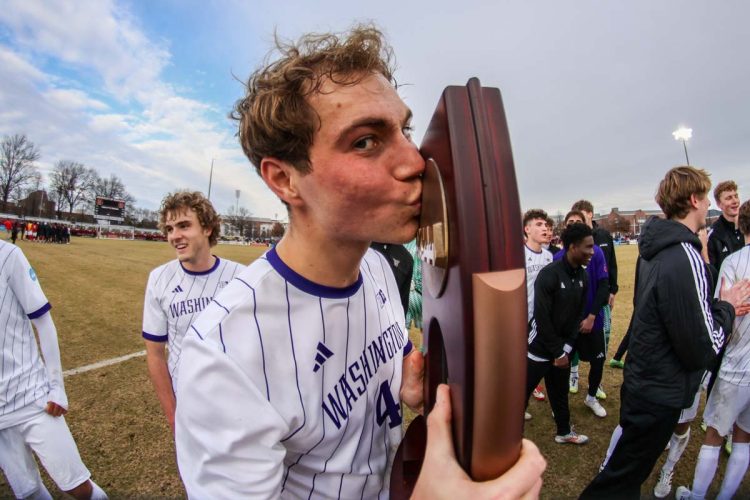
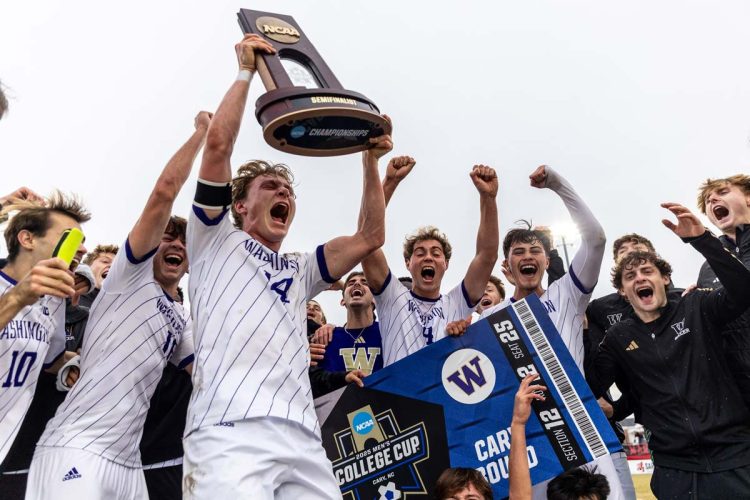
The same reporter had to tell a dumbfounded Clark who actually scored the winning goal. When he found out, Clark said, “We live by the Bertos, we die by the Bertos.”
Bertos, like Clark and dozens of his current and former Husky players, will soon play in Major League Soccer. He was selected by San Diego FC following the 2024 season but will return for his senior season at the UW this fall, with the pro club still holding his professional rights.
After Clark realized Bertos had scored the clinching goal, Bertos said of his coach, “He just told me how proud he was of me, kind of reflecting on what a great year it was, how much I’d grown as a player. He was just so happy for Washington in general.”
Bertos explains what makes Clark a unique mentor. “Something that Jamie is so good at is really connecting with his players in different ways off the field. When you’re a young player, you might not like Jamie, because he’s hard on you, but you learn how he likes to coach and you find ways to mature and find ways to grow. It was like, OK, if I want to be a pro, I need to listen, and Jamie has been through it all.”
“It almost feels like he doesn’t care as much about soccer. He’s more concerned whether you’re enjoying your time there,” says fellow defender Egor Akulov, a homegrown talent whose mom worked in bioengineering at the UW. “We got off to a slow start last year and he just kept scheduling fun activities and, before you knew it, things came together.”
“I can confidently say that he made everybody on the team have a good time, regardless if you’re playing or not playing,” adds Kalani Kossa-Rienzi, a former Husky midfielder who now plays for the Seattle Sounders alongside fellow UW alum and U.S. World Cup team member Cristian Roldan. “I have a really specific memory of my junior year. We went to Florida for a game and were gone for like four days. After the game, he pulled all the strings he could pull to let us go to an amusement park as a team. We were all having a blast. He would be on the rides with us, laughing and joking around. Coaches don’t do that.”
In 2010, in his first and only year as the head coach at Creighton University, Clark guided the Blue Jays to a 13-5-2 record and the second round of the 2010 NCAA tournament. For the following season, he accepted the head coaching position at the UW.
After leading the Huskies to a 12-4-2 record in 2011, the top job at Clark’s alma mater, Stanford, came open and he was a candidate. When he was pondering whether to leave Creighton for the UW after a lone season in Omaha, Clark asked his dad if he could really leave.
“He was like, if you leave, you can’t leave again,” recalls Clark of Bobby’s advice.
Stanford was a dream job. Still, Clark heeded his father’s advice and stayed put. Suffice it to say, he has no regrets. “I couldn’t be happier. This place is home,” says Clark. “Winning a title and not is like night and day. The celebration, the care, the pride, the joy of everyone from actually winning a title vs. being really close to winning a title is just on a different level.”
Hey, when you know, you know.