Better breathing indoors
An expert on pollutants and professor of atmospheric sciences, Dan Jaffe weighs in on lüften, the German practice of removing stale air from the home.
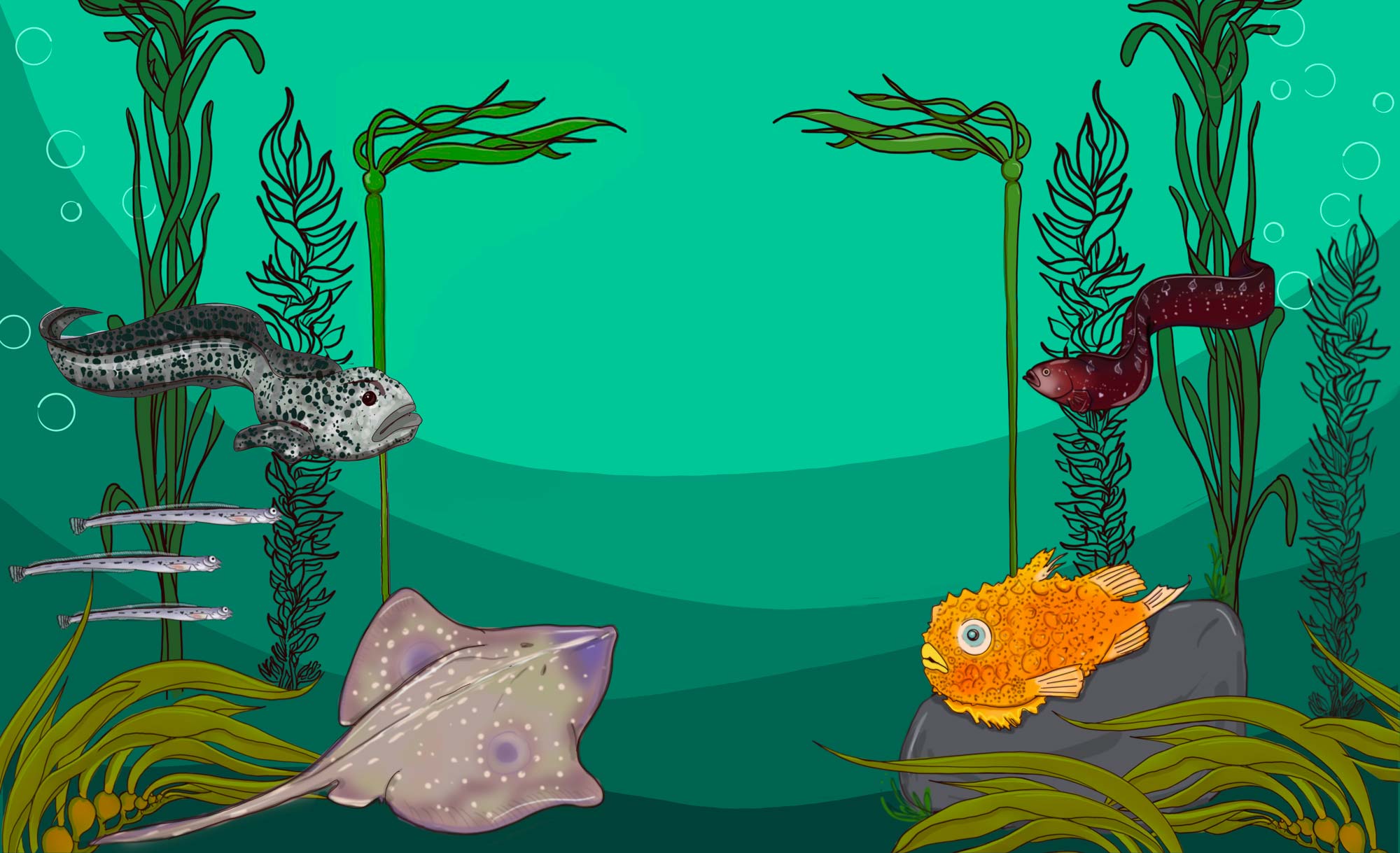
At the UW's Friday Harbor Labs, scientists learn great lessons from armored and obscure life under the sea.
As a graduate biology student during the COVID-19 pandemic, Karly Cohen, ’22, aimed a simple UV light into the fish tanks of a darkened lab at the UW’s Friday Harbor Laboratories and discovered a dazzling, shimmering new world. The fins of the long and rigid-looking, bottom-dwelling poacher fish glowed pink with diatom algae. Then she pointed her light at a tank of spherical lumpsuckers, a species that she had studied, and a single fish flashed and pulsed in shocking fuchsia red, taking her by surprise.
Cohen, who is now a postdoctoral researcher and lecturer at Friday Harbor, spent many hours studying the Pacific spiny lumpsucker and thought she knew it well. But when she removed the fish from its tank to photograph it, she noticed that it wasn’t just glowing red. Its pelvic fins, which have evolved into the shape of a ventral adhesive disc on the creature’s belly, lit up in a brilliant green.
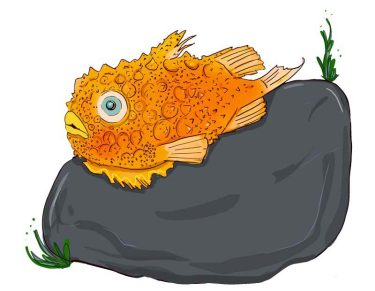
Pacific Spiny Lumpsucker
Until then, no one knew of the fish’s secret superpower, which is significant to its protective camouflage, and also functions as a means to mate identification and underwater communication. Cohen and UW Biology and Aquatic Fishery Professor Adam Summers published their findings, alerting the world. And then the discovery led her and former colleagues Jonathan Huie, ’19, and former researcher Emily Carr to find and document biofluorescence in 47 additional ray-finned fishes.
The biofluorescent lumpsucker is one of many charismatic microfauna studied by UW scientists. From glowing skin and adhesive suction discs to impact-resistant armor, these marine creatures offer a host of strange evolutionary mysteries hiding beneath the waters of the Salish Sea. By studying those adaptions, researchers are not only uncovering evolutionary history, but they’re finding inspiration for new technologies, from medical devices to underwater drones.
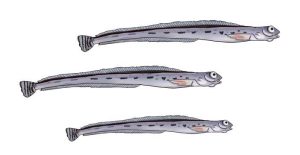
Prickleback
Cohen’s initial research into the spiny lumpsucker explored how it evolved its tough armor, which keeps it from being battered by the sea. The suctioning disc on its belly allows the golf-ball sized fish to stick to rough surfaces, anchoring to rocks to conserve energy in strong tidal currents. These biological features make it a great model for looking at comparative biomechanics—a field that marries biology and physics to look at how organisms evolve on their own messy and illogical trajectories.
Looking at armored fish, for example, helped scientists think more deeply about how armor works to protect marine organisms from being bashed around in the intertidal. “Lumpsucker armor and the armor on poachers is a great model for trying to make devices that protect people penetrating hazardous environments where they may end up encountering falling debris,” says Summers, a professor at the Friday Harbor Laboratories whose research focuses on comparative biomechanics. “If you’re going to burrow through some wreckage, it’s nice to not have all your bits scraped off.”
“Living things have evolved to solve complex problems. As humans try to explore new areas, it's useful for us to look to nature for inspiration.”
Cassandra Donatelli, professor and comparative biomechanist, UW Tacoma
By approaching biological questions with a framework of physics and mechanical engineering, scientists can translate biological survival mechanisms into groundbreaking technology. Studying the suction discs of lumpsuckers and Pacific clingfish led a research team at Friday Harbor to create and patent a suction cup that provides stronger hydrodynamic adhesion than previous man-made suction cups. “Nature has figured things out over millions of years, so it is good at solving problems!” says Cassandra Donatelli, a professor and comparative biomechanist at UW Tacoma who has spent many summers doing research at Friday Harbor. “Living things have evolved to solve complex problems in the oceans, up in the trees, underground and everywhere in between. As humans try to explore new areas, it’s useful for us to look to nature for inspiration on how to exist and move through these environments.”
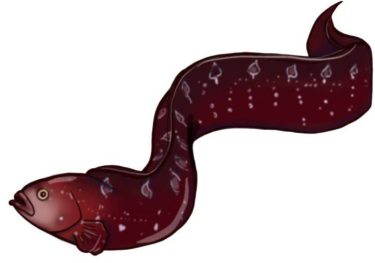
Gunnell
Donatelli studies armored fishes and locomotion in elongate fishes like American eels, morays, gunnels and pricklebacks, which have fin spines that stick out through their skin. Her lab has researched developing medical devices and braces around joint injury based on its study of the bony plates on armored fish. Her work on the efficient, streamlined body forms of elongate fishes may inform the design of the more efficient marine devices, like buoys and drones.
“The American eel can swim months without eating and doesn’t lose weight,” Donatelli says. “I studied the behavior and skins of gunnels and pricklebacks, which are similar elongate fishes, to take those fish apart and reconstruct them into model forms to use as an inspiration for refining ocean-monitoring devices.” Drones are used to monitor temperature, currents and salinity in the sea, but the battery life of these monitors dies after a few hours. Donatelli’s research improves upon these designs so that the devices use wave energy and don’t need to return to shore as often to recharge. She’s also testing out a few designs based on armored fishes to make more efficiently shaped buoys.
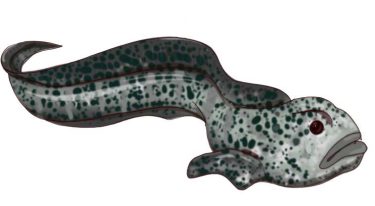
Wolf eel
Every fish that Summers’ research team studies at Friday Harbor offers opportunities to better understand mechanics, materials and structure that can be applied to bio-inspired design. For instance, flatfish and skates burrow into the ground. “For engineers, burrowing into the ground requires high-force penetrators,” Summers says. But neither fish uses this approach. They wiggle their bodies so that the solid ground of the seabed rises over them. Based on this observation, Summers’ team built robots which resemble skates and flatfish that mimic burrowing.
Researchers like Cohen, Summers and Donatelli are keen to bring the details of their discoveries to the public. Working with colleagues in Germany led by Andrew Schulz, a postdoctoral fellow and researcher in the Haptic Intelligence Department at the Max Planck Institute for Intelligent Systems, Cohen has created an open-source platform that produces 3-D-printed tactile models from 2-D microscopy images. Users can touch the difference between cells and understand how hard and soft tissues interact to better understand how sharp something can feel. “It’s been wildly useful across colleagues’ classrooms and we’re thinking about how to expand the tool for teaching,” Cohen says. “What do these shapes mean in the ocean? And in the intertidal vs. in a deep-sea environment? It’s these kinds of tools that let scientists and everyone engage with the natural world.”
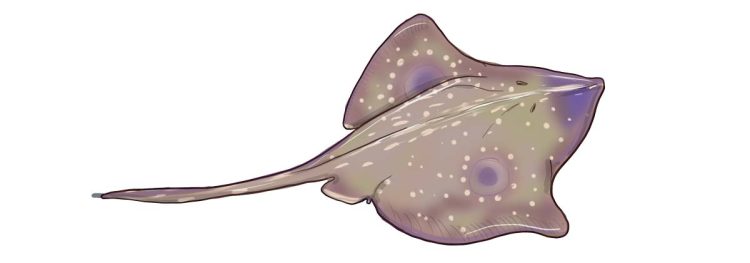
Skate
Summers insists that natural history, as a study of organisms in their natural environment, is the basis for discovery and innovation. “Your prep work is to go out and watch things live,” he says. “That’s where you’ll find the motivations for the questions that will lead to your papers. The engine for discovery isn’t in books or libraries. It’s wandering out into the woods, or intertidal and deep sea.”
In the years since Cohen first pointed a UV light into those tanks, scientists have identified dozens of glowing fish species. Yet the brilliant green suction disc that first caught her eye raises new questions—like how that hidden glow appears in the filtered light deep beneath the waves and how fish use it for communication and camouflage. For the researchers at Friday Harbor, the fresh questions are part of the appeal. Every strange fish hauled from the Salish Sea—whether armored, adhesive or fluorescent—offers a reminder that evolution may offer more surprises than answers.