Brunkow's brilliance
Mary Brunkow, ’83, helped uncover the gene that keeps the immune system in check.
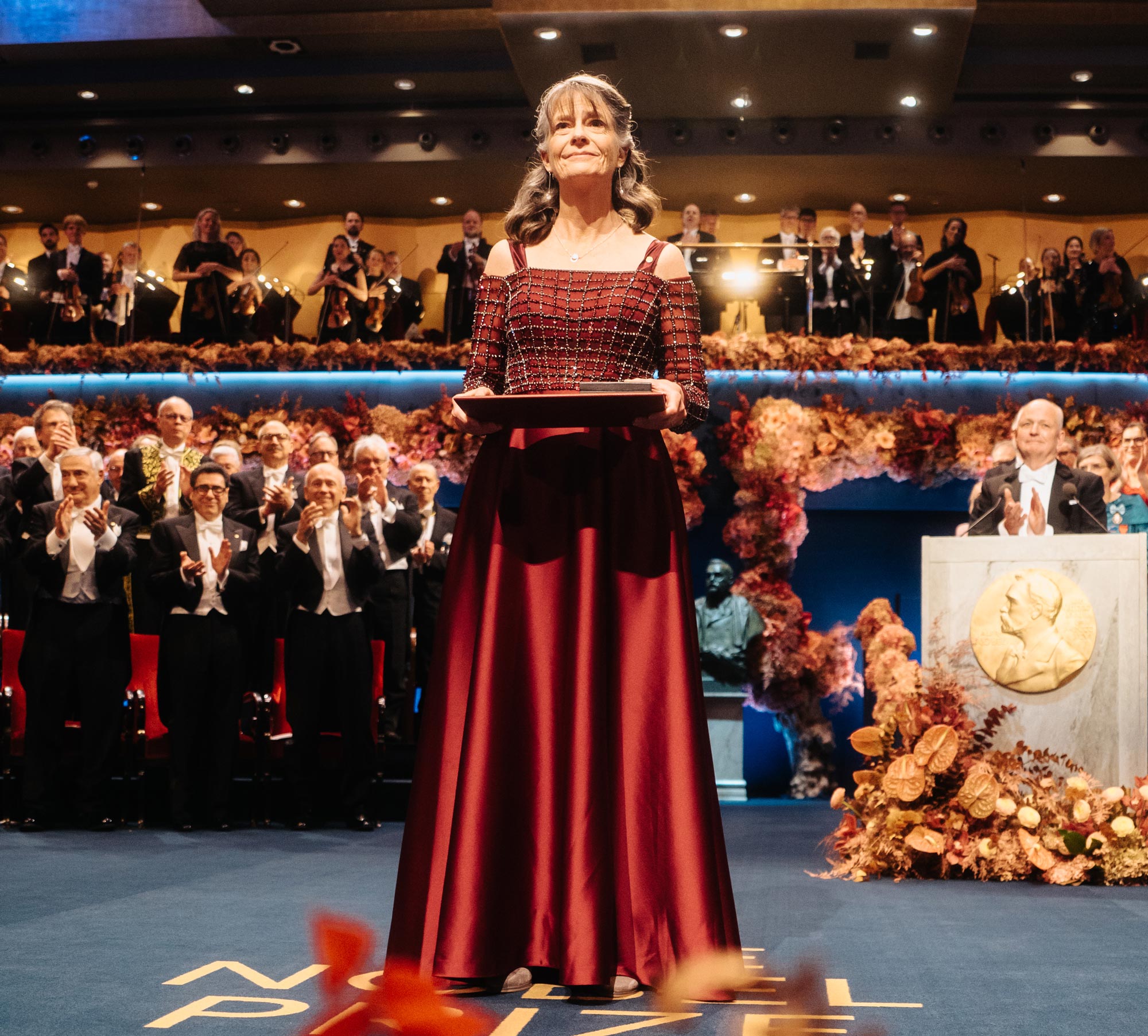
Mary Brunkow's unconventional journey from UW student to Nobel laureate was shaped by a love of discovery.
Walking across the University of Washington campus one day, Mary Brunkow, ’83, spotted her genetics professor sitting on a bench in the sun and decided, somewhat against her nature, to stop and chat.
A pre-med student from Portland, Brunkow loved the energy and anonymity of the sprawling university. The professor was Larry Sandler, whose genetics course had become the unexpected highlight of her schedule.
She had been captivated by his ability to animate a difficult subject. He wove complex science together with colorful stories about the people behind the discoveries. Brunkow was on the edge of her seat listening to the “big guy from Brooklyn,” whose gold rings clanked as he brought his hands together to punctuate his points. “It was a tough subject,” she recalls. “My classmates’ scores were low, but I was nailing it for some reason—and he knew that.”
Determined to follow in her grandfather’s footsteps and become a doctor, she pushed past her natural introversion and approached Sandler. Did he know of any labs where she might work and strengthen her medical school applications?
“Right away, he said, ‘Come work in my lab,’” she says. “I couldn’t believe it. I would never have been bold enough to ask.”
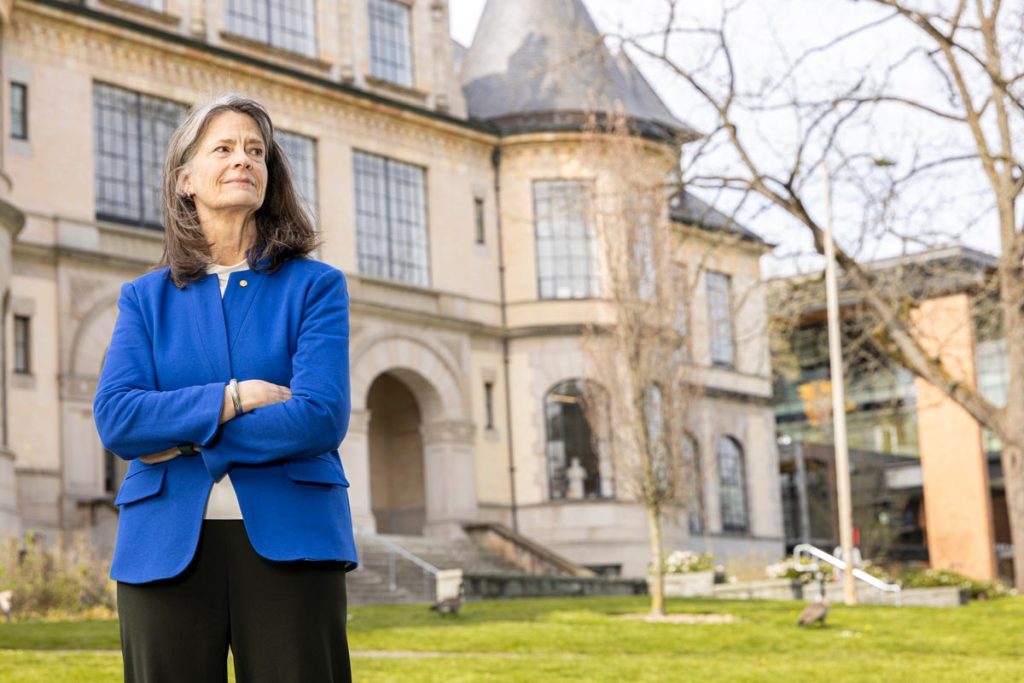
Mary Brunkow is the 2026 recipient of the Alumna Summa Laude Dignata Award (ASLD), the highest honor bestowed upon a University of Washington graduate, presented annually by the UW and UW Alumni Association. It recognizes a legacy of achievement and service built over a lifetime. Photo by Mark Stone.
She hadn’t planned on a future in genetics. But once she joined Sandler’s lab—assisting a graduate student studying fruit flies, learning to anesthetize them, examine their wings and track genetic crosses—her ambitions shifted. Plans for medical school faded away.
“It was just magical,” she says of the Sandler lab. The door often stayed closed to keep fruit flies from invading a neighboring yeast lab. Inside, a small, lively group of graduate students, visiting scientists and a technician worked under the professor’s generous, boisterous leadership. “I couldn’t have been happier.”
More than four decades later, a lobby television at the Institute for Systems Biology in Seattle’s South Lake Union neighborhood plays footage from Stockholm. Onscreen, Brunkow in a shimmering dress stands amid a sea of tuxedos, waiting to accept her Nobel Prize.
Brunkow still struggles to process it. She first learned the news on a dark October morning, when a photographer knocked on her door. A call with the Nobel Foundation followed a few minutes later, and then several months of phone calls and press interviews. She struggled to find her new normal as she prepared to travel to Sweden in December with her co-winners in Physiology or Medicine, Fred Ramsdell and Shimon Sakaguchi, to be recognized for their groundbreaking discoveries identifying regulatory T cells, which prevent the body’s immune system from attacking its own tissues.
It was profound, but not the capstone of her career, she realized. It was the beginning of a new chapter.
Mary Brunkow grew up the middle child in a happy Portland household, attending Catholic school and excelling in math and science. But by her senior year of high school, she says, “I was crawling the walls. I was ready to get out into the world.”
She arrived at the University of Washington at a moment of scientific expansion and early biotech momentum. In a packed lecture class in Kane Hall, she watched as her teacher, biochemist Benjamin Hall, walked in one day to a standing ovation. News had just broken about his work with transgenic yeast, research that would eventually lead to important vaccines and ultimately generate millions in research support for the University.
“It was a very exciting time,” Brunkow says. “Biotechnology was just coming onto the scene. And at the UW, especially, there was a sense that something big was happening.”
Nurturing her skills as a scientist as well as her ambitions, Sandler encouraged her plans to pursue graduate school, steering her toward programs strong in fruit fly genetics. She landed at Princeton—but once there, her interests evolved.
A lecture by molecular biologist Shirley Tilghman changed her course. “I was blown away,” Brunkow says. “She was so dynamic and enthusiastic.” Tilghman’s work on gene expression—then at the frontier of molecular biology—drew Brunkow in. Just as important, Tilghman was a powerful example of something still rare at the time: a senior woman scientist leading a major research program.
As one of the first graduate students in Tilghman’s Princeton lab, Brunkow immersed herself in molecular biology. The work was rigorous, the expectations high and the environment unusually collaborative, with a notable number of women—whom she describes as patient and kind but also brilliant—among its ranks. There, she learned not only techniques like tissue culture and using transgenic mouse models, but also how to think like a scientist, how to design experiments, navigate setbacks and persist.
Tilghman recently described Brunkow as courageous for taking on a risky project: the study of a newly identified gene called H19. It might have led nowhere. Instead, it became the first identified example of a non-coding RNA gene, helping open a new frontier in biology.
The experience sparked in Brunkow a lasting fascination with mouse genetics. And it gave her the highly technical skills needed to alter a genome and watch biology respond in real time. Her postdoctoral work at a research institute in Toronto deepened that expertise, particularly in manipulating large segments of DNA and working with mouse mutants as new technologies rapidly expanded what researchers could do.
But after four years, she needed a change. As she sat in seminar after seminar on developmental biology, her impatience grew. The science was elegant, but “I had to find a way to turn my research into something closer to application in the real world.”
By the early 1990s, Seattle, like Boston and the Bay Area, had emerged as a growing hub for biotechnology. Research at the UW and the Fred Hutchinson Cancer Research Center anchored a vibrant scientific community.
Brunkow wanted to return to the Northwest. She found her opportunity at Darwin Molecular, a biotech startup focused on using genomics, sequencing and bioinformatics to develop new therapies for cancer, AIDS and autoimmune disease.
She joined in December 1994 as one of roughly 30 employees, arriving as the company’s labs were just coming online in a quiet office park in Bothell. Each morning, she drove her Subaru Impreza to work with a packed lunch, heading into long, intense days that she remembers as both demanding and exhilarating.
Inside the unassuming buildings, teams worked at the cutting edge of genomics and immunology. Collaboration was key. Brunkow led a molecular biology group that worked closely with immunologist Fred Ramsdell and his team.
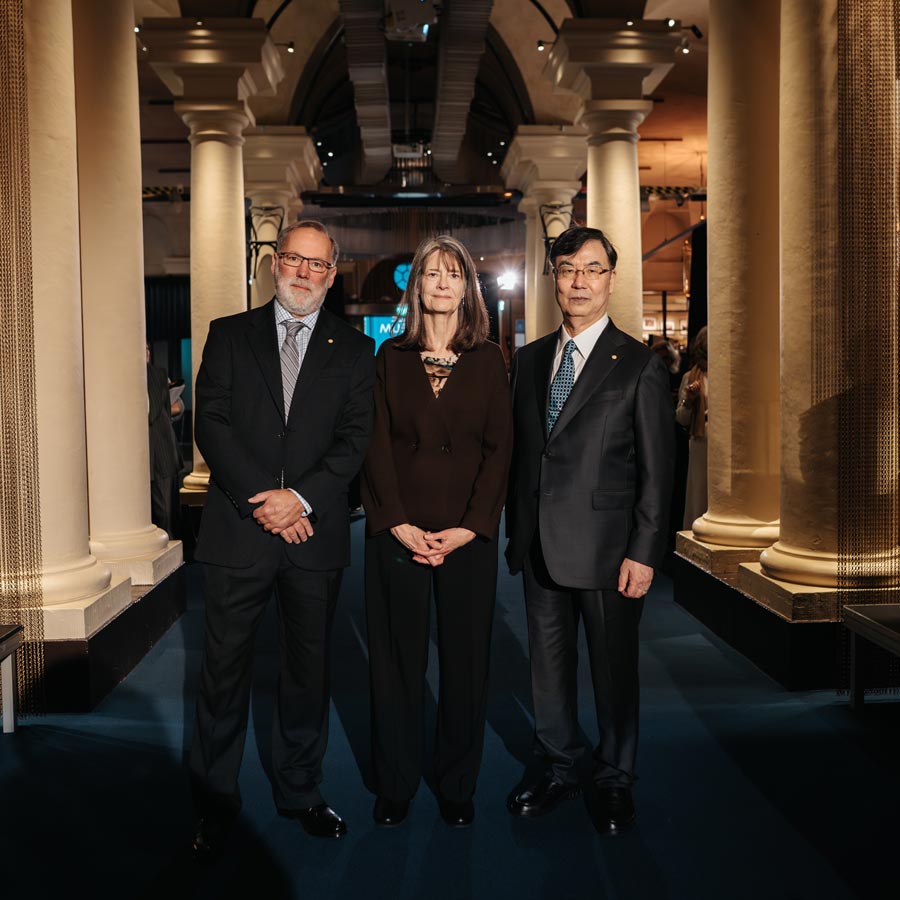
Mary Brunkow, ’83, shares the Nobel Prize in Physiology or Medicine with former colleague Fred Ramsdell and Shimon Sakaguchi, a Japanese immunologist. Their discovery of regulatory T cells and the FOXP3 gene revolutionized our understanding of the body’s autoimmune response. Photo courtesy Clement Morin, Nobel Prize Outreach.
At one point, her group took delivery of a shipment of “scurfy” mice from Oak Ridge National Laboratory in Tennessee—animals carrying a mysterious mutation that caused severe immune dysfunction: scaly skin, swollen lymph nodes and a shortened lifespan.
Maintaining a mouse colony with those conditions was no small task. Initially, Brunkow housed the animals in a converted janitor’s closet—tight quarters, but enough space for a small rack system and a sink. As the research evolved, the team expanded to a larger space across the parking lot.
By 1998, Brunkow and Ramsdell’s teams were zeroing in on the gene responsible for the scurfy phenotype, which they named FOXP3. Brunkow’s group handled the molecular biology—cloning and identifying the gene—while Ramsdell’s team focused on immunological function. Their work was informed by global research, including that of Japanese scientist Shimon Sakaguchi, who had recently identified regulatory T cells, which maintain stability in the immune system.
Together, the findings revealed a fundamental mechanism: how the immune system restrains itself from attacking the body it is meant to protect. It opened an entirely new field of immunology. “It was a eureka moment,” Brunkow says.
“We knew it was exciting, but we couldn't have imagined what it would become.”
Mary Brunkow, '83
Their work became foundational, eventually cited by hundreds of labs studying regulatory T cells. Their discovery has improved treatments for cancer and autoimmune diseases like lupus and type 1 diabetes. “We knew it was exciting,” she says. “But we couldn’t have imagined what it would become.”
Darwin Molecular eventually closed in 2004, as many early biotech startups did. Brunkow moved on to new roles and to raising a family, including twin daughters born a few years later. For the past 16 years, she has worked at the Institute for Systems Biology, where she is currently a researcher and program manager in a lab focused on the immune system. With her daughters off to college, she was finding more time for baking, gardening, traveling and spending time with her husband, Ross, and dog, Zelda.
Now, Brunkow finds herself in fresh territory. She is no longer just a scientist or a project manager or a mom. She’s a public figure. “I’m still trying to figure out what to do with this platform,” she says.
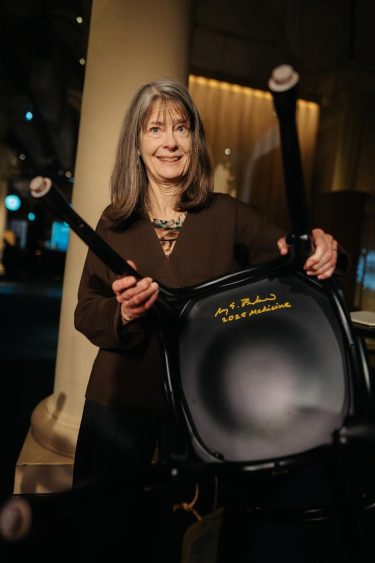
Mary Brunkow holds up the chair she signed during Nobel Week 2025. Noble laureates traditionally sign chairs at the restaurant of Stockholm’s Nobel Prize Museum. Courtesy Clement Morin, Nobel Prize Outreach.
“I want to use my voice in a way that does some good,” she says. “To share something useful. To open pathways into science.” She has been speaking about the importance of basic science and the foundational work that makes breakthroughs possible. She talks about funding, collaboration and the long pathway from obscure questions to lifesaving therapies.
And she talks about women in science. “I owe a huge amount to the women who came before me—the Shirley Tilghmans of the world,” she says. “I never felt discrimination. But you don’t often see women at the very top.”
From a conference room at the Institute for Systems Biology, she looks out over South Lake Union, a neighborhood that in the past three decades has transformed from rail yards and warehouses into a vibrant hub of research and technology.
Likewise, the Nobel Prize has shifted the frame of her career. In Stockholm, standing among laureates, Brunkow was struck by how different her path had been. She and her collaborators were not traditional academics and principal investigators, but private-sector scientists working across roles and disciplines, contributing pieces to a larger puzzle.
Looking back, Brunkow points to timing as much as anything else: the maturation of the field, the tools made possible by the Human Genome Project and the network of people working toward similar questions. “Reconstructing it,” she says, “you can see how many things had to line up.” An unexpected path, a sunny bench outside a lecture hall, a janitor’s closet filled with mice—all leading her to the stage in Stockholm.
She pauses. “And how unlikely it is that you’d predict it from the start.”