Returning to Tule Lake
Author Tamiko Nimura traveled into the past to recover her family’s history and her father’s childhood.
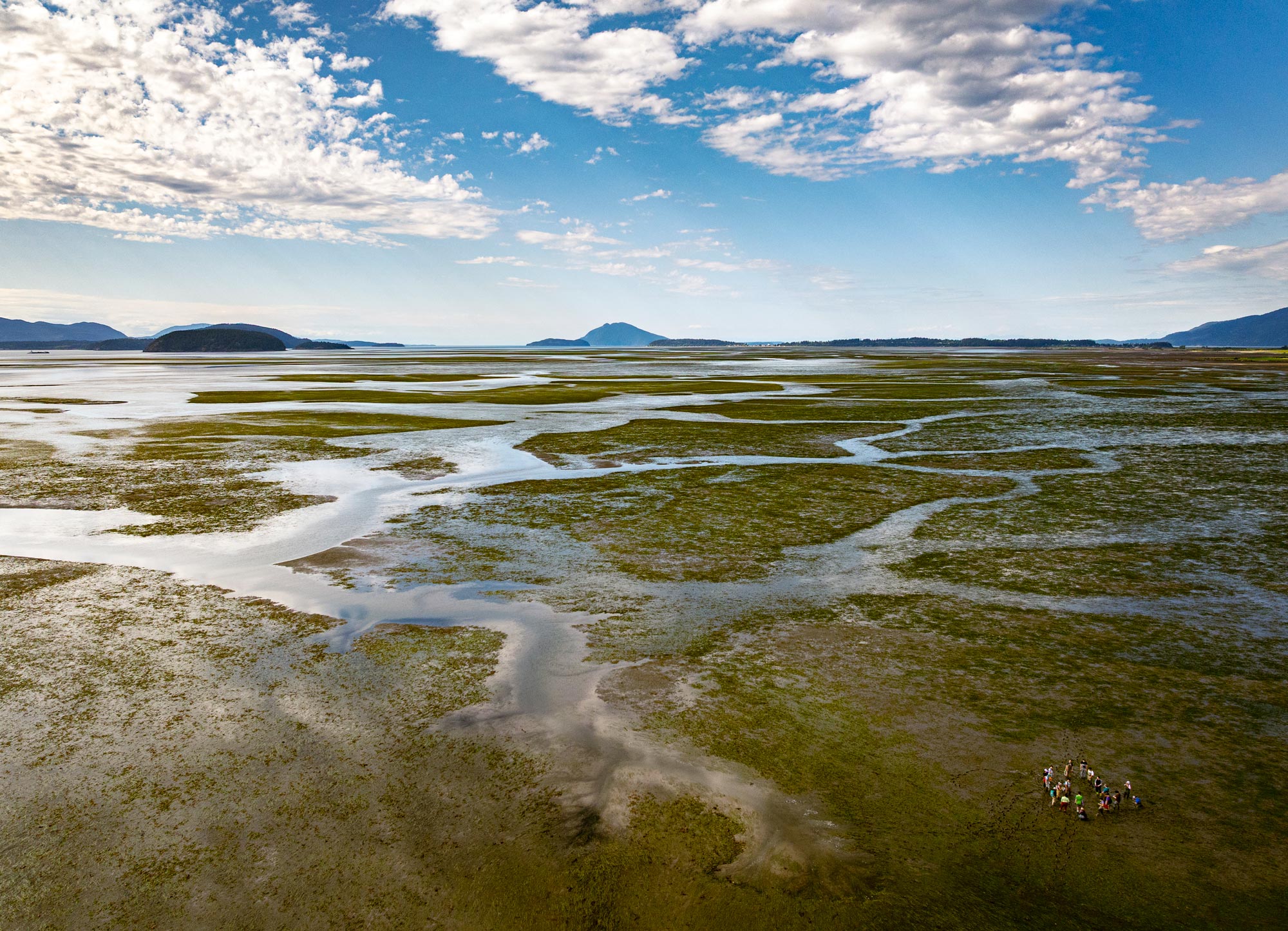
All three UW campuses have been recognized for getting their hands dirty and collaborating with their communities. These UW students get into the thick of it at Padilla Bay.
On a spring afternoon during low tide, Callie Murakami stepped into the mudflats of Padilla Bay, her waders sinking as she and her classmates spread out across the eelgrass beds.
Bending low, sometimes kneeling, she reached into the sun-warmed sediment to collect data to track the health of a coastal ecosystem that supports salmon, crab and countless other species. The work was messy and physical, and far removed from a traditional classroom. “The mudflats were stunning,” she says. “You’re out there collecting data, but you’re also experiencing the environment you’re trying to understand and protect.”
A senior studying aquatic and fishery sciences at the University of Washington, Murakami has spent much of her education learning in lecture halls, working in a lab and seizing every opportunity to get in the field and be where science meets ecosystems and the communities they support.
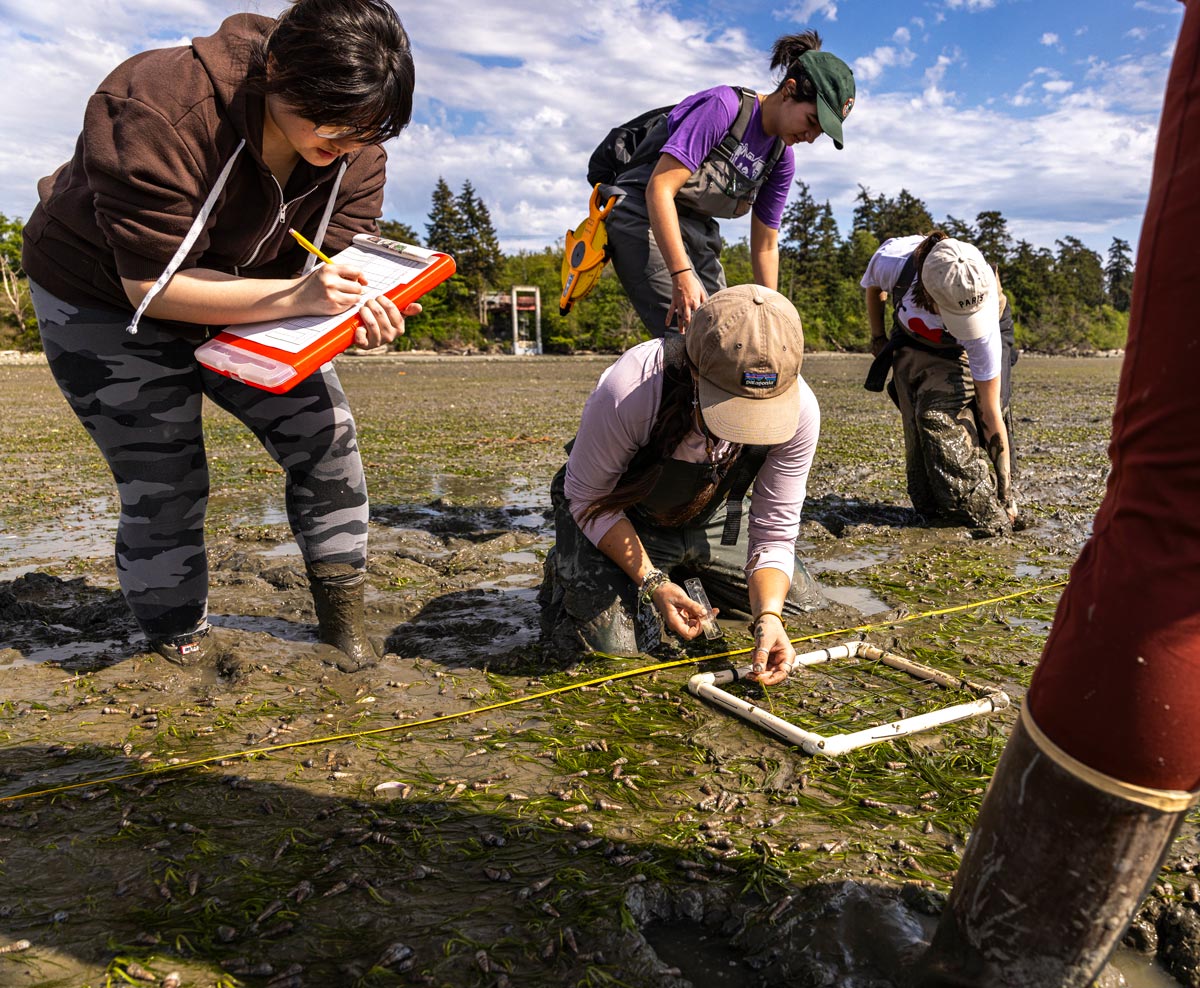
Through fieldwork in places like Padilla Bay, students like Callie Murakami (purple T-shirt) contribute to marine research—connecting science with the needs of Washington communities.
The UW embeds these experiences into its broader approach, using community engagement to shape how students learn. Through partnerships with hundreds of organizations across Washington state and beyond, students apply their academic training to real-world challenges, gaining practical skills while often contributing to community-driven solutions.
That approach recently earned national recognition. All three UW campuses—Seattle, Bothell and Tacoma—earned the Carnegie Foundation’s Community Engagement Classification, which recognizes institutions that collaborate significantly and consistently with their communities. The recognition places UW among a select group of universities nationwide and reflects years of investment in building meaningful partnerships.
“This reclassification affirms what I’ve long believed about the role of public universities,” says UW President Robert J. Jones. “Our work has to be rooted in partnership and focused on impact for all people.”
“We heard real stories and got a completely different perspective than you get in a classroom. That understanding shows up in my courses now. I have more to say because of it.”
Natalia Lizarraga, '26
The designation also reflects the scale of that work. The UW partners with more than 700 organizations, including nonprofit service providers, school districts, tribal nations, local governments and businesses. In recent years, the University has strengthened those efforts across all its campuses, developing shared practices and tools to better support community-based work. An initiative launched in 2022 has helped expand and coordinate those efforts, including the development of a digital hub that connects students, faculty and community partners.
“These partnerships allow students to take on academically rigorous work in real community contexts,” says Ed Taylor, vice provost for undergraduate academic affairs. “That leads to a much deeper understanding of the challenges they’re studying.”
Across the university, those partnerships vary by discipline but share the common goal of learning through doing. The approach connects academic study with lived experience, giving students a deeper understanding of both.
For Murakami, that has meant combining fieldwork with research and outreach. When she’s not on field trips like the one exploring eelgrass ecosystems, she works in Professor Mark Scheuerell’s Applied Ecology Lab, helping graduate students and researchers understand how pollution moves through coastal environments. The research she supports informs the Washington Department of Fish and Wildlife’s efforts to clean up Puget Sound.
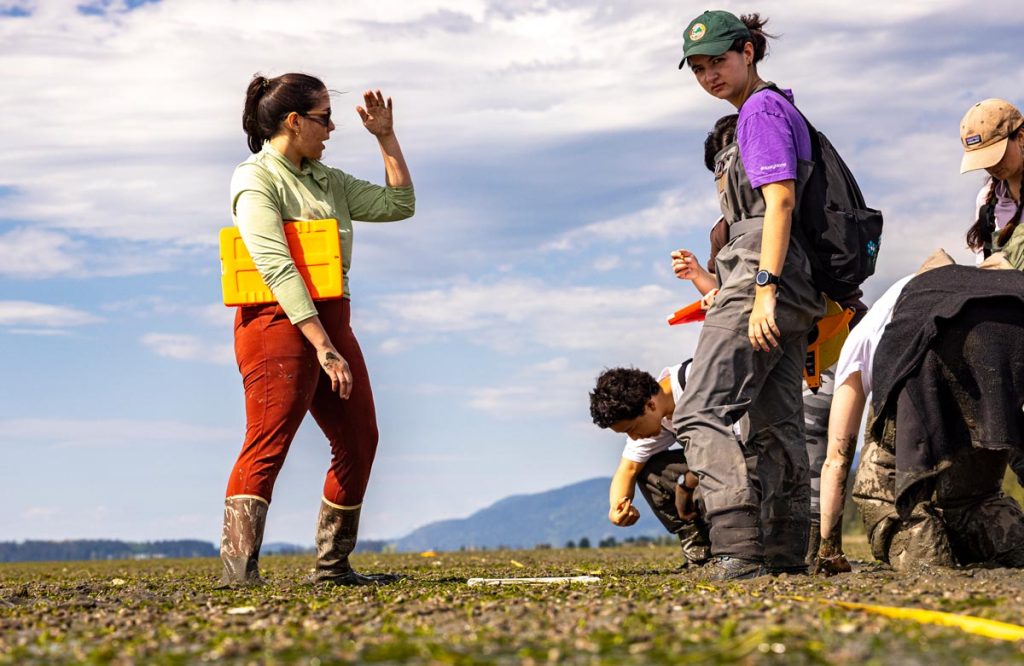
Looking over the mudflats, student Callie Murakami joins classmates in studying vital eelgrass ecosystems.
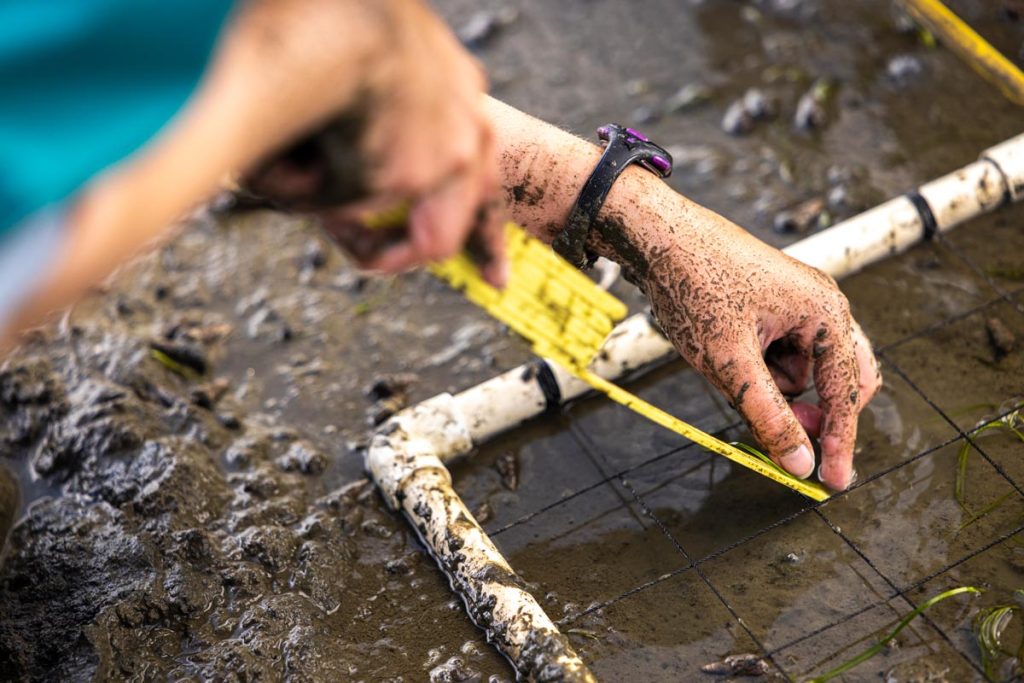
A quadrat is used to count plants and animals.
She has also volunteered at a salmon hatchery and with youth education programs, helping younger students learn about watersheds and environmental stewardship and encouraging their interest in science. Growing up in Washington, Murakami was introduced early to the importance of salmon and marine ecosystems. At the UW, those early lessons deepened into a sense of purpose.
“One thing I really like about this work is that the data you collect can go back and support the environment and the people around it,” she says. “I want to find ways to translate that work into action.”
For students in public health, that connection between knowledge and community often takes a different form.
Last fall, Natalia Lizarraga, a senior at UW Bothell, found herself in a meeting with Latina women, listening to their stories and helping connect them to local resources. Through a partnership with the Latino Educational Training Institute (LETI) in Snohomish County, she had landed an internship in which she supported weekly wellness sessions for immigrant women, covering topics like mental health, nutrition and domestic violence, while connecting participants with vital community services.
“It was amazing to actually talk to people instead of working from a textbook,” she says. “We heard real stories and got a completely different perspective than you get in a classroom. That understanding shows up in my courses now. I have more to say because of it.” That experience inspired Lizarraga to continue her work with LETI, joining the organization as an employee, helping expand programs that support Washington’s immigrant communities.
Her experience reflects a long-standing collaboration between UW Bothell and LETI. When the nonprofit sought to expand its services a decade ago, University leaders and students created a partnership that supports both community needs and student learning.
Today, dozens of students engage in work-study roles and research with LETI, contributing to programs in education, health and social services. “The community engagement effort that they have is one of the best that I have seen,” says Rosario Reyes, LETI’s founder and president. “I wish other schools would emulate it.”
“One thing I really like about this work is that the data you collect can go back and support the environment and the people around it. I want to find ways to translate that work into action.”
Callie Murakami, '26
Across all three campuses, similar partnerships connect students to communities in meaningful ways. Through Riverways Education Partnerships, students work with rural and tribal schools, supporting K–12 learning and expanding access to STEM education. In many communities, those relationships span years, with students returning regularly to support classrooms, mentor students and build enduring connections. At UW Tacoma, collaborations with local organizations address challenges ranging from environmental restoration to youth mental health. All together, these efforts reflect a University-wide commitment to addressing complex social and environmental issues while preparing students for lives and careers rooted in service. For many students, the lasting impact of that approach guides them into their careers and lives enriched with community connections.
In the mudflats of Padilla Bay and in community centers across the region, learning takes on different dimensions—shaped by direct experience, collaboration and a deeper understanding of the world beyond campus.
For Murakami, those moments in the field have helped clarify not only what she wants to study, but why it matters. “You can go out and explore and collect data and enjoy the environment,” she says. “But what really motivates me is knowing that the work can support ecosystems and communities. That’s what makes it meaningful.”
Though their paths look different—one in aquatic ecosystems, the other in community spaces—Murakami and Lizarraga are driven by the same idea: that learning is most powerful when it is connected to real people and real places.
At the University, the classroom doesn’t end at the edge of campus. For students across disciplines, it extends into communities, ecosystems and partnerships across the state—places where knowledge is applied, tested and shared, and where education becomes a way to contribute to something larger.