Art criticism for the masses
“Anybody can write about art,” says Kemi Adeyemi, founder of The Black Embodiments Studio, an arts organization rooted in bolstering the critical conversation around Black contemporary art.
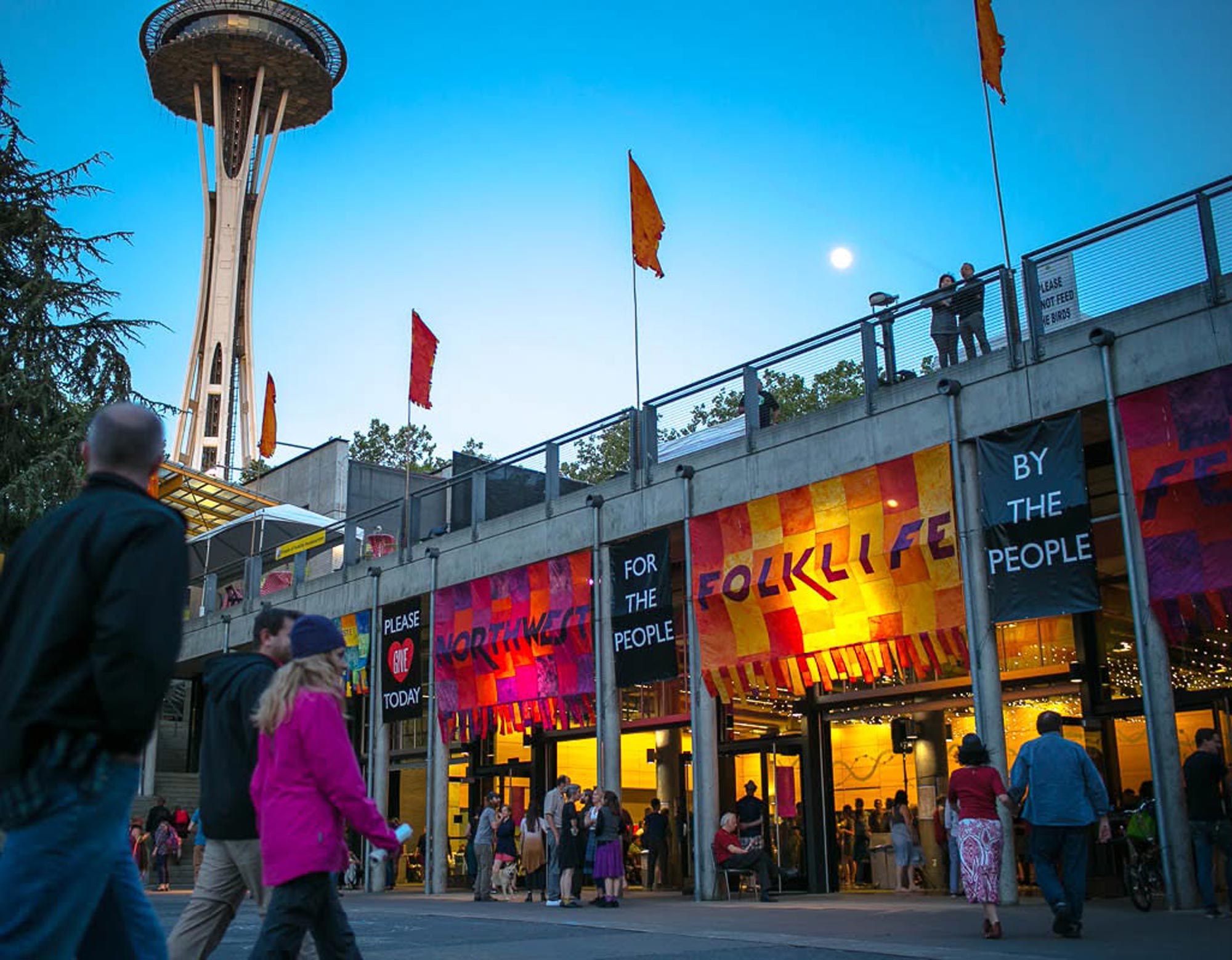
A new generation of UW alumni are reimagining Seattle’s cultural spaces at Common Area Maintenance, Northwest Folklife and The Royal Room.
From affordable housing to archives, music venues and community libraries, UW alumni are redefining how institutions can serve the public. Their work often starts with a shift of perspective: The communities aren’t just audiences to be served, but partners with knowledge and ideas of their own.
They’re building cultural spaces across Seattle, shaping communities, preserving histories and addressing larger questions of health, housing and belonging.
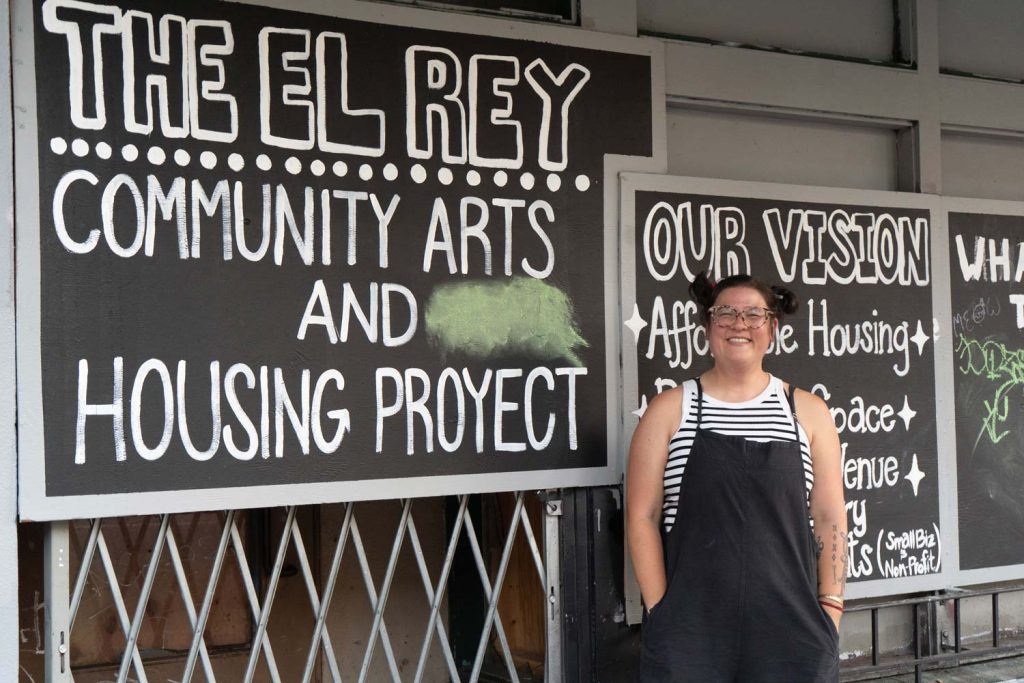
Assistant Director Amy Hirayama, ’22, of Common Area Maintenance, engages with community to imagine affordable housing for artists in Belltown, Seattle.
When writer Amy Hirayama, ’22, walked into Common Area Maintenance gallery in Belltown several years ago, it was housed in a former abandoned appliance repair shop that the artists had transformed into one of the city’s most community-engaged, forward-thinking arts organizations.
She came to take part in a strange and wonderful literary happening with noise musicians, live painting and poetry composed in Morse code played on a piano. She was soon playing a key role in CAM’s expansion as the organization’s assistant director.
At first Hirayama was tasked with expanding CAM into literary programming. The DIY art studio space had been created in 2015 with a group of artists who couldn’t afford their own studios. Pooling their resources, they built a shared space for artists across disciplines. Hirayama envisioned a writers membership program to formalize a relationship with literary artists and offer space, workshops, meetups and opportunities to create within community. Instead of creating the program herself, Hirayama invited the city’s writers to share their challenges.
“We emailed every single writer on our mailing list,” Hirayama recalls. They held a visioning session with more than 30 writers. “What do you need?” Hirayama asked. “What gaps can this fill?” Using the feedback, they created a working group of 15 who met over six months to create the structure for membership and classes. The program rolled out in 2025, and classes are set to launch in 2027.
Hirayama’s approach was shaped in part by her work as a middle school teacher and by her time at UW Bothell. During the COVID-19 pandemic, she completed the graduate program in Creative Writing & Poetics entirely on Zoom. The experience taught her about deliberately building a community and inviting participation.
The same philosophy is now shaping CAM’s physical spaces. The uncertainty of leases poses a constant threat to community-based spaces and stymies their growth. In 2024, CAM took over the former Art Tech building on First Avenue and opened its Common Objects space, a multimedia gallery and community space. Last year, it acquired the El Rey apartment building in Belltown for just $20, after rescuing the vacant building from demolition.
The CAM team has plans to develop affordable housing in the four-story structure. The top two floors will include 10 affordable apartments with community areas. CAM also plans to offer short-term residency lodging so that smaller organizations like literary nonprofit Clarion West, where Hirayama also works, can invite visiting artists and affordably house them. The ground floor will feature classrooms, a commercial kitchen, a gallery, office spaces and storefront retail that CAM wants to lease out to mission-driven organizations.
“One of our foundational values is artists over profit,” Hirayama says. “This is a space where you don’t have to be good at what you do or love. You have to love what you are doing. It’s that love for the creative practice that we encourage and nurture, and that is hugely connective for people—centering the humans behind the art with intention, care and love.”
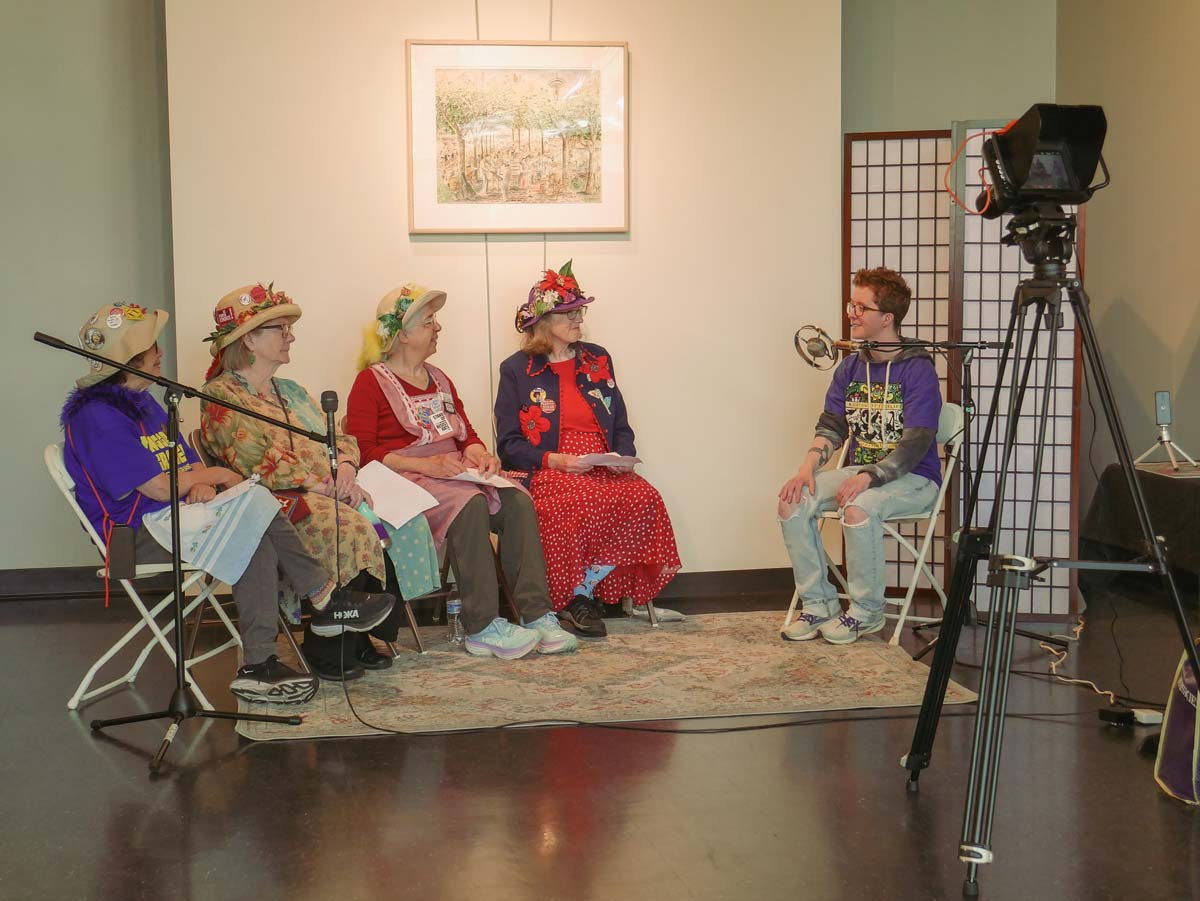
Emily Silks, ’26, interviews the Seattle Raging Grannies during the Northwest Folklife Festival as part of the archive co-stewardship project.
When Emily Silks, ’26, started working as Northwest Folklife’s first staff archivist, they expected to spend time with the festival’s recordings. Instead, they became occupied with discovering what was missing.
Silks built partnerships with Folklife artists to ensure that Folklife represents artists based on choices and the priorities of its community. For the 2026 festival, Silks set up a story booth where people could bring their own materials and recordings to be transferred to more stable formats and catalogued as one part of a multifaceted approach to community-driven archiving at Folklife.
One contribution documented the rise of the women’s movement in Seattle in the 1980s and ’90s and focused on Karin Blaine and Siri Sobottka of the Blaine Sisters Band, and on Maggie Savage and Cathy Coven, who were at the center of local queer feminist perspective. The history was new to Silks.
Another donation came from sound artist and musician Susie Kozawa, who collaborated with UW music faculty emeritus Stuart Dempster, and is known for her sonic improvisation with homemade instruments made from everyday objects. She creates site-specific audio experiences that capture the spirit of place.
Over five decades, Kozawa recorded the sounds of the Folklife festival to create soundscapes and capture something that stage recordings just don’t. “When she took out her field recorder in the ’80s, she heard jam sessions and all these sounds mingling together that showed an original capture from the audience member experience,” Silks says. “Those impromptu jam sessions no longer exist in the same way. Her recordings show both her active artistry and a marker of the times.”
As an institution, Folklife has invited professionals to come into the festival and make their own recordings. But Silks is excited to highlight those who cared enough to hold onto things for the sake of preservation. Silks specializes in “slow archiving”—an approach that pushes against the notion that an archive needs to hold and safeguard materials. Instead, archival practice becomes about sustaining and reconciling relationships, by facilitating the circulation of collections while considering how knowledge is preserved and embodied through ongoing conversation. Silks also draws inspiration from her mentors at the UW like ethnomusicology curator John Vallier, Professor Michelle Habell-Pallán and Associate Professor Sonnet Retman, who created the Women Who Rock archive.
Silks sees community partners as co-stewards. Working with the Zimbabwean music and dance community, she provided copies of recordings to the group and organized a joint viewing session. Folklife paid for Anzanga, a long-standing Zimbabwean marimba ensemble led by Sheree Seretse, to help describe the cultural context of the performances to enhance the archival descriptions and provide feedback on how the group wished to see the material presented and shared. Silks is currently revamping Folklife’s website to make it more searchable. In the long term, they hope to offer digital exhibits and articles that features Folklife’s work with community partners.
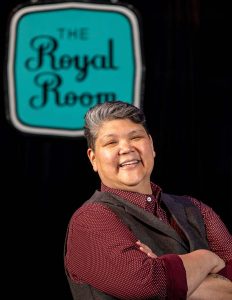
Reese Tanimura, ’12, owns The Royal Room, a Columbia City institution known for music and community.
In 2025, Reese Tanimura, ’12, who was working full time as managing director of Northwest Folklife, found herself the new owner and sole operator of The Royal Room in Columbia City. “I call it my hobby,” she says with a laugh. Tanimura had performed and curated a blues series for the club and was a regular. But after the COVID-19 pandemic, the owners approached her about buying the beloved 14-year-old community anchor. “They felt that I wasn’t going to turn it into a sports bar or do anything too out of character,” she says.
Tanimura has kept the club’s eclectic mix of music and community events, sometimes partnering with the South Hudson Music Project, to present everything from free shows for MLK Day and Juneteenth to recitals for Jazz Night School and community-driven fundraising shows supporting organizations like NW Immigrant Rights Project. The rich musical ecosystem at The Royal Room easily complements and intersects with Tanimura’s work with Folklife. She’s able to host some of the musical groups that come through the outdoor festival onto the stage at the Royal Room, which offers a very different performance setting. She also draws from her work with Folk Alliance International to host bands who are traveling through Seattle and connect them with local musicians. In both environments, she stewards a vision of a place where people can find connection and fulfillment through encountering live music.
Tanimura left behind a career as a teacher to move into the nonprofit sector, eventually enrolling in the nonprofit management certificate program at the UW. Born in Hawaii, Tanimura lived there until she was 8. She moved back after college to teach in a rural part of Oahu. Her early roots in Hawaiian culture shaped her respect for elders, community and knowledge systems. “You are essentially in an ecosystem and connected with the place around you,” Tanimura says. “This includes the environment, humans, land and water. Respect is embedded in everything.”
In Waianae, where she worked with at-risk students, Tanimura found that there were ways in which the community knew itself and asked for what they wanted to be embedded in their educational systems. A colleague launched and grew a media program that helped young people tell their stories while teaching them journalism skills. Her school developed a sustainable aquaculture program focused on farming edible seaweed, which was sold to local restaurants. Tanimura taught her music students songs that had a direct relationship to them, instead of just typical classical or institutionally recommended repertoire. “It was an example of a community that knows itself and knows what it wants,” she says. “The institution has to catch up with community, which has a huge basis of strength and knowledge.”
As Tanimura moved through different nonprofits and served on boards, the certificate program at UW helped her to understand the thinking behind those relationships. Her teachers shared insights on how board governance has evolved as a practice, shifting from outdated hierarchical structures of passive compliance to equity-driven governance as “a form of collective stewardship and partnership with staff to make the best ends for a nonprofit.”