Spring media roundup
Until the cherry trees reach peak bloom, hide from the last leg of the Pacific Northwest's winter and cozy up with a new book from the UW community.
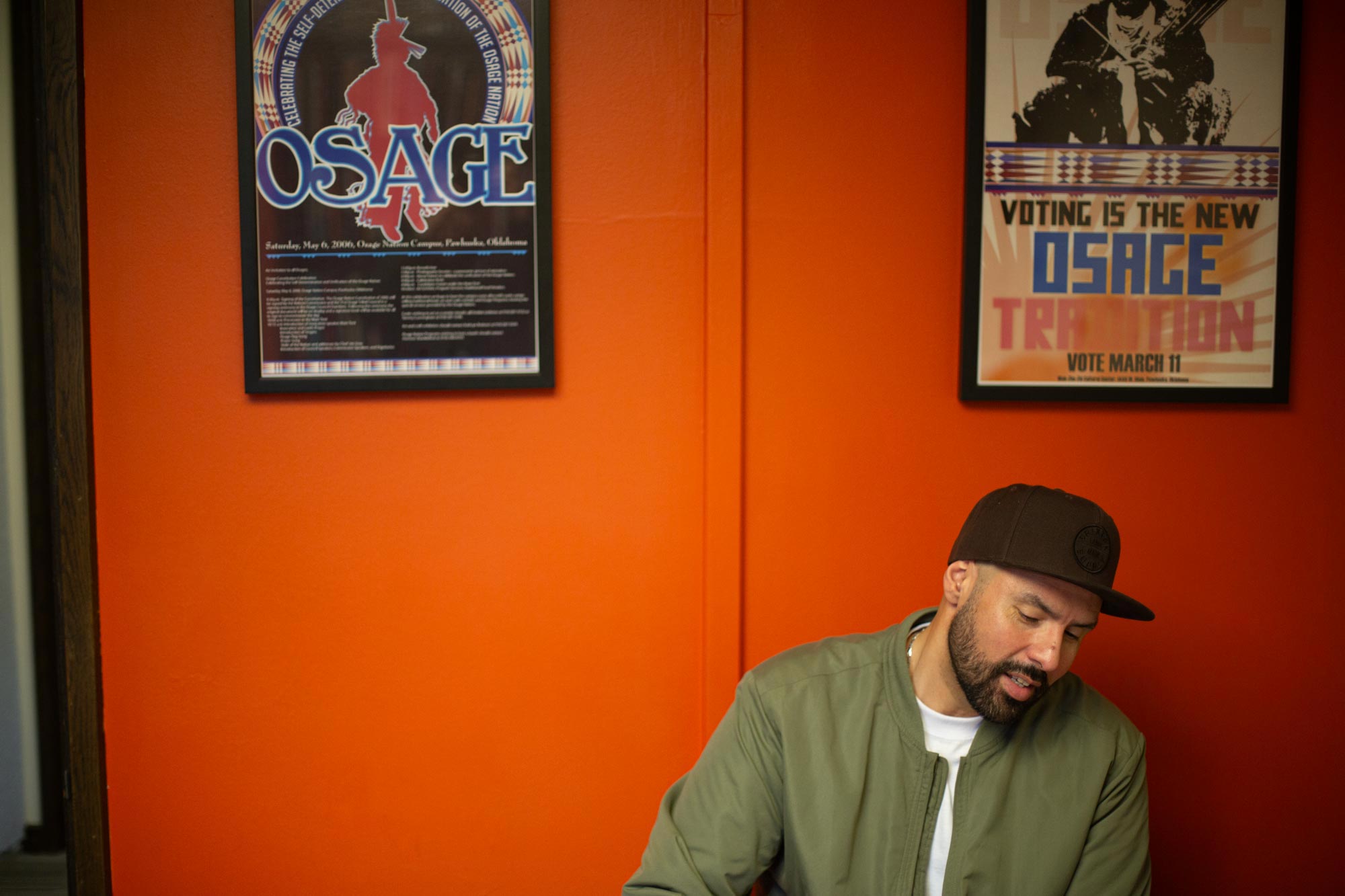
After more than two decades in prison, Benjamin Brockie begins again—as a student, a father and an advocate for education and Indigenous justice.
The last time Benjamin Brockie saw his grandmother, she was in her hospital bed. He had been allowed two hours of compassionate release from prison to see her.
He was dressed in an orange jumpsuit and shower shoes, his wrists locked in shackles that rattled as he walked down the hallway escorted by an armed guard.
When she saw him, she called his name, reached out and began to cry.
Brockie leaned over and she embraced him, but he couldn’t hug her back.
“I just felt so shameful,” he says now, “because I let my family down.”
He had been in prison for six years at that point. He was serving a 67-year sentence for crimes including bank robbery, offenses he committed at 20 and had long recognized as harm to those he threatened. What he hadn’t fully grasped—until that moment in the hospital room—was how far the hurt he caused had spread.
“Seeing her like that,” he says, “I realized I didn’t just harm those victims. I harmed their families. I harmed my family. I harmed my community.” Six years later, his actions were still wounding people he loved.
At the end of the visit, Brockie returned to prison certain of one thing: he would probably die there. The realization came with a new resolve. “I wanted to do better,” he says. “At least for my family and the family members of my victims.”
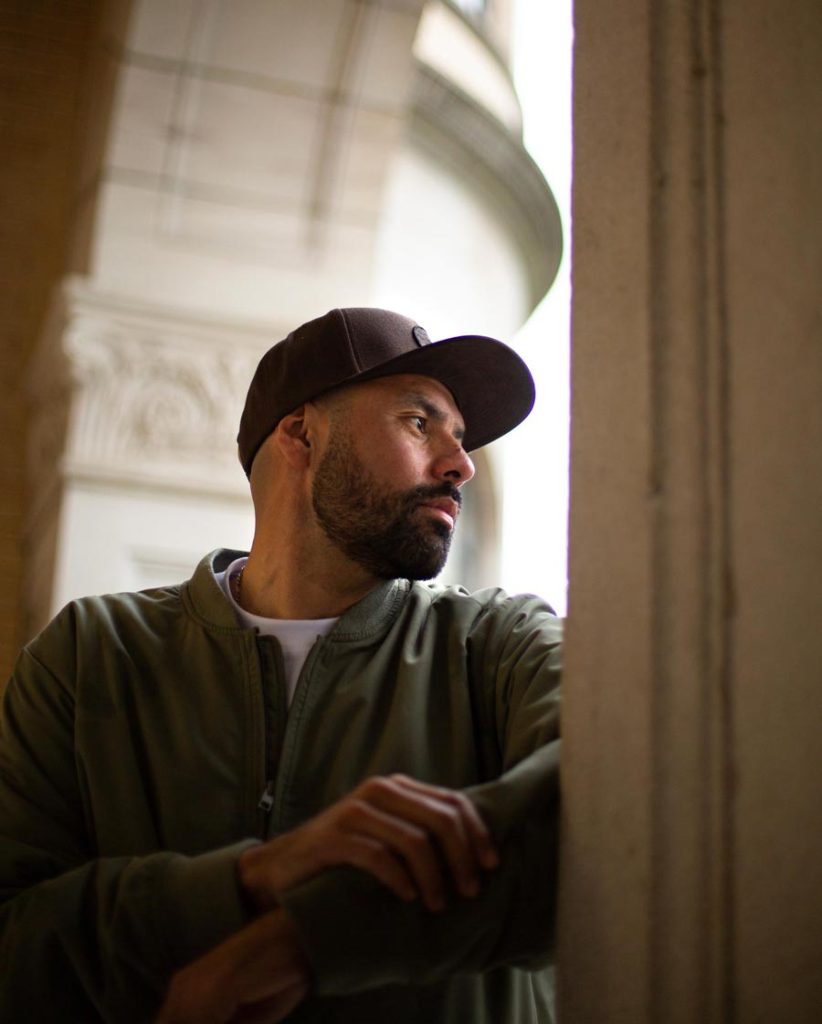
Brockie grew up in Spokane, where much of his family still lives. He is an enrolled member of the A’aninin tribe of Fort Belknap, Montana. By his own telling, he was not an easy teenager. Money was tight. When he started robbing businesses, he saw it as a quick, albeit reckless, solution.
But in 2003, he was convicted of two counts of first-degree robbery, two counts of threats to bomb and 15 counts of first-degree kidnapping. The sentence—more than 67 years—was crushing. He was barely old enough to understand what it meant to grow old, let alone imagine never leaving prison. “At first, I couldn’t even think about it,” he says. “It was just hopeless.”
He prayed constantly—for forgiveness and for an opportunity. “If I could go home, I’d go to school. I’d do whatever I had to do to be free.”
He understood how rare it was for a prayer like that to be answered.
Education became a lifeline. Brockie enrolled in an associate degree program studying human and social services. He maintained a 4.0 GPA. He read obsessively. He served on the Advisory Council of Incarcerated Individuals, advocating for rehabilitation rather than punishment. He tutored and encouraged other incarcerated men. He won a scholarship. He tried to become someone who could live with himself. And he dared to hope for a life outside prison.
Around 2016, his case came to the Seattle Clemency Project, a volunteer effort pairing incarcerated people serving extreme sentences with attorneys willing to take on uncertain cases. Bianca Lacaille, ’14, ’17, was a first-year associate at her law firm and her practice was in corporate law. But she was eager to help with Brockie’s petition, especially after traveling to Spokane and meeting him at the Airway Heights Correctional Center.
“I had never been to a prison before,” she says. “Up to that point, we had only communicated by letter.” She could sense his nervousness. “He had so much at stake. But I also saw an individual who was so intellectual and so thoughtful with his words and his worldview. He was able to speak about what he did and had an understanding of the impact he had had on others.” Fellow attorney Hugh Barber, a former King County prosecutor who has taught trial advocacy at the UW, noticed how much Brockie did for others inside—not only trying to improve himself, but helping his peers.
There was no guarantee the attorneys’ work would lead anywhere. Brockie’s first clemency petition in 2019 didn’t even get a hearing. When he heard that news, he sank into a depression, convinced that it had been his only chance. “He half expected us to move on and be stuck again on his own,” Lacaille says. “But I quickly reassured him he was stuck with me, and we were going to keep fighting for him.”
Lacaille and Barber saw possibility in his case. Barber thought Brockie’s sentence was unduly harsh—a lifetime sentence for two bank robberies with a pellet gun. Brockie rejected the argument, taking responsibility for the crimes. He didn’t want his release to hinge on technicalities or sympathy. Accountability mattered to him.
“He had so much at stake. But I also saw an individual who was so intellectual and so thoughtful with his words and his worldview.”
Bianca Lacaille, ’14, ’17, attorney
The Brockie today is not the Brockie of 23 years ago, say Barber and Lacaille. That was the argument they ultimately made to the Clemency and Pardons Board in June 2024.
When the decision came to grant him clemency and Gov. Jay Inslee, ’73, signed the commutation in late summer 2024, Brockie, who had been admitted to the University of Washington that fall, didn’t celebrate. He waited.
“I was still scared up until I walked out that front door,” he says. Nearly 60 people waited for him outside the prison, among them his wife, his mother, siblings and friends, people who had believed in him long before the state did. “My family was there. My community. I was free. I was done doing time. I was home.”
Brockie is likely the first Indigenous person to be granted clemency by Washington state.
What struck him most as he walked from prison to the waiting crowd, though, wasn’t the noise or the reunion. It was the sky. “In prison, you never see the horizon completely,” he says. “That first day, I could see all the way toward Idaho, all the way west. The big sky. The wind felt so good.” He pauses, searching for the right word. “It was magical.”
Ten days later, he moved into a reentry residence in South Seattle and began preparing for something he had dreamed of for decades: college.
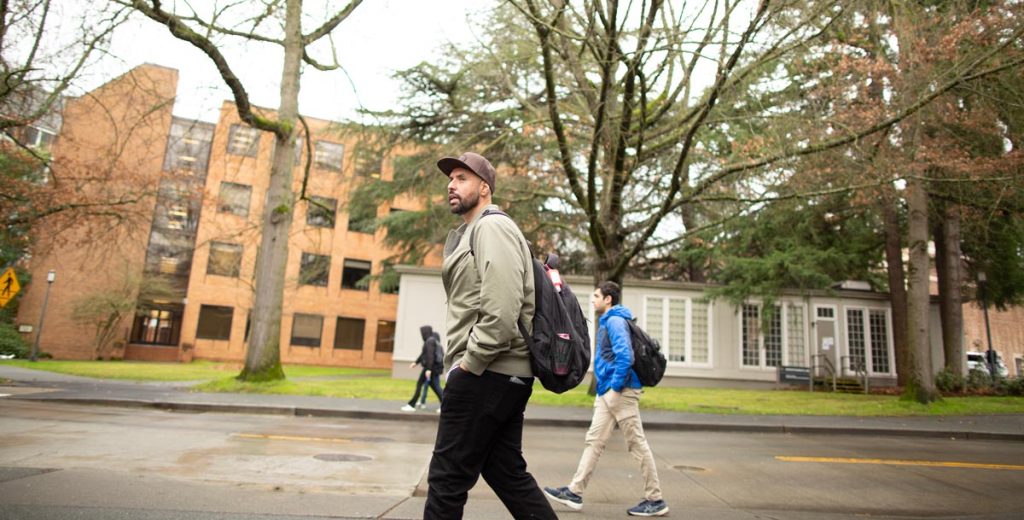
Ben Brockie relishes every minute he gets on the UW campus.
Most incarceration stories end at the release. But for Brockie, it was the beginning. With an AA degree earned in prison and a scholarship and admission to the UW to complete his bachelor’s, he had no time to waste.
But reentry and the challenges of navigating the University overwhelmed him. Living alongside others who had been behind bars, having a long bus commute where he felt the need to be hyper-vigilant and suddenly facing thousands of daily decisions left him mentally exhausted. Brockie was older but less worldly than most of his classmates. He didn’t know how to use a smartphone. He didn’t know how to open Canvas or send emails, he says. “What was Google Drive?”
“I was using a paper map to try to find my way around,” he says. Prison had taught him structure and routine. Freedom required effort and improvisation.
Brockie worked twice as hard as his classmates, all the while trying to keep his past hidden and not burden anyone with his confusion. “I just wished I had somebody to walk me through it all,” he says. Someone to help him submit an assignment, guide him to an office. To help him start conversations that seemed easy for everyone else.
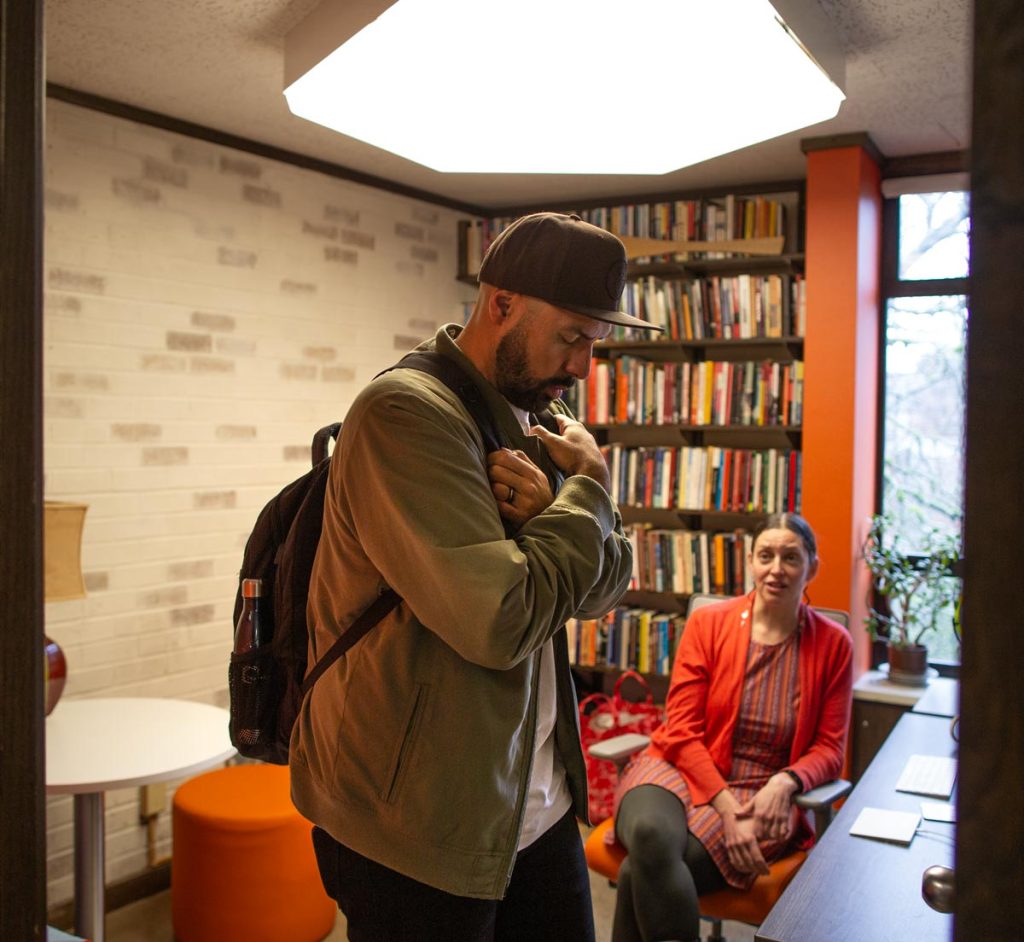
Ben Brockie wraps up an office visit with Jean Dennison, one of his professors in American Indian Studies.
His sociology adviser, Susanna Hansson, ’84, noticed. “She worked with me over the phone and helped me build a class schedule while I was still in prison,” he says. When he finally got to Seattle, she toured him through campus. “And she has held my hand ever since,” he says. It wasn’t her job to help him reenter the world, he says, but she did it anyway.
More than a year into his studies, Brockie can list exactly what formerly incarcerated students need to survive on campus. Not pity. Not special treatment. Just guidance and safety.
“There are other formerly incarcerated students here,” he says. “But we keep low profiles.” He hasn’t been able to connect with many of them. The isolation is familiar. So is the silence.
“We need a safe space,” he says. “A place where we can come together and share resources.” He recently formed a registered student organization, Formerly Incarcerated Students at the UW, hoping to build for others the support he once needed and advocate for a reentry navigator on the main campus (UW Tacoma does have a support program for formerly incarcerated students).
Brockie is majoring in sociology and American Indian studies, and is expecting to graduate in June.
He has also started a family. He and his wife, Marisol, welcomed their baby last summer. “Bo is a dream I thought would never come true,” he says. “Having a life sentence doesn’t just take your freedom; it slowly takes away the idea that you’ll ever be someone’s safe place, their example, their home.”
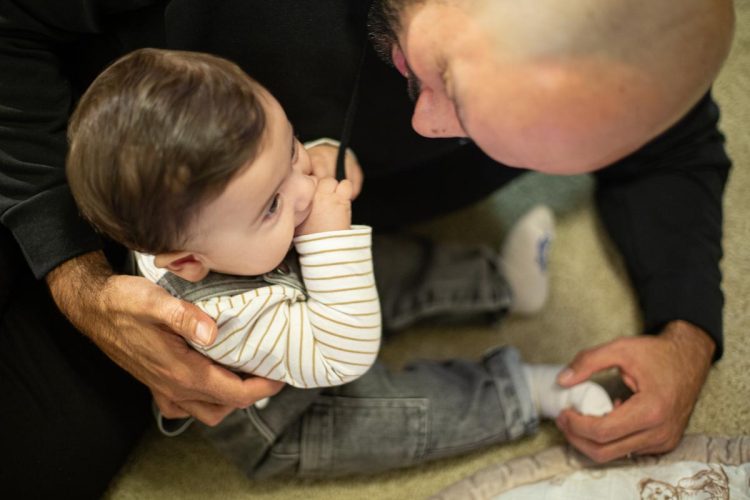
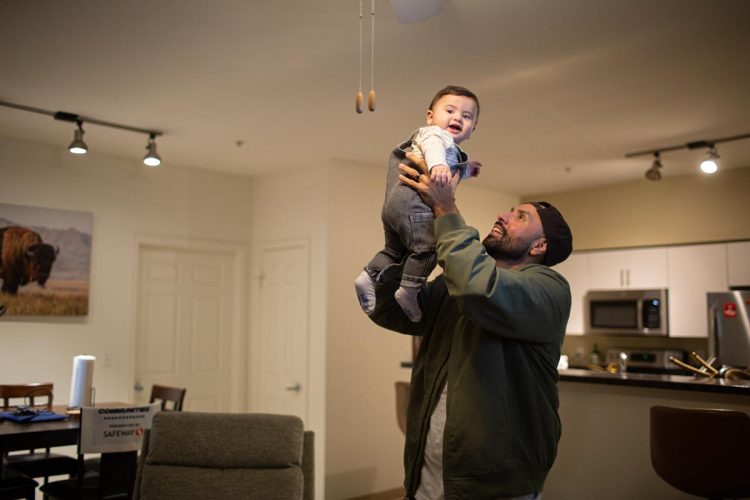
Now he’s applying to law school, aiming to further his work challenging inequities, ensuring Indigenous representation and amplifying Native voices within systems that have historically excluded them. He is following the call to action that Raymond Delos Reyes, ’04, a Seattle attorney and member of the Washington State Clemency and Pardons Board, gave as he voted in support of Brockie’s clemency petition: “Go to law school. We need you.”
Brockie hopes to draw from his own experience to improve conditions and opportunities for imprisoned people. Education should not be contingent on the promise of release, he says. People serving long sentences rarely get access to higher education programs, even though education alone can reshape how someone understands their responsibility to the world. “I was always looking for ways to give back,” he says.
Now on the outside, that instinct has expanded. His coursework led to a public health internship last summer with the Urban Indian Health Institute, where he found mentors in Abigail Echo-Hawk, ’09, the executive director of the Seattle Indian Health Board, and program manager Sacena Gurule. He worked on designing an awareness program about Missing and Murdered Indigenous Women and People, exploring ways to reach into prison communities where there might be knowledge about cold cases. He also presented at the Washington State Minority and Justice Commission 2025 Supreme Court Symposium.
He has his family, he has his school, he has his outreach work to other formerly incarcerated students and he has his mission of becoming a lawyer. “I don’t mind,” he says of the demanding schedule. “I don’t think I’m unique or special. More people who are incarcerated are smarter and more driven. I just got a chance.”
Brockie knows better than to frame his life as a story of redemption. He doesn’t ask to be forgiven or pretend that the harm he caused has diminished with time. Instead, what he believes is that his responsibility is even greater now that he’s free.
And every day, he feels grateful walking through a world that he once thought he had lost.
Despite having to live his life at full speed, the sense of wonder he felt on his first day of freedom hasn’t left him. “This morning,” he says, “I walked across the Quad. I saw the trees and the leaves and the buildings, and I just think they’re beautiful.” He stops himself, acknowledging the simplicity of it. “I just think how lucky I am.”