Trusting your gut
Do weight-loss and diabetes drugs like Mounjaro and Ozempic provide us with a healthier metabolism? Or should we focus on feeding our gut microbiome?
Acting as patients, UW drama students help teach trainee physicians about communication and empathy in delivering care.
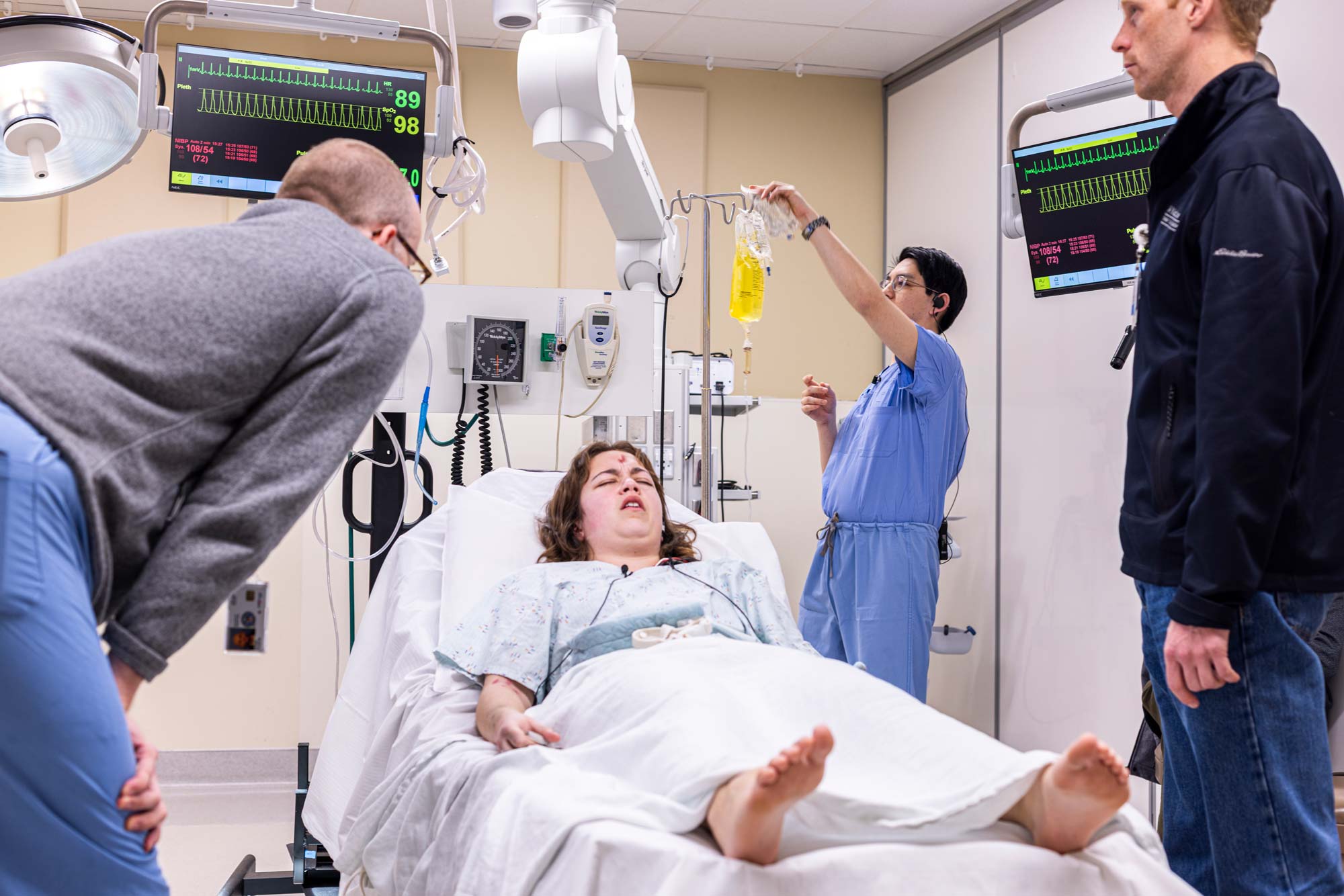
Above: UW Drama student Ella Campanario plays a confused patient.
Inside Harborview Medical Center in Seattle, a patient in a hospital gown lies on a gurney. While answering questions posed by two UW Medicine neurology residents, the patient’s breathing grows labored. The residents must respond.
Across the hall, a 40-something mother and her adult daughter meet with another neurology resident to discuss the mother’s memory decline. While the daughter expresses her concern, her mother makes light of recent memory lapses, chalking them up to depression, for which she is being treated.
Such scenarios are quite familiar for neurologists. But on this day, they are simulations, with students from the University of Washington College of Arts & Sciences’ School of Drama performing the roles of patients and family members. Through these simulations, medical residents can hone their diagnostic and communication skills before they face similar, real-life scenarios with actual patients.
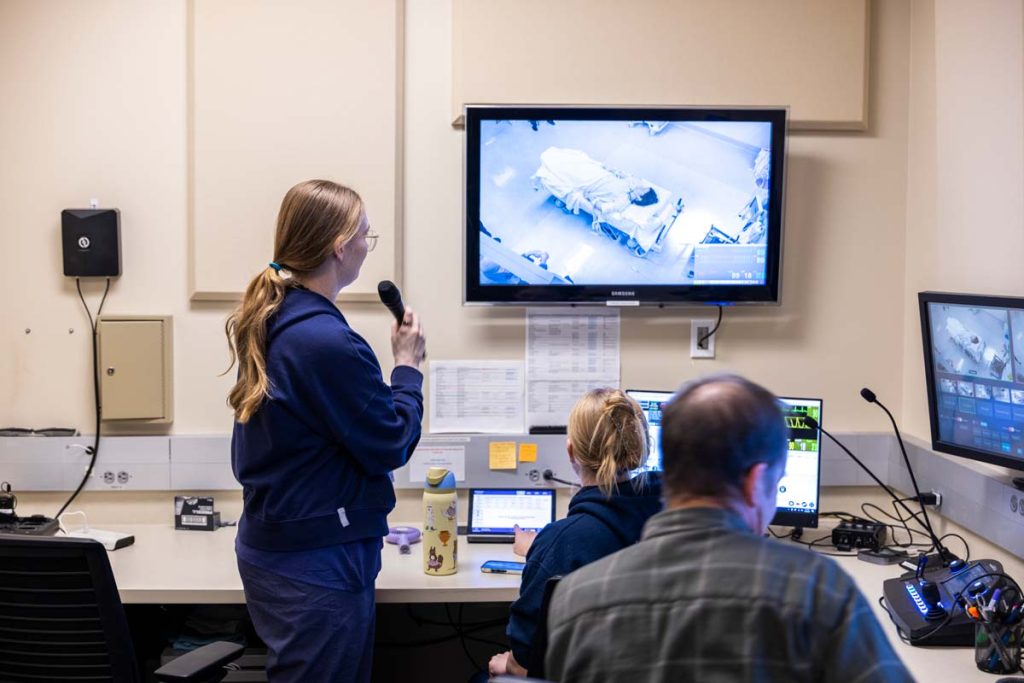
Alexandria Wilson, scientific instructional technician for WISH (WWAMI Institute for Simulation in Healthcare), tests a simulation patient’s ear-piece connection.
But it isn’t just the residents who are here to learn. “I’ve wanted to act for a while, and I’ve always been interested in medicine, so this was a perfect combination,” says Lev Parker, a UW creative writing major and drama minor who played the role of the patient on the gurney. “This was my first performance, my first stage.”
Simulations are nothing new in health care—the UW has a “standardized patient” program involving simulations for clinical training—but neurology training has traditionally been “lecture-based with a lot of self-study,” explains Wolfgang Muhlhofer, associate professor and vice chair of education in the UW Department of Neurology. “That’s not really putting our trainees’ active problem-solving, medical decision-making and communications skills to work.”
To address this, UW Neurology introduced a full-day “boot camp” of simulation training for incoming residents in 2022. To play the role of patients, Muhlhofer explored using paid “standardized patients” through the UW’s standardized patient program. But the cost and lack of availability on the date of the planned boot camp were problematic. So, he reached out to the faculty in the UW School of Drama to see about recruiting student actors as volunteers.
“Subtext is important because patients don’t just show up with a symptom. They all have a story that they carry around with them.”
Wolfgang Muhlhofer, UW Department of Neurology
Initially, Drama faculty felt uncomfortable asking students to take on an acting job without being compensated. Then Scott Magelssen, professor of theater history and performance studies and executive director of the School of Drama, offered to create a two-credit course for those interested in participating. Having spent his career studying simulations in various contexts—from living-history museums to simulations preparing soldiers for combat—Magelssen knew how valuable simulations can be.
“Simulations are really important because they rehearse for real life,” says Magelssen, who holds the Floyd U. Jones Family Endowed Chair in the School of Drama. “They use the tools from theater and performance to create a world that is realistic enough that the training feels authentic. They allow us to engage and activate our whole bodies, our emotions, to gain knowledge and skills.”
Drama students signed up for Magelssen’s course and participated in the neurology boot-camp simulations. The simulations were so well received by neurology residents that the Department of Neurology began offering optional two-hour simulation workshops each quarter. Drama students were happy to be involved.
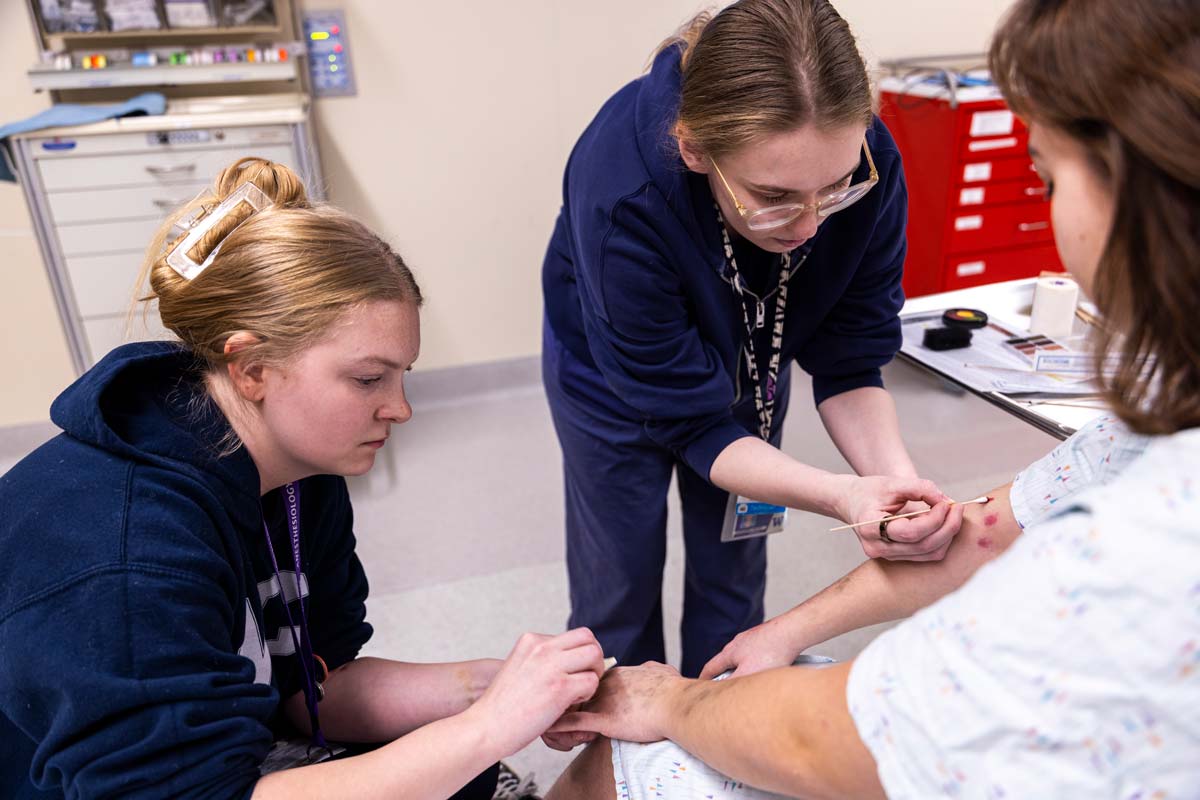
Emma Wardenburg and Alexandria Wilson apply moulage to UW Drama student Ella Campanario.
“I think our drama students are hungry for these kinds of experiences,” Magelssen says. “This was a way to have them participate in the simulations but also have an educational component, an opportunity to reflect on the ways they are using their skills and how their art can make an impact in the world outside of the theater.”
Like any acting role, the simulation actors arrive prepared, with guidance from Muhlhofer. He first sends an email describing the upcoming simulation scenarios, then discusses the scenarios in more detail with interested students over Zoom. Before the event, the students receive a script—“more like Cliff Notes,” Muhlhofer says—containing information about their character and the story to tell the trainee physicians. The notes include things they should mention to the trainees as well as the things they shouldn’t volunteer, along with subtext for the character.
“Subtext is important because patients don’t just show up with a symptom,” says Muhlhofer. “They all have a story that they carry around with them. A lot of times, I leave it up to the actors to improvise based on some basic personality traits, some basic emotions they should have in this particular situation.”
Muhlhofer then meets in person with the student actors for a dry run before the simulation takes place. He will play the role of the trainee physician and offer suggestions for making the patient’s physical symptoms and emotional responses as believable as possible. The more real the scenario feels, he explains, the more the neurology residents will be able to learn from it.
Muhlhofer recalls one scenario in which the patient complained of a headache, suddenly became unresponsive and had a seizure. “The calm scenario turned into this really high-stress situation,” Muhlhofer says. “The resident was rushing around the bed trying to interact with the patient. The resident’s pager fell to the floor, so the resident kicked it across the room to get it out of the way while yelling orders to the nurse. They had a visceral response to what was happening and got so into it that it felt real.”
Colleen Carey, who is majoring in the comparative history of ideas and minoring in drama, recalls playing the role of a patient admitted to the emergency room with a cluster of symptoms. The simulation was run twice with different trainees. She explains: “There are lessons I continue to learn in this arena that cannot be learned anywhere else.”