Beaver believers
A group of UW alumni show how beavers, far from being a nuisance, play a key role in keeping biodiversity alive and thriving.
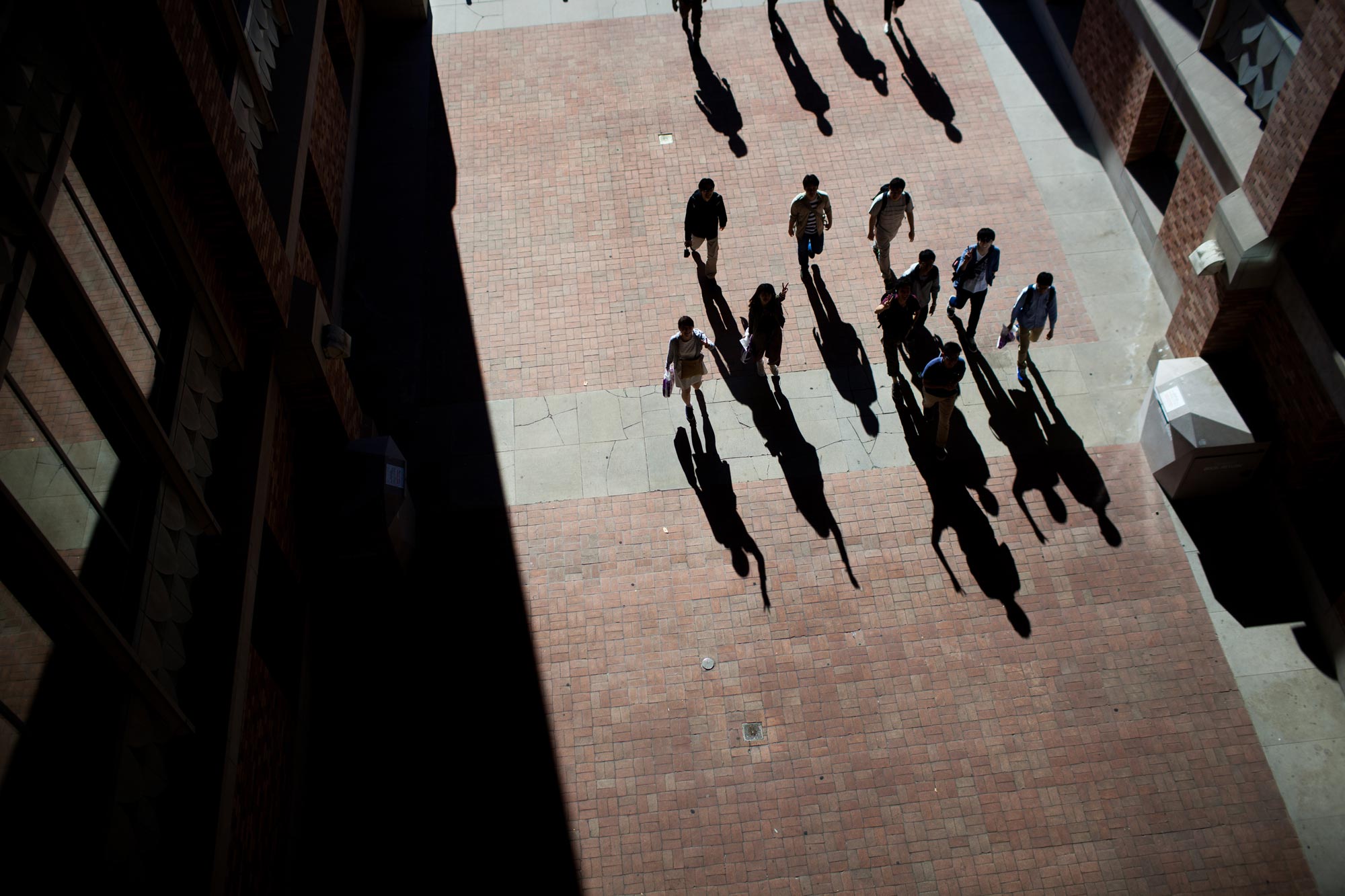
Students are proving that a UW degree is not financially out of reach.
Twice a week last winter, Ebubechi Abonyi pulled on her lab coat to run experiments for her work-study job. In the spring, she staffed campus events, handing out swag and talking to prospective students as an ambassador for the University of Washington Alumni Association. And in the time between the classroom and the homework, she posted content for a small brand partnership and worked with pre-college students interested in STEM careers. “Ever since my sophomore year, I’ve had a minimum of three jobs,” she says.
Hers isn’t the traditional version of college: four uncomplicated years of self-discovery, classes, friends and football games. It’s something more considered and more affordable. Through a patchwork of scholarships, campus jobs and some family support, the architectural design major from Moses Lake has managed to cover her costs and is graduating in June without student loan debt.
But her experience doesn’t fit the national narrative about higher education. A viral debate is playing out on platforms like YouTube, Facebook and Reddit. Powerful voices—including Elon Musk, the founder of Tesla—have dismissed college as “for fun,” not for learning. At the same time, others, like Tesla’s former head of human resources, argue that a college degree is more valuable than ever.
The data shows a college degree still leads to higher lifetime earnings, greater job security and better health outcomes. And it’s better for communities because college graduates demonstrate higher civic participation and contribute more in taxes.
But the public isn’t sure. According to the Pew Research Center, roughly seven in 10 Americans now believe the U.S. higher education system is heading in the wrong direction. The reasons are familiar: ideological indoctrination, a suspicion that a four-year degree no longer guarantees a well-paying job, rising costs and shocking stories of six-figure debt.
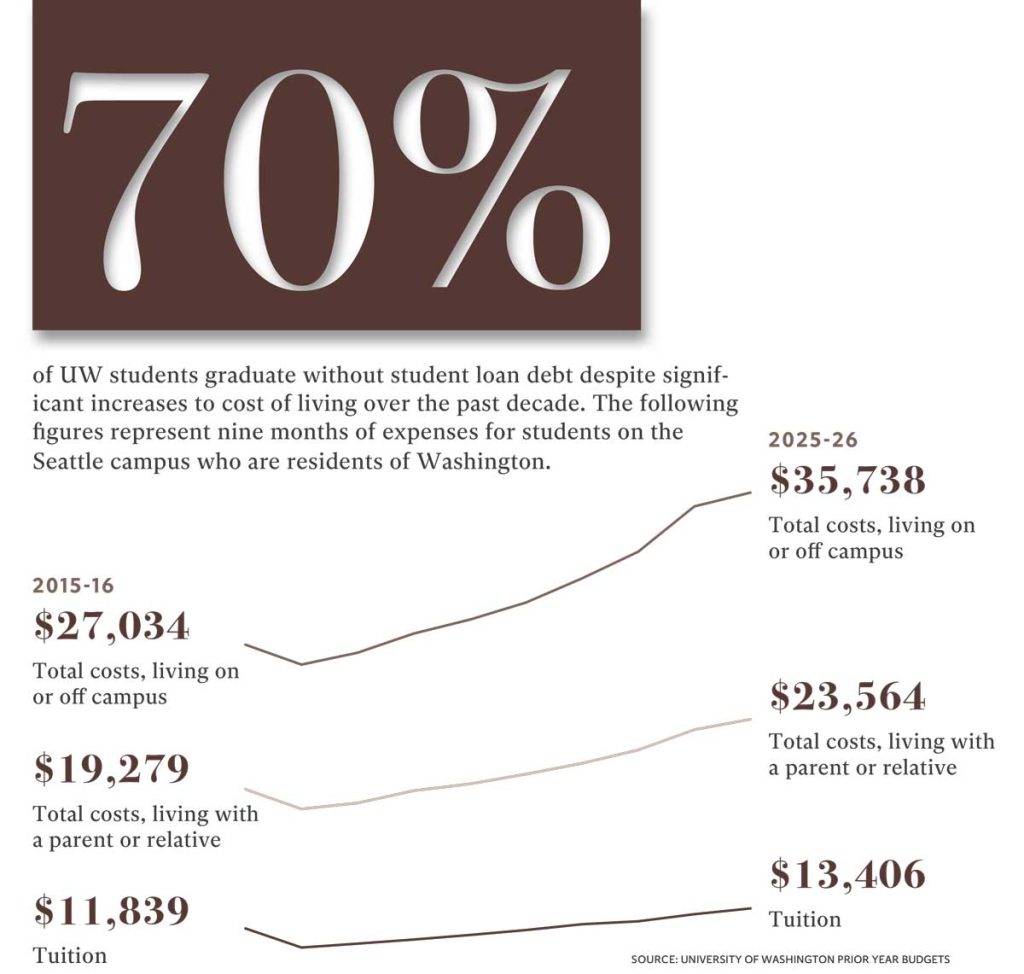
Students like Abonyi—in fact, roughly 70% of UW undergraduates—are proving the opposite. They’re leaving campus this year with a wealth of knowledge, useful skills, job experience and no student loan debt. The rest leave with a cumulative debt of about $21,000. Nationally, average student borrowing lands around $25,000 to $26,000—significant, but far from the six-figure nightmare.
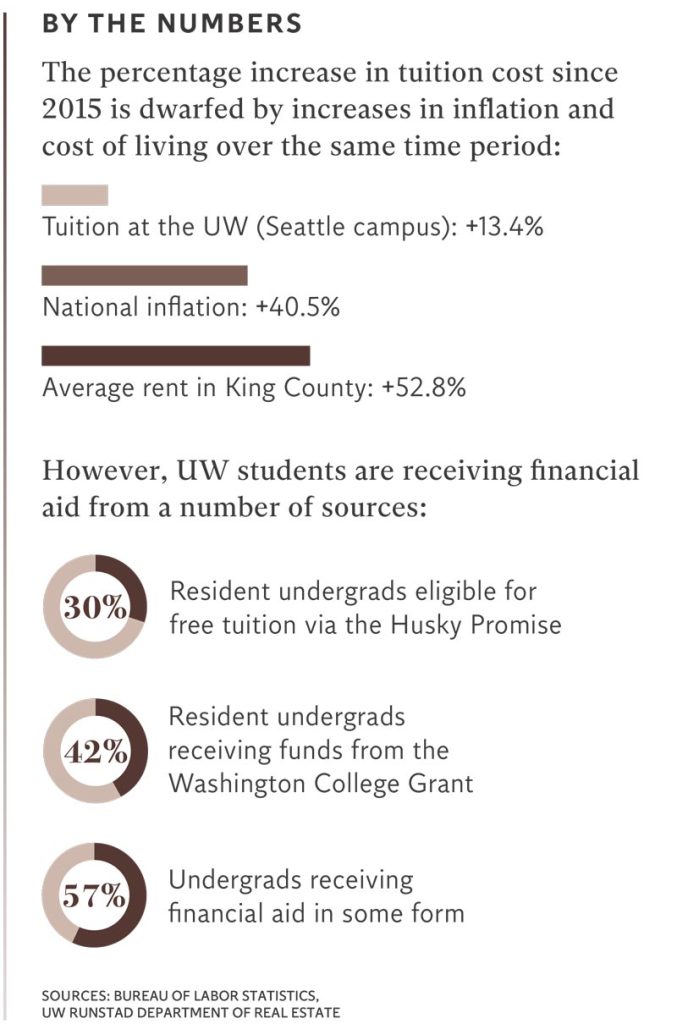
From Tim Wold’s vantage point as interim executive director of financial aid and scholarships at the UW, families encounter the same sticker shock each year. Tuition—more than $13,000—is where it starts. Add in housing, food, transportation and textbooks, and the number—nearly $37,000—can feel unmanageable. “When you look at the full cost of attendance,” he says, “it can be daunting.”
 Ebubechi Abonyi
• Architectural design major from Moses Lake
• Worked in a research lab and held other part-time jobs
• Combined scholarships, campus employment and family support
• Graduating without student loan debt
 Natalia Lizarraga
• Health studies major at UW Bothell
• Lived at home and used public transportation for two years
• Turned an internship into a job pathway
• Avoided debt by working as a barista and campus tour leader
 Samuel Peña-Rojas
• Business administration major at UW Tacoma
• Started at community college to lower costs before transferring
• Received support through the Dressel Scholars program
• Held a paid internship and student government role while earning
his degree debt-free
But it doesn’t have to be what students actually pay, he says. Federal financial aid, state support, institutional grants and scholarships reshape the equation. “And while we’re now at 70% of students who don’t need to borrow, we’re figuring out how to grow that number,” Wold says. It’s a goal for UW President Robert J. Jones that every Washington student might graduate debt-free.
The gap between perception and reality has become one of the defining features of the college debate. It fuels skepticism, even as students engineer ways to make the math work.
Wold, ’89, understands that tension. “Picture a first-generation kid from Spokane whose parents didn’t graduate high school and had a fixed income. And he was able to attend the UW as debt-free as possible,” he says. “That was me in 1984.” Wold worked his way through school. His student job in the financial aid office became his career.
Students have always needed scholarships and loans. The difference today, says Wold, is that the strategy required to manage the financial challenges has become more complex. “There’s a perceived narrative and there’s what’s real. A Washington education is affordable,” he says. “You can make it affordable by the choices you make.”
Those choices—often overlooked in the broader debate—are where the real story lives. Natalia Lizarraga, for example, is a senior majoring in health studies at UW Bothell who has treated college as a network of opportunities. While studying, she landed a class-connected internship with the Latino Educational Training Institute, facilitating community discussions on topics like health, wellness and safety. That internship turned into a part-time role and will become a full-time job after graduation. Along the way, she worked as a barista and led campus orientation tours, layering income streams and experience in a way that made her degree immediately relevant in the labor market.
The University is adapting to the new reality. Programs like the nearly 20-year-old Husky Promise guarantee that in-state students with financial need can have tuition and standard fees at the UW covered through grants and scholarships. State programs such as the Washington College Grant and the Washington State Opportunity Scholarship underpin that support, while federal benefits like the GI Bill help more than 1,300 students on the Seattle campus alone, with another 1,000 across Tacoma and Bothell. Another crucial pocket of support comes from donor-funded scholarships, about 600 of which are given out each year.
“There’s a perceived narrative and there’s what’s real. A Washington education is affordable. You can make it affordable by the choices you make.”
Tim Wold, Interim Executive Director of Financial Aid and Scholarships
“We really want to encourage working with our office and completing an aid application, whether you think you will or will not qualify,” Wold says. Even Washington residents who might not be eligible for federal aid because of their citizenship status may still get Washington state support. “We have a robust financial aid program. Right now, throughout our UW system, 25,600 students typically receive some form of financial aid.
“We also try to award support into those higher middle-income categories,” he says. In those cases, the family income is too high for the student to be eligible for federal need-based grants.
Wold has heard anecdotally of students dropping out for financial reasons. “I hope they are reaching out to us first, though,” he says. “Let us get in there and look at the specific case. We can make adjustments for loss of income. The hardest part is that students don’t always reach out.”
More concerning to him are changes happening beyond campus. New federal borrowing limits could push more students and families toward private loans, often with higher interest rates and fewer protections. “It keeps me up at night,” he says. “The ability of students to access reputable, low-interest loans—I fear we are heading back to increased private borrowing.”
That anxiety complicates the otherwise optimistic data. Because while the long-term returns of a college degree remain strong, the path to those outcomes is becoming narrower, more dependent on planning.
Samuel Peña-Rojas’ first move toward college was both financial and social. Realizing that a four-year residential experience isn’t the only path to a four-year degree, he started at a community college where he could explore his interests at a lower cost and in a supportive environment. After two years, he transferred to UW Tacoma to complete his bachelor’s in business administration. Along the way, he earned several different scholarships, secured a paid internship at a tech company and took on a compensated student government role.
Free to enter the workforce unencumbered by debt and eager to gain some real-world experience before pursuing his MBA, Peña-Rojas feels he was smart about his choices and his experience. “Community college was a cost-effective option,” he says. “And because of that support, I felt I had all the tools necessary to excel at the UW.”
Wold remembers when Huskies spent their summers working on fishing boats and in canneries in Alaska, earning enough to cover tuition, housing and books. Today, they stay closer to home, pursuing internships tied directly to their fields—positions that not only generate income but also serve as pipelines to full-time employment.
These stories share a common thread. The students aren’t just going to college; they’re navigating it deliberately by stacking financial aid, seeking paid experience and making pragmatic decisions about where and how to study. Can you live at home? Do you have to have a car? Will you pack yourself a lunch? Can you work part-time or land a paid summer internship?
The popular critique of higher education often misses the mark. It treats college as a single, overpriced product with a fixed outcome. But Washington students are finding options, price points and strategies.
“I have been able to maximize my time here because of the support I was able to get,” Peña-Rojas says. “College can be expensive, but that shouldn’t prohibit you from pursuing it.”